

How Casino Game Categories Are Structured and Why Classification Matters
When players talk about “games” in an online casino, they often mean everything at once. Slots, tables, live dealers, specialty formats — all of it collapses into a single mental category. From a system perspective, that approach hides the most important detail: casino games are not a single product type.
At Betty Casino, the Games section is not just a catalogue. It is a structured environment where each game category serves a different purpose, behaves under different rules, and creates different player expectations. Understanding this structure is essential for informed play.
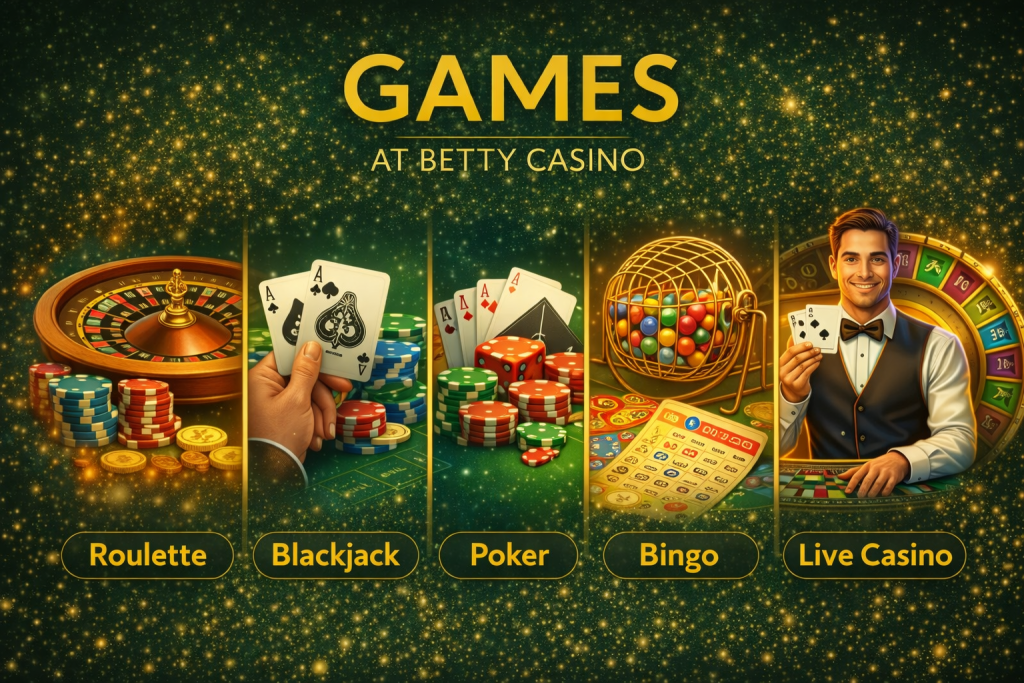
Games Are Systems, Not Just Entertainment
Every casino game category is built on a distinct operational model:
- how outcomes are generated
- how player decisions affect results
- how sessions unfold over time
- how responsibility tools interact with gameplay
Grouping everything under “games” without distinction creates confusion. The casino avoids this by clearly separating game types at the structural level.
Core Game Categories in Online Casinos
While titles and visuals vary, most online casinos—including Betty Casino—organize games into a small number of foundational categories.
Primary Game Structures
| Game Category | Outcome Generation | Player Influence | Session Pace |
|---|---|---|---|
| Slots | RNG-based | None | Fast |
| Table Games | RNG + rules | Moderate | Medium |
| Live Dealer Games | Real-time RNG / dealer | High | Slow |
| Card Games | RNG + strategy | High | Variable |
| Specialty Games | RNG hybrids | Low–Medium | Fast |
Each category defines not just what players play, but how they interact with risk, time, and control.
Why This Classification Exists
Casino game classification is not cosmetic. It serves several technical and regulatory purposes:
- determining verification requirements
- defining bet limits
- shaping responsible gaming controls
- allocating server resources
For example, live dealer games require streaming infrastructure and latency management, while RNG-based games scale horizontally with minimal overhead.
Outcome Models: Determinism vs Randomness
Another crucial distinction is how outcomes are produced.
- Pure RNG games (most slots, specialty games) generate outcomes instantly and independently.
- Hybrid games (some table and card games) combine RNG with decision trees.
- Live games introduce human pacing and external randomness.
This affects not only fairness perception but also emotional pacing. Faster outcome cycles increase engagement intensity; slower cycles introduce deliberation.
Player Agency Across Game Types
One of the most misunderstood aspects of casino games is player agency — the degree to which decisions influence outcomes.
Slots offer almost none. Table and card games offer some. Live games offer pacing control rather than outcome control.
Understanding this helps players choose games that align with their preferences rather than chasing illusory control.
Player Preference Distribution by Game Type (Illustrative)
The following chart illustrates how players typically distribute attention across major game categories.
Data is illustrative only, used to explain behavior patterns.
This distribution highlights a key point: volume does not equal complexity. Slots dominate volume, but not necessarily decision depth.
Games as Time-Management Tools
Different game types implicitly manage time:
- slots compress time into rapid cycles
- table games stretch time through rules and decisions
- live games slow time through human interaction
From a responsibility standpoint, this matters more than payout rates. Games shape how long players stay engaged, not just how much they wager.
Why Casinos Separate Games From Bonuses
Another structural reason for game classification is bonus interaction. Not all games interact with promotions equally. Some contribute fully to wagering, others partially, others not at all.
This separation protects system integrity and prevents unintended incentive loops.
My Perspective as a Reviewer
When I review a casino’s Games section, I don’t ask “How many games are there?”
I ask:
- Are game types clearly separated?
- Is player agency accurately represented?
- Do pacing and control align with category expectations?
At Betty Casino, the Games section reflects a deliberate structural logic rather than a visual dumping ground.
Table Games, Card Games, and the Illusion of Control
If slots represent pure randomness, table and card games represent something more complex: structured randomness with constrained player choice. This is where many players begin to believe they can “play better” rather than simply play longer.
That belief deserves careful unpacking.
At Betty Casino, table and card games are not positioned as skill-based alternatives to slots. They are presented as decision-influenced systems, where choices affect variance and pacing — not long-term expectation.
What Makes Table Games Structurally Different
Table games introduce rules. Rules slow the game down, introduce decision points, and create the experience of agency.
But rules do not remove randomness. They only channel it.
Examples include:
- Blackjack decision trees
- Roulette bet structures
- Poker hand hierarchies
In all cases, randomness still governs outcomes. Decisions only affect distribution, not certainty.
Player Choice vs Outcome Control
One of the most common misunderstandings is equating choice with control.
- Choice determines how a game unfolds
- Control would determine what outcome occurs
Casino games never grant the second.
Understanding this distinction reduces frustration and unrealistic expectations.
Structural Comparison: Slots vs Table vs Card Games
| Game Type | Decision Frequency | Outcome Dependency | Pace |
|---|---|---|---|
| Slots | None | Pure RNG | Fast |
| Roulette | Low | RNG + bet structure | Medium |
| Blackjack | High | RNG + optimal decisions | Medium |
| Poker (house games) | High | RNG + strategy | Slow |
| Live Table Games | Medium | RNG + dealer pacing | Slow |
This comparison highlights why table and card games feel more engaging: they require attention.
Blackjack as a Case Study
Blackjack is often cited as a game “where skill matters.” That statement is partially true — but often misunderstood.
Optimal play reduces variance and improves decision efficiency. It does not eliminate randomness. A perfect strategy still experiences losing streaks because card order remains unpredictable.
At Betty Casino, Blackjack behaves the same way it does anywhere else: fair, rule-bound, and indifferent to intention.
Poker-Style Games and Misplaced Confidence
Casino poker variants (such as Caribbean Stud or Casino Hold’em) resemble competitive poker but function differently.
- You are not playing against other players
- The house sets fixed rules and payouts
- Strategy reduces mistakes, not house edge
This distinction is essential. Treating casino poker like competitive poker leads to false assumptions about long-term outcomes.
Live Dealer Games: Time as a Variable
Live games add a human layer. That changes pacing, not probability.
Dealer speed, table availability, and social interaction slow the game down. Slower games often feel safer because fewer bets occur per hour. That perception is not wrong — but it is contextual.
Live games reduce bet frequency, not risk per bet.
Player Engagement Across Decision-Based Games (Illustrative)
The following chart shows how player attention is typically distributed across decision-based game categories.
Data is illustrative and used for behavioral explanation only.
This balance reflects how players gravitate toward games where decision-making feels meaningful — even when outcomes remain random.
Why Table Games Feel “Fairer”
Table games often feel fairer than slots for three reasons:
- Outcomes are slower
- Decisions are visible
- Rules are explicit
None of these change probability. They change perception.
That perception can be healthy when it encourages moderation — or harmful when it creates overconfidence.
Responsibility in Decision-Based Games
Decision-based games introduce a different risk profile. Players may:
- overestimate skill impact
- increase stakes after “correct” decisions
- chase losses under the assumption of mastery
Responsible play tools apply equally here, even if emotional framing differs.
When Human Presence Changes Perception
Live casino games occupy a unique space in online gambling. They are not simply another category alongside slots or table games. They are a change in rhythm, attention, and emotional framing. When a human dealer enters the system, player behavior changes — even though probability does not.
At Betty Casino, live and specialty games are treated as context-shifting formats, not upgrades. That distinction matters.
What Makes Live Casino Structurally Different
Live casino games introduce three variables that RNG-based games do not:
- real-time pacing controlled by a human dealer
- visual confirmation of actions and outcomes
- social presence, even without direct interaction
None of these variables affect odds. They affect how risk feels.
Live Blackjack still uses predefined rules. Live Roulette still relies on random outcomes. What changes is the psychological environment.
The Illusion of Transparency
Seeing a real wheel spin or cards dealt by a human often feels more transparent. Players interpret visibility as fairness.
This is understandable — but incomplete.
The fairness of live games comes from certification and procedural controls, not from visibility. Human presence does not remove randomness; it merely makes it observable.
Specialty Games: Hybrids, Not Innovations
Specialty games often blur category lines. They combine fast outcomes with simplified interfaces and gamified elements.
Examples typically include:
- crash-style games
- instant win formats
- multiplier-based rounds
These games are not new in substance. They are presentation-layer experiments built on standard RNG logic.
Structural Comparison: Live vs Specialty Games
| Aspect | Live Casino Games | Specialty Games |
|---|---|---|
| Pacing | Slow, fixed | Fast, variable |
| Outcome Visibility | High | Medium |
| Player Decisions | Limited | Minimal |
| Emotional Intensity | Moderate | High |
| Session Length | Longer | Shorter |
This explains why players often switch between these categories within the same session — they regulate emotional tempo.
Why Live Games Slow Down Risk Accumulation
Live games naturally cap bet frequency. A roulette spin takes time. A Blackjack hand requires dealer actions. This reduces bets per hour, which often feels safer.
However, slower pace does not equal lower risk. It simply spreads exposure over time.
Players may compensate by increasing bet size.
Specialty Games and Time Compression
Specialty games do the opposite. They compress time by removing pauses. This increases engagement intensity and shortens decision cycles.
That compression is not accidental. It is a design choice that caters to players who prefer immediacy over deliberation.
Player Attention Allocation in Live and Specialty Games (Illustrative)
The following chart shows how players typically divide their attention between live and specialty formats.
Data is illustrative and used for behavioral analysis only.
This distribution reflects how players often use these formats to regulate session energy.
Social Presence Without Social Pressure
Unlike multiplayer games, live casino environments create a sense of presence without obligation. There is no need to respond, compete, or perform.
This lowers social pressure while preserving engagement. It is one reason live casino appeals to players who dislike isolation but also avoid competition.
Responsibility in Human-Facing Games
Human presence can both stabilize and destabilize behavior:
- it slows impulsive betting
- it increases emotional attachment
- it can encourage longer sessions
For this reason, responsible gaming tools remain essential even in live formats. Visibility does not replace limits.
This distribution reflects how players often use these formats to regulate session energy.
Social Presence Without Social Pressure
Unlike multiplayer games, live casino environments create a sense of presence without obligation. There is no need to respond, compete, or perform.
This lowers social pressure while preserving engagement. It is one reason live casino appeals to players who dislike isolation but also avoid competition.
Responsibility in Human-Facing Games
Human presence can both stabilize and destabilize behavior:
- it slows impulsive betting
- it increases emotional attachment
- it can encourage longer sessions
For this reason, responsible gaming tools remain essential even in live formats. Visibility does not replace limits.
Variety as a Stabilizer, Not a Hook
Large game libraries are often presented as a selling point. In practice, variety serves a different function: stabilization.
When players feel trapped in one category, behavior tends to escalate. When multiple categories are available, players self-regulate by switching formats to adjust pace and emotional load.
At Betty Casino, variety is structured rather than chaotic. Slots, table games, live formats, and specialty games are separated clearly, allowing players to move intentionally instead of drifting.
How Players Transition Between Game Types
Over time, most players develop a personal rotation:
- faster formats during short sessions
- slower, decision-based games during longer sessions
- live formats during social or evening play
- breaks marked by inactivity rather than forced exits
This rotation is not random. It reflects attempts to manage attention, emotion, and time.
Long-Term Game Rotation Patterns
| Player Objective | Preferred Game Type | Typical Duration |
|---|---|---|
| Quick engagement | Slots | Short |
| Controlled pacing | Table games | Medium |
| Social presence | Live casino | Long |
| Intensity bursts | Specialty games | Very short |
| Recovery / pause | Inactivity | Variable |
Understanding these patterns matters more than understanding individual RTP values.
Why Game Choice Influences Responsibility
Responsibility is often framed as limits and warnings. In reality, choice architecture plays an equal role.
If all available games share the same pace and volatility, limits are constantly tested. When different rhythms coexist, players can downshift without leaving the platform.
This is one reason why separating Games into meaningful categories is more responsible than promoting a single dominant format.
Platform Structure and Access Points
Another long-term factor is how players enter games:
- from the lobby
- from recent history
- via promotions
- via search
Repeated exposure to the same access path reinforces habits. Balanced platforms diversify entry points to avoid fixation.
For example, players who arrive via Login and immediately see varied categories behave differently from those funneled into a single promoted game.
Game Exposure Over Extended Use (Illustrative)
The chart below shows an illustrative distribution of how players typically allocate time across game categories over extended periods.
Data is conceptual and used for behavioral explanation only.
This illustrates a key point: dominance fades over time. Variety balances exposure.
Bonuses and Game Interaction (Without Overlap)
Bonuses often distort game choice by rewarding specific formats. Long-term stability improves when bonuses are clearly separated from core play.
Accessing Bonus offers should be optional, not structural. When players feel forced into certain games to “unlock value,” variety loses its regulatory function.
Entry, Commitment, and Exit
Healthy platforms support all three phases:
- entry via Sign up that explains options
- commitment through consistent rules
- exit through inactivity without penalty
Games play a role in each phase. When exit is respected, re-entry becomes calmer and more deliberate.
My Perspective on Sustainable Game Design
I do not evaluate a casino’s Games section by how exciting it looks. I evaluate it by whether it:
- supports switching without pressure
- avoids artificial urgency
- maintains predictable behavior across categories
- allows players to disengage cleanly
At Betty Casino, the structure of the Games section supports these outcomes without overstatement.