
Responsible Gambling Canada Guide
Responsible gambling means treating gambling as entertainment with financial risk, not as income, recovery, or a solution to money problems. For Canada players, this topic matters because online gambling can be fast, private, and available from many devices. The easier access becomes, the more important it is to understand limits, warning signs, support tools, and safer decision-making before harm appears.
This guide is educational. It does not promote gambling activity or suggest that any system can make gambling risk-free. The purpose is to explain how responsible gambling works, why limits matter, what signs may indicate loss of control, and where safer gambling tools fit into the online casino environment.
A responsible gambling page should be direct, practical, and calm. It should avoid shame-based language and focus on awareness. Many people do not recognize risk early because gambling problems often develop gradually. Clear information helps readers notice changes in time, spending, mood, and decision-making before the situation becomes harder to manage.
What Responsible Gambling Means
Responsible gambling is the practice of setting boundaries around gambling activity and staying aware of the risks involved. This includes deciding how much time and money can be spent, avoiding gambling when stressed or upset, not chasing losses, and using available support tools when control becomes difficult.
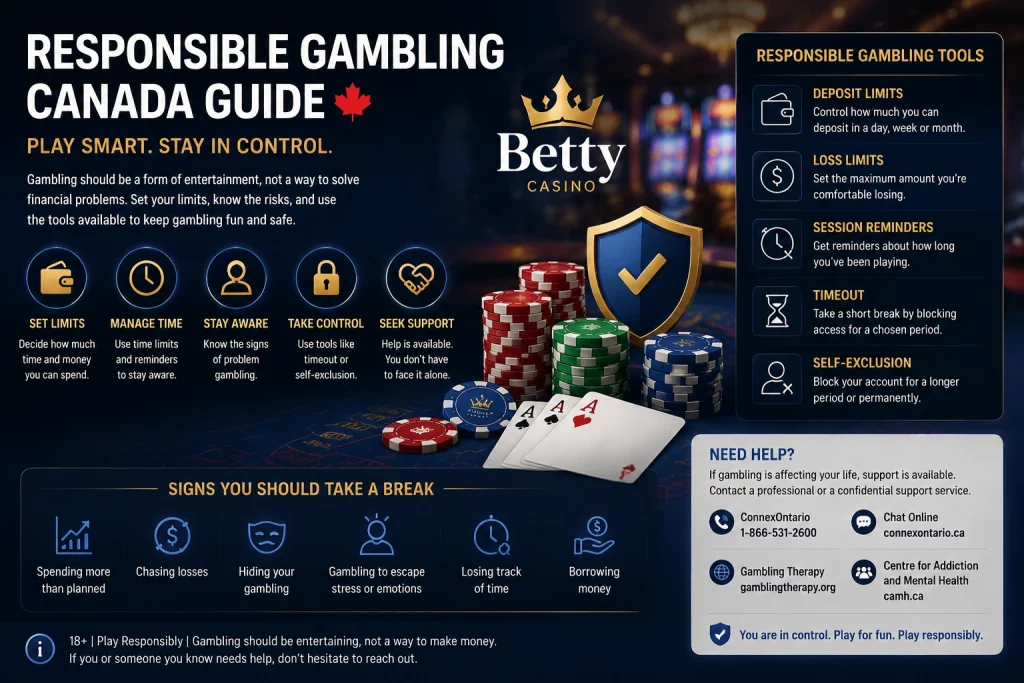
The key point is that responsible gambling is not only for people already experiencing harm. It is a prevention framework. Limits, time reminders, and cooling-off tools are most useful when used early. Waiting until gambling feels out of control can make the situation more difficult.
In Canada, responsible gambling is commonly discussed through public health, player protection, and consumer safety. Educational resources usually focus on harm prevention, informed choices, and access to support rather than on entertainment value alone.
| Responsible Gambling Area | What It Means | Why It Matters |
| Budget limits | Setting a fixed amount that can be lost without affecting essential needs. | Prevents gambling from interfering with bills, savings, or daily life. |
| Time limits | Controlling how long gambling sessions last. | Reduces the risk of extended, impulsive, or emotional play. |
| Loss awareness | Recognizing that losses are part of gambling and should not be chased. | Helps prevent escalating behaviour after negative outcomes. |
| Self-exclusion | Blocking access for a defined period or permanently where available. | Supports users who need stronger separation from gambling access. |
| Support resources | Professional, peer, or public-health help for gambling-related harm. | Provides outside assistance when self-control tools are not enough. |
Why Gambling Risk Can Be Easy to Underestimate
Gambling risk is often underestimated because losses can happen gradually. A person may start with small amounts, then increase spending after a losing session, accept higher risk, or spend more time trying to recover previous losses. The change can feel temporary, but repeated patterns can become harmful.
Online gambling also changes how risk feels. Digital balances may feel less concrete than physical cash. Fast game rounds can make spending harder to track. Mobile access can make gambling feel casual, even when real money is involved. Promotional language may also distract from the fact that all gambling includes risk.
Responsible gambling education should help readers pause and measure behaviour objectively. The main question is not whether gambling feels entertaining in the moment, but whether it remains controlled, affordable, and separate from financial or emotional pressure.
Early Warning Signs
Warning signs can include spending more than planned, gambling longer than intended, hiding gambling activity, borrowing money, chasing losses, feeling anxious about outcomes, or thinking about gambling during unrelated parts of the day. These signs do not require panic, but they should be taken seriously.
Another warning sign is emotional dependence. If gambling becomes a way to escape stress, loneliness, boredom, anger, or financial worry, the risk level increases. Gambling outcomes are unpredictable, so using them to manage emotions can create stronger distress when losses occur.
A responsible guide should encourage readers to act early. Reducing access, setting limits, taking a break, or contacting support can be more effective before the behaviour becomes severe.
Responsible Gambling Tools in Online Casinos
Responsible gambling tools are designed to help players control time, spending, and access. They do not change game mathematics, and they do not make gambling safe or profitable. Their purpose is to reduce harm by giving users practical ways to set boundaries before behaviour becomes difficult to manage.
In an online casino setting, these tools may appear in account settings, help pages, safer gambling sections, or support areas. A responsible platform should make them visible and easy to use. If a reader needs to search too deeply to find limits, timeout options, or self-exclusion information, the platform is not communicating safety information clearly enough.
For Canada players, these tools should be understood as normal safeguards. They are not only for emergencies. A person can use limits before any problem appears, just as they might set a budget for travel, shopping, or entertainment. Early use is usually more effective than waiting until losses or stress become serious.
| Tool | Purpose | When It Can Help |
| Deposit limit | Restricts how much money can be deposited during a selected period. | Useful before spending becomes higher than planned. |
| Loss limit | Restricts how much can be lost within a defined timeframe where available. | Useful when a user wants stronger financial control. |
| Session reminder | Shows time-based reminders during activity. | Useful when online sessions become longer than expected. |
| Timeout | Blocks access temporarily for a selected break period. | Useful after emotional play, stress, or repeated losses. |
| Self-exclusion | Restricts access for a longer period or permanently where available. | Useful when gambling control feels difficult or unsafe. |
How Account Access Relates to Safer Play
Account access is not only a technical feature. It also affects safer gambling controls. When users enter through Login, they should be able to find account limits, session history, communication settings, and support options without unnecessary confusion. A responsible platform should keep these controls close to the user account area, not hidden in vague policy pages.
Account creation through Sign up should also be presented with clear eligibility and age requirements. Gambling access should not be treated like a casual entertainment signup with no context. Users should understand that account information may be checked, identity may need verification, and safer gambling tools may be available from the beginning.
This is especially important for younger adults and first-time users. The easier it is to create an account, the more important it is to show risk information early. A clear registration process should not only collect details; it should also explain responsibilities.
Bonuses and Responsible Gambling
Promotions can increase risk when they make gambling feel more urgent, more rewarding, or less costly than it really is. A Bonus may include wagering requirements, expiry dates, maximum bet rules, restricted games, and withdrawal conditions. If these terms are not understood, users may continue playing longer than planned to complete conditions.
Responsible gambling education should explain that bonus value is conditional. A bonus is not the same as cash, and it should not be treated as guaranteed benefit. The safest approach is to read terms before accepting any promotion and avoid using bonuses as a reason to exceed a planned budget.
For Canada players, this is one of the most practical lessons. Promotional offers can make decisions feel less deliberate. A responsible user should ask whether the promotion changes behaviour. If it encourages longer sessions, higher stakes, or chasing requirements, it may increase risk rather than reduce it.
Mobile Gambling and App-Based Access
Mobile access can make gambling feel more casual because it is available from phones, tablets, and app-style interfaces. An App or mobile browser can provide convenience, but it can also reduce the friction that normally limits gambling activity. A short session can start quickly, and repeated access can become a habit.
Responsible gambling tools should work clearly on mobile. Limits, timeout options, self-exclusion, account history, and support pages should be accessible from smaller screens. If safety tools are difficult to find on mobile, the user experience is weaker from a player-protection perspective.
Mobile use also makes notifications important. Promotional alerts, reminders, or account messages can draw users back into gambling activity. A responsible player should review notification settings and reduce triggers if they create pressure or repeated urges to return.
Games, Slots, and Risk Awareness
Different game types can create different risk patterns. Slots may have fast rounds, visual stimulation, bonus features, and volatility. Other Games may involve table rules, side bets, live formats, or jackpot mechanics. The risk is not identical across every game, but all gambling products involve uncertainty.
A person may underestimate risk in games that feel simple or visually familiar. Fast outcomes can make spending harder to track. Near-miss visuals can create a feeling that a result was close. Bonus rounds can make a session feel more exciting even when the overall balance is declining.
Responsible gambling education should encourage readers to focus on spending, time, and emotional state rather than on game appearance. If a game creates urgency, frustration, or a strong desire to recover losses, that is a signal to stop and reassess.
Help Pages, FAQ, and Support Links
A responsible casino information structure should make support easy to find. A clear FAQ can explain limits, self-exclusion, account closure, verification, payment rules, and safer gambling resources. Useful Links should lead to responsible gambling pages, support organizations, terms, privacy information, and complaint processes.
The quality of help content matters. If the FAQ only answers promotional questions but does not explain risk tools, the site is incomplete from a player-safety perspective. If external support resources are missing, users may not know where to turn when they need help beyond account support.
For Canada players, reliable safer gambling information should be easy to access before harm becomes severe. The best time to learn about support is before a crisis, not during one.
Warning Signs of Gambling Harm
Responsible gambling education should explain warning signs clearly and without judgement. A person does not need to reach a crisis before taking action. Early signs can appear gradually: spending more than planned, gambling longer than intended, returning after losses, hiding activity, borrowing money, or feeling anxious when not gambling.
A key warning sign is chasing losses. This means continuing to gamble because previous losses feel recoverable. Chasing can make gambling more dangerous because decisions become emotional rather than planned. The person is no longer treating gambling as entertainment; they are trying to repair a financial or emotional outcome through more risk.
Another warning sign is using gambling to manage mood. If gambling becomes a way to escape stress, boredom, loneliness, anger, or financial pressure, the activity can become harder to control. Responsible gambling tools and outside support become especially important in these situations.
When to Take a Break
A break is useful when gambling starts to feel automatic, stressful, secretive, or financially uncomfortable. Taking a break does not mean failure. It is a normal risk-control step. A short pause can help a person regain perspective before decisions become more emotional.
Timeout tools can block access for a selected period. Self-exclusion is stronger and may restrict access for longer. The right option depends on the level of risk. If someone repeatedly breaks personal limits, a stronger access restriction may be more appropriate than a simple reminder.
A person should also take a break if gambling interferes with sleep, school, work, relationships, bills, or mental health. These are signs that gambling is no longer staying inside an entertainment boundary.
Talking to Someone About Gambling
Talking to someone can reduce secrecy and pressure. This may be a trusted friend, family member, counsellor, doctor, or gambling support service. The goal is not to create shame. The goal is to make the behaviour easier to see clearly and manage safely.
A person may choose to share practical facts: how often they gamble, how much they spend, whether they chase losses, and whether gambling is affecting money or mood. Clear information helps the other person understand the situation.
If gambling feels difficult to control, outside support is more reliable than trying to solve it alone through willpower. Support services can help with planning, access restrictions, financial boundaries, and coping strategies.
Safer Gambling Resources and Support in Canada
Responsible gambling education is most effective when paired with access to credible resources. Canada players can benefit from a mix of platform-level tools, provincial support, and national awareness programs. These resources help players manage exposure, make informed decisions, and seek assistance before problems escalate.
Platform Tools
A responsible casino platform may provide the following tools:
- Deposit limits: Set daily, weekly, or monthly maximum deposits.
- Loss limits: Restrict how much can be lost in a defined period.
- Session reminders: Notify users when time spent gambling exceeds planned limits.
- Timeouts: Temporarily block access to the platform for a set period.
- Self-exclusion: Longer-term or permanent access restrictions.
These tools should be visible and accessible from the user account, mobile App, or website interface. They allow users to proactively manage play rather than react after losses occur.
| Resource | Description | Link |
| Responsible Gambling Council | Education, awareness, and prevention tools for safer gambling in Canada. | Visit site |
| ConnexOntario | Support for gambling, mental health, and substance use in Ontario. | Visit site |
| Gamblers Anonymous Canada | Peer support and group meetings for problem gambling. | Visit site |
| Centre for Addiction and Mental Health | Resources and counselling for gambling-related harms. | Visit site |
| Provincial gaming authorities | Regulation, support, and responsible gambling programs in each province. | Visit site |
How to Combine Tools and Awareness
Effective risk management combines multiple strategies:
- Set realistic deposit and loss limits before starting a session.
- Use session reminders or timeout tools to prevent extended play.
- Understand the Bonus conditions, wagering requirements, and eligible Games before participating.
- Track account history via Login and platform activity logs.
- Access FAQ and Links for guidance on rules, payout structure, and support.
Using multiple tools simultaneously provides stronger protection than relying on a single measure.
Responsible Gambling Awareness
How to Seek Help Early
Early help reduces risk. Players should contact support if they notice:
- Spending more than planned.
- Chasing losses after a session.
- Emotional dependence on gambling.
- Difficulty stopping or using limits.
- Negative effects on finances, relationships, or mental health.
Support can include platform-based help, provincial programs, counselling, or peer support. Using Links to these resources before problems escalate increases effectiveness.
Mobile and App Considerations
Mobile access and app usage can increase temptation due to convenience. Responsible gambling tools should be fully functional on mobile interfaces. Session reminders, deposit limits, and self-exclusion options must work across devices to ensure consistent protection.
Canada players should check that the App or mobile browser version offers the same controls as desktop platforms. The ease of access should never reduce transparency or limit tool availability.
Responsible gambling is both an educational concept and a practical framework that helps players approach casino activity safely and consciously. For Canada players, understanding the risks associated with gambling and taking proactive steps to manage exposure is critical. This involves using tools such as deposit limits, loss limits, session reminders, timeout features, and self-exclusion options to set boundaries around spending and time spent playing. Access to professional support services and awareness programs is equally important, as these provide guidance, counselling, and strategies to prevent harm before it escalates.
The brand Betty Casino emphasizes responsible play as a core part of its platform philosophy. It encourages players to familiarize themselves with all available control features, ensuring they can actively manage their gaming activity rather than reactively coping with losses or extended sessions. These safeguards are most effective when implemented consistently, whether on desktop platforms or through mobile applications, and when combined with an understanding of game mechanics, volatility, RTP, and payout structures.
Bonuses, promotions, and special game features should also be evaluated carefully. While they can enhance the entertainment experience, they can also increase the temptation to exceed planned limits if players do not approach them responsibly. Education about these mechanics, combined with the active use of safety tools, forms the foundation for healthier, more sustainable gambling habits.
Ultimately, the strongest approach to minimizing harm and maintaining control is the combination of informed awareness and practical action. By learning about the risks, understanding how games operate, and applying the available safeguards consistently, players can enjoy the entertainment aspects of Betty Casino while reducing the likelihood of negative consequences. Responsible gambling is not a one-time action but an ongoing practice that ensures a safer, more balanced experience in the online gaming environment.






Comments