
Why Casino Asks ID Canada
Identity verification is one of the main reasons a Canadian Betty Casino account may ask for personal documents. The request is not just about checking a name on a profile. It connects several account elements together: legal identity, age confirmation, payment ownership, account security, withdrawal protection, and fraud prevention. Without this step, a digital gambling account would be much easier to misuse through false details, stolen payment methods, duplicate accounts, or unauthorized access.
In Canada, casinos are part of a wider financial-monitoring environment. FINTRAC guidance for casinos explains that identity verification can be required in several situations, including account-related activity before funds are disbursed, suspicious transactions, large transactions, casino disbursements, and other regulated scenarios. FINTRAC also describes accepted identity verification approaches, including government-issued photo identification, credit file methods, and dual-process methods using reliable source information.
For players, the ID request often appears at moments where account risk increases. This can happen during registration review, before a withdrawal, after payment changes, after suspicious login patterns, or when account details do not match documents already submitted. The platform needs to confirm that the person using the account is the same person named in the profile and connected to the payment method.
This page explains why an ID request appears, what information is usually checked, and why accurate documents matter. The focus is on account safety, age protection, payment integrity, and privacy awareness rather than gameplay.
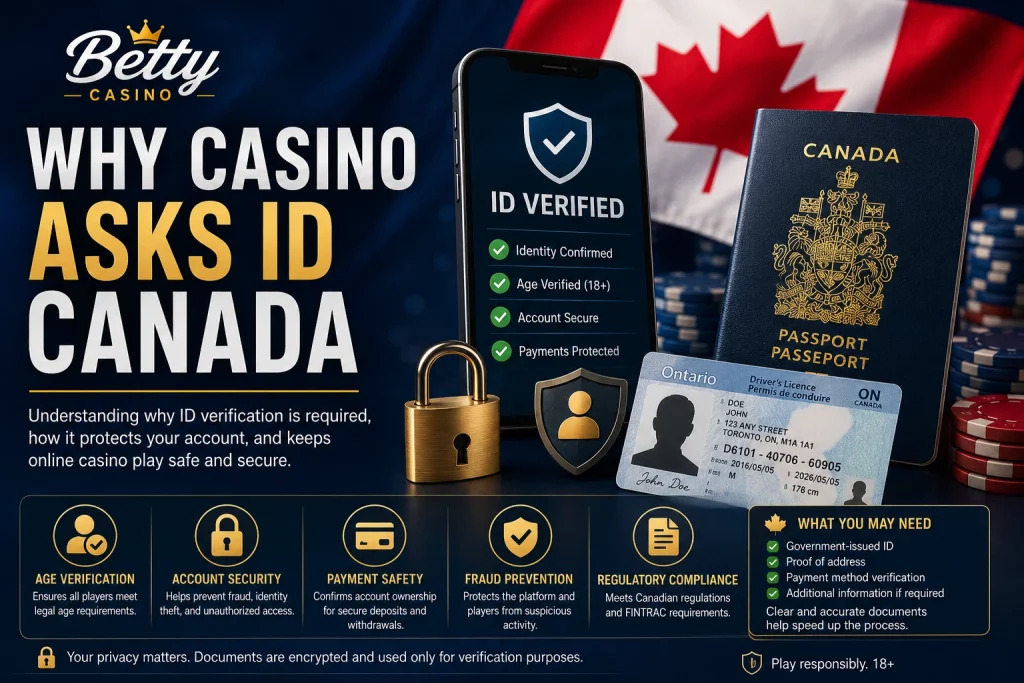
ID Verification and Age Protection
One of the clearest reasons casinos ask for ID in Canada is age verification. A casino account must not be used by someone below the legal age allowed in the relevant province or territory. A government-issued identity document helps confirm the date of birth and prevents accounts from being opened or used under false age details.
This is why the date of birth entered during registration must match the ID document exactly. If the account profile shows one date and the passport, driver’s licence, or provincial ID shows another, the account may be paused until the mismatch is reviewed. Even a simple day-and-month error can create a serious verification issue because age confirmation is a core requirement.
Age checks also protect the account holder from identity misuse. If someone attempts to create an account using another person’s name or document details, the verification process can expose inconsistencies between the profile, uploaded ID, and payment records. This reduces the risk of unauthorized account creation.
For Canadian players, the practical lesson is simple: registration information must be entered carefully. Legal name, date of birth, address, and contact details should match official records from the start. Correct information reduces later verification friction.
| ID Check Area | What Is Reviewed | Why It Matters | Common Issue |
|---|---|---|---|
| Age Confirmation | Date of birth on government-issued ID | Helps prevent underage account use | Wrong birth date entered in account profile |
| Legal Name | Full name on passport, driver’s licence, or provincial ID | Confirms identity consistency | Nickname or shortened name used during registration |
| Photo Identity | Visible face image on ID document | Helps confirm that the document belongs to a real person | Glare, blur, cropped image, or damaged ID photo |
| Document Validity | Expiry date, issue details, document condition | Confirms the ID is current and usable | Expired document or hidden expiry field |
| Account Consistency | ID compared with address and payment records | Reduces fraud, duplicate accounts, and ownership disputes | Name or address differs across documents |
Why ID Is Connected to Withdrawals
ID verification becomes especially important when funds are withdrawn. A withdrawal is not only a payment action; it is also a point where the platform must confirm that the person requesting funds is the verified account holder. If identity is not confirmed, a withdrawal could be sent to the wrong person or connected to unauthorized activity.
This is why an ID request may appear even if the account was created earlier without immediate document upload. The platform may allow basic account access first, but require identity confirmation before releasing funds. FINTRAC guidance for casinos specifically refers to verifying account holders before funds are disbursed in account-related situations.
A withdrawal review may compare the ID with payment proof. If the passport or driver’s licence shows one legal name, but the card, bank account, or e-wallet shows another, the review may take longer. The platform needs to confirm that the account holder controls the payment method.
This protects both the account and the payment system. It reduces the risk of third-party payment use, account takeover, stolen card activity, and withdrawal disputes. A verified ID creates a reference point for all later payment decisions.
How ID Verification Reduces Fraud
Identity verification helps reduce several types of account fraud. The most common risks include false-name accounts, duplicate accounts, stolen payment methods, underage access, and account takeover attempts. A clear ID document makes these harder to execute because the account must be tied to a real person.
Fraud prevention is not only about stopping criminals. It also helps prevent ordinary account disputes. If two people claim access to the same account, or if a payment source is questioned, verified identity records help support a clearer resolution. The account history becomes easier to review because the platform has a confirmed identity attached to it.
ID checks also discourage repeated account creation. If the same person tries to create multiple accounts with different emails but similar identity information, document review can reveal the overlap. This matters because multiple accounts can create payment, bonus, and security problems.
A strong verification process therefore supports account integrity. It gives the platform a way to confirm that the profile, documents, payment activity, and withdrawal requests belong to one person.
Main Reasons Casinos Ask for ID
What Information an ID Usually Confirms
A government-issued ID usually confirms several pieces of information at once. The most important are full legal name, date of birth, photograph, document number, issuing authority, and expiry date. Depending on the document type, it may also show address information, province, or nationality.
A passport is often used because it provides strong identity details in a standardized format. A driver’s licence or provincial ID card may also be useful, especially when it includes both identity and address information. In many cases, both the front and back of a card may be requested if important information appears on both sides.
The document should be readable and complete. If the account holder uploads only part of the ID, hides important details, or sends a blurred photo, the review team may not be able to approve it. The issue is not whether the person owns the document; the issue is whether the uploaded file proves it clearly enough.
Players should also understand that ID does not always complete every verification layer. An ID confirms who the person is. Proof of address confirms current residence. Payment proof confirms ownership of a card, bank account, or wallet. Each document has a different role.
Privacy and Data Safety During ID Upload
ID documents contain sensitive personal information. A passport, driver’s licence, or provincial ID can be misused if stored or shared carelessly. For that reason, ID should be uploaded only through the official account document system or verified support channel. Random email addresses, social media messages, or unknown upload links should be avoided.
Before uploading, the image should be checked for clarity and completeness. After uploading, unnecessary copies should be removed from unsecured locations such as public folders, shared devices, messaging apps, or cloud albums. If the file must be stored, it should be kept in a protected folder on a personal device.
FINTRAC’s guidance recognizes multiple methods for verifying identity, including methods that can rely on electronic images or reliable source information under defined conditions. This reflects the reality that many identity checks now happen remotely, but document quality and authenticity still matter.
Good privacy habits are part of responsible account management. A clear ID upload helps verification, but secure file handling helps protect personal data after the review is complete.
Why ID Checks Are Connected to Payments
ID verification is closely connected to payment security because account activity is not limited to profile creation. Once money enters or leaves an account, the platform has to confirm that the person using the account is the same person connected to the payment method. This is especially important when withdrawals, payment method changes, bank account updates, or unusual transaction patterns appear.
A casino may request ID before approving a withdrawal because the identity document acts as the main reference point for account ownership. The name on the passport, driver’s licence, or provincial ID can be compared with the bank statement, payment card, or e-wallet profile. If these records match clearly, the account becomes easier to review.
Canadian financial-monitoring rules also place identity verification inside a broader compliance framework. FINTRAC guidance for casinos lists multiple situations where identity verification may be required, including casino disbursements, receipt of funds, electronic funds transfers, account-related activity, suspicious transactions, and other regulated scenarios.
The practical purpose is to reduce payment misuse. If an account can receive deposits from one person and withdrawals to another person without proper checks, the risk of fraud, disputes, and unauthorized activity increases. ID verification helps connect the person, the account, and the payment route into one reviewable profile.
| Payment Situation | Why ID May Be Requested | Document Usually Compared | Risk Without Review |
|---|---|---|---|
| Withdrawal Request | Confirms that the payout is requested by the verified account holder | Government-issued ID and payment proof | Unauthorized withdrawal or ownership dispute |
| New Payment Method | Checks whether the card, bank account, or wallet belongs to the user | ID, bank statement, card proof, wallet profile | Third-party payment misuse |
| Large Transaction Activity | Supports additional account and financial review | ID and financial documentation | Unclear source or ownership of funds |
| Suspicious Activity Review | Helps confirm whether the account is being used by the real owner | ID, account history, payment records | Account takeover or identity misuse |
| Account Recovery | Confirms identity when access details are lost or changed | ID and supporting account information | Wrong person gaining access |
Accepted Identity Verification Methods
An ID request does not always mean only one document type can be used. FINTRAC describes several methods that can be used to verify a person’s identity, including government-issued photo identification, credit file method, dual-process method, affiliate or member method, and reliance method.
For a player-facing account review, the most familiar option is usually government-issued photo ID. This may include a passport, driver’s licence, or provincial identity card. These documents are useful because they show the legal name, date of birth, photograph, document number, issuing authority, and expiry date.
Other verification methods may rely on reliable source information instead of a simple photo upload. For example, the dual-process method can use information from two different reliable sources to confirm identity details. This is why some reviews may ask for more than one document rather than relying on a single ID image.
From a user perspective, the key issue is consistency. The verification method may vary, but the information must point to the same person. Name, date of birth, address, and payment ownership should not conflict across the documents submitted.
Why One ID Document May Not Be Enough
A government-issued ID confirms who the user is, but it does not always answer every account question. An ID usually confirms name, photo, date of birth, and document validity. It may not confirm current address, payment ownership, or source of funds.
This is why additional documents may be requested. Proof of address confirms where the account holder currently lives. Payment proof confirms whether the card, bank account, or wallet belongs to the same person. Financial documents may be requested when account activity requires more context.
Each document category has a different function. Submitting the wrong document can delay review. If the request asks for proof of address, another photo of a passport may not solve the issue. If the request asks for payment ownership, a utility bill may not answer the question.
The fastest review path is usually created when each request is answered directly. A clear ID for identity, a recent address document for residence, and a payment document for ownership give the review team fewer unresolved points.
Why Accurate Registration Details Matter
Many ID problems begin during registration. If the account is created with a nickname, incomplete surname, incorrect date of birth, or outdated address, the document review may later expose the mismatch. These errors can turn a simple ID check into manual review.
Legal name should be entered exactly as it appears on official documents. Date of birth should be checked carefully. Address details should include unit number, street, city, province, and postal code where required. Contact details should belong to the account holder and remain accessible.
Small inconsistencies may still require clarification. A missing middle name is usually less serious than a different surname, but both can slow the review if the platform cannot confidently match records. A wrong birth date is more serious because it affects age confirmation.
Accurate registration data reduces friction later. It gives the ID document a clear account profile to match against and prevents unnecessary correction requests during withdrawal or security checks.
ID Verification and Account Recovery
ID verification is also useful when account access is lost. If a user forgets credentials, loses access to email, changes phone number, or notices unauthorized activity, support may need to confirm ownership before restoring access.
In these cases, ID works as a safeguard. The platform should not give access to someone who only knows an email address or username. A verified identity document helps confirm that the person requesting recovery is connected to the original account profile.
Account recovery reviews can be stricter than ordinary document checks because the risk is higher. If the wrong person gains access, they may change payment details, withdraw funds, or view private account information. ID verification reduces that risk.
A strong recovery request usually includes a valid ID, matching profile details, and clear communication through official support channels. Sending documents through informal routes should be avoided because ID files contain sensitive personal data.
Privacy Risks When Uploading ID
ID documents should be handled carefully before and after upload. A passport, driver’s licence, or provincial ID contains personal details that can be misused if copied, stored, or shared carelessly. The upload process should therefore be limited to official account systems or verified support channels.
Users should avoid sending ID files through unknown links, random emails, social media messages, or third-party chat accounts. If a document request appears suspicious, it is safer to access the account directly through the official site and check whether the same request appears inside the account area.
After uploading, local storage should be reviewed. Duplicate photos may remain in phone galleries, downloads folders, scanner apps, cloud backups, or messaging apps. If those copies are no longer needed, they should be removed from unsecured locations.
Good privacy handling does not only help verification. It protects the person behind the account from identity exposure, unauthorized file sharing, and future misuse of personal data.
ID Requests During Manual Account Review
Manual account review usually happens when automated checks cannot confirm the account details with enough confidence. In this stage, the ID document becomes a reference point for comparing legal name, date of birth, document validity, payment ownership, and account history. FINTRAC guidance for casinos explains that identity verification is required in specified casino-related situations under Canada’s anti-money-laundering framework, including account and transaction contexts.
A manual review may be triggered by mismatched profile details, unclear document uploads, payment ownership questions, suspicious transaction indicators, or repeated changes to account information. The review is not only about the ID image itself. It is about whether the account, person, payment route, and submitted documents form one consistent record.
For example, a government-issued ID may show a full legal name while the account profile uses a shortened version. A payment record may show a different surname. A proof of address document may contain an old province or postal code. These issues do not always mean the account is fraudulent, but they require clarification before the review can close.
Manual checks also help prevent account takeover. If someone gains access to an account and attempts to change payment details or request funds, ID review gives the platform a way to confirm whether the person acting on the account is the verified account holder.
| Manual Review Trigger | Why ID Is Requested | What Reviewers Compare | Possible Outcome |
|---|---|---|---|
| Profile Mismatch | Confirms whether account details match official identity data | Name, date of birth, document validity | Correction request or profile update review |
| Withdrawal Review | Checks whether the person requesting funds is the account holder | ID, payment proof, withdrawal destination | Approval, delay, or request for payment ownership proof |
| Suspicious Activity | Helps confirm whether account access is legitimate | Identity document, login pattern, account history | Security review or temporary account restriction |
| Account Recovery | Prevents access from being given to the wrong person | ID, email history, phone details, prior verification records | Recovery approval or further identity questions |
| Document Quality Issue | Confirms details that were unreadable in the first upload | Photo, expiry date, document number, full legal name | Request for clearer file |
Why ID Is Checked Against Other Documents
An ID document is only one part of identity verification. It confirms who the person is, but other documents may confirm where the person lives, who owns the payment method, and whether the account activity fits the verified profile. FINTRAC describes several methods for verifying identity, including government-issued photo identification, credit file, dual-process, affiliate or member, and reliance methods.
This is why a casino may ask for more than one file. A passport or driver’s licence can confirm legal identity, but it may not prove current address. A bank statement can help confirm address and payment ownership. A card image may confirm partial payment details but not full identity. Each document answers a different question.
The review team may compare the same data point across several documents. Legal name should remain consistent. Date of birth should match the account profile. Address should match proof of residence. Payment documents should belong to the verified person. If the same person is clearly represented across all files, the account history is easier to assess.
Inconsistent documents create more work. A platform may need to ask for an updated file, clearer image, or supporting explanation. The goal is not to collect documents for their own sake; it is to remove uncertainty from the account record.
ID Verification and Account Takeover Prevention
Account takeover is one of the main security risks in digital account systems. It happens when someone other than the real account holder gains access and attempts to control the account. ID verification can reduce this risk by requiring identity confirmation before sensitive changes are approved.
Sensitive changes may include payment method updates, withdrawal requests, password recovery, email changes, phone number changes, or profile corrections. If these changes happen without proper identity control, an account can be misused more easily.
A verified ID creates an ownership anchor. Support teams can compare future requests against the verified identity record. If a person contacting support cannot match the identity profile, account access can be paused while additional checks are performed.
This type of review protects personal information as well as funds. A Betty Casino account may contain name, address, date of birth, payment references, transaction history, and support records. ID checks help prevent those records from being exposed to the wrong person.
Main Review Layers Behind ID Requests
Why Document Quality Affects ID Review
Document quality affects how quickly an ID request can be reviewed. A valid ID can still fail the review if the uploaded file is blurry, cropped, expired, over-edited, or missing important details. Reviewers need to read the information clearly enough to compare it with the account profile.
A strong ID file usually shows the full document, visible photo, legal name, date of birth, expiry date, and document number where required. If the document is a card, both sides may be needed when information appears on the back. If the document is a passport, the full photo page should normally be visible.
Common problems include glare over the photo, hidden expiry dates, cropped corners, dark images, low-resolution screenshots, or files compressed by messaging apps. These issues may lead to a new upload request because the first file does not provide enough evidence.
Players should also avoid unnecessary editing. Covering sensitive details may seem protective, but hiding the wrong field can make verification impossible. If masking is allowed, it should not hide the details needed to confirm identity.
ID Requests and Privacy Awareness
An ID request should always be handled with privacy in mind. Government-issued ID contains sensitive information, including full name, birth date, photo, document number, and issuing authority. If the file is stored or transmitted carelessly, it can create unnecessary exposure.
Documents should be submitted only through official account systems or verified support channels. ID files should not be sent through unknown emails, social media accounts, public comment sections, or links that cannot be confirmed. A request that appears outside the account area should be checked carefully before any document is shared.
After upload, local storage should be reviewed. Phone galleries, downloads folders, scanner apps, cloud backups, and chat attachments may retain duplicate copies. If those files are no longer needed, removing them from unsecured places reduces privacy risk.
Good ID handling means two things at once: the document should be clear enough for review, and the file should be protected before and after submission.
Final Reasons ID May Be Requested
An ID request is usually triggered when the account needs stronger confirmation of identity, age, ownership, or security status. The document allows the review team to connect the person named in the profile with the person using the account and the person connected to payments or support requests. Without this confirmation, account records remain weaker and harder to protect.
For Canadian casino-related verification, ID checks can appear in several account and transaction contexts. FINTRAC guidance for casinos lists identity-verification obligations in situations such as casino disbursements, receipt of funds, electronic funds transfers, suspicious transaction contexts, and account-related cases. FINTRAC also describes five identity-verification methods for persons, including government-issued photo ID, credit file, dual-process, affiliate or member, and reliance methods.
From a user perspective, the most common reason is consistency. The name on the ID should match the account. The date of birth should support age confirmation. The payment documents should belong to the same person. The address records should not conflict with the profile. When these elements fit together, review is usually simpler.
The main mistake is treating ID verification as a random document request. In practice, each request answers a specific question: who is using the account, whether that person is old enough, whether the payment route belongs to them, and whether sensitive account actions are being requested by the real account holder.
| ID Request Reason | What the Review Tries to Confirm | Useful Supporting Detail | Risk If Not Confirmed |
|---|---|---|---|
| Age Check | The account holder meets the required age rules | Date of birth on government-issued ID | Underage or false-age account use |
| Withdrawal Review | The person requesting funds owns the verified account | ID name matching payment records | Unauthorized payout or payment dispute |
| Payment Ownership | The card, bank account, or wallet belongs to the same person | Bank statement, card proof, or wallet profile | Third-party payment misuse |
| Account Recovery | The person requesting access is the real account holder | ID matched with historical account details | Wrong person gaining account access |
| Suspicious Activity Review | Account activity is consistent with the verified user | ID, account history, and transaction context | Account takeover or identity misuse |
What to Do When ID Is Requested
When an ID request appears, the strongest response is to read the request carefully and upload the exact document type needed. If the request asks for government-issued photo ID, a passport, driver’s licence, or provincial ID may be appropriate. If the request asks for proof of address or payment ownership, an ID alone may not solve the issue.
The document should be clear, valid, complete, and readable. A photo ID should show the full document, the legal name, the date of birth, the photo, the document number if required, and the expiry date. If the ID is a card, both sides may be needed when important information appears on the back.
Files should not be heavily edited. Blurring the wrong area, covering the name, hiding the expiry date, or cropping the corners can make the upload unusable. If masking is allowed for a specific field, it should follow the platform’s instructions exactly.
If the ID is rejected, the replacement should fix the stated problem. A blurry file needs a sharper image. An expired document needs a current replacement. A mismatch needs clarification or profile correction. Re-uploading the same flawed file usually extends the review.
Why Reverification Can Happen
ID verification can happen more than once. A document accepted earlier may need updating if it expires, if account details change, or if a later transaction requires a fresh review. This is common in account systems that rely on accurate identity records over time.
Reverification may appear after a legal name change, address update, payment method change, account recovery request, or unusual account activity. It can also appear when an old ID document is no longer current. The review team needs an identity record that still supports the present account profile.
This should not automatically be treated as an accusation or problem. Often it is a routine way to keep account records accurate. The simplest response is to provide a valid, clear, current identity document that matches the account details.
Long-term consistency reduces repeated checks. If the same legal name, date of birth, address, and payment ownership remain aligned across records, there are fewer conflicts for support or verification teams to resolve.
ID Verification and Data Protection
ID verification involves sensitive personal data. A government-issued document may show full name, birth date, photo, document number, issuing authority, and expiry date. Because of this, the upload process should be handled carefully.
Documents should be submitted only through official account systems or verified support channels. A user should avoid sending ID images through unknown links, social media accounts, public comments, or email addresses that cannot be confirmed. If a request looks suspicious, the safer step is to access the account directly and check whether the same request is shown inside the official account area.
After uploading, local copies should be reviewed. ID images often remain in downloads folders, phone galleries, scanner apps, cloud backups, or message threads. If the file is no longer needed, removing unnecessary copies from unsecured places reduces exposure.
Secure handling matters beyond the verification process itself. The goal is not only to pass a review, but also to avoid leaving sensitive files in locations where they can be copied, forwarded, or accessed by someone else.
Final Notes on Why Casinos Ask for ID in Canada
Betty Casino ask for ID in Canada because identity checks support age protection, account ownership, payment safety, withdrawal review, fraud prevention, and account recovery. In regulated casino contexts, FINTRAC guidance also connects identity verification with specified transaction and account obligations under Canada’s financial-compliance framework.
A strong ID upload is complete, readable, current, and consistent with the profile. The legal name should match. The date of birth should match. The document should not be expired. The photo and document fields should be visible. If another document category is requested, such as proof of address or payment ownership, the user should provide that exact category instead of repeating an ID upload.
Most verification delays come from preventable problems: blurry images, cropped files, expired documents, wrong document type, profile mismatches, or unclear payment ownership. Careful preparation reduces repeated requests and helps the account review close more efficiently.
The practical conclusion is simple: ID verification is a control mechanism for confirming who owns and uses the account. It protects access, payments, withdrawals, and personal data when handled correctly.






Comments