
Gambling Limits Canada Players
Gambling limits are one of the most important responsible gambling tools for Canada players. They help users control how much money, time, and attention they spend on gambling before emotions or repeated sessions make decisions harder. A limit does not change the odds of a game, does not remove the house edge, and does not make gambling risk-free. Its role is practical: it creates a boundary that protects the user from uncontrolled exposure.
For an educational resource such as Betty Casino, gambling limits should be explained as part of player protection. They are not only for people who already feel gambling is out of control. Limits are useful earlier, when a player wants to keep gambling inside a fixed entertainment budget and avoid pressure after losses. The best time to set a limit is before a session begins, not after a negative result.
Online gambling can make spending harder to notice because account balances, fast rounds, and mobile access can feel less concrete than physical cash. A person may start with a small plan, continue after a loss, and then deposit again because recovery feels possible. Limits help interrupt that cycle by turning personal intentions into fixed account controls.
What Gambling Limits Mean
Gambling limits are settings that restrict deposits, losses, wager volume, session time, or platform access for a selected period. The exact tools available can vary by platform and jurisdiction, but the core purpose is the same: to reduce financial and behavioural risk. Some limits can be lowered immediately, while increases may require a waiting period. That delay is important because it prevents impulsive changes during emotional play.
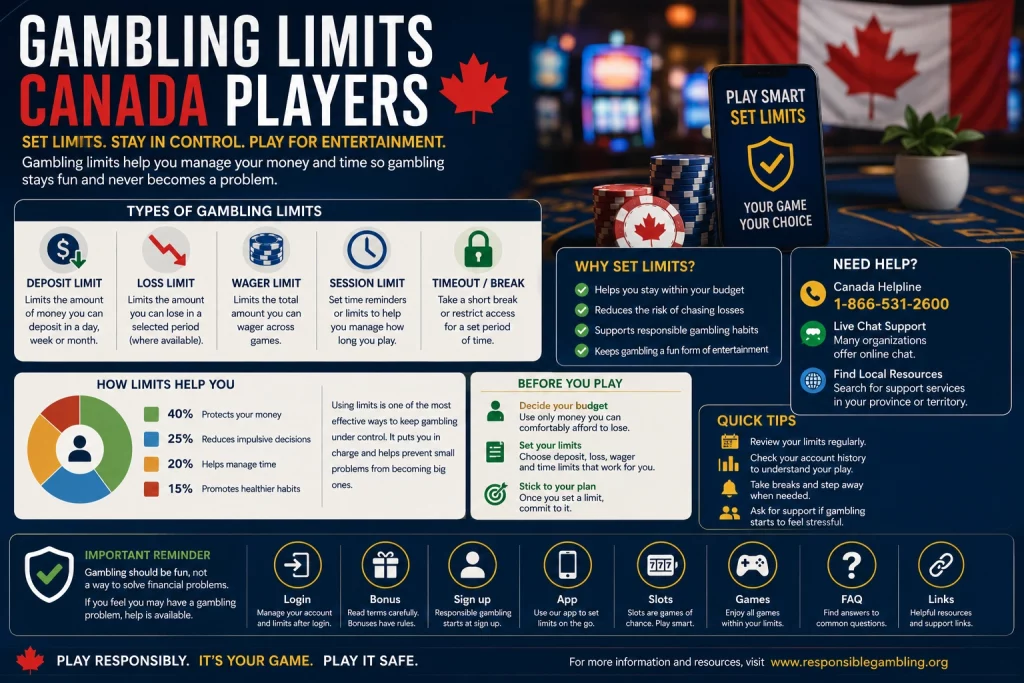
Deposit limits are usually the most common. They restrict how much money can be added to an account within a daily, weekly, or monthly period. Loss limits may restrict how much a user can lose in a defined period. Wager limits control total betting volume, which matters because many small bets can add up quickly. Session reminders help users notice time spent on the platform, while timeouts create a temporary break from access.
For Canada players, limits should be treated as normal account safeguards. They help maintain separation between gambling activity and essential money needed for rent, food, transport, bills, savings, debt payments, or family responsibilities.
| Limit Type | What It Controls | Why It Helps Canada Players |
| Deposit limit | The amount of money that can be deposited during a selected period. | Helps protect essential funds and reduce repeated top-ups after losses. |
| Loss limit | The amount that can be lost within a defined timeframe where available. | Helps reduce the risk of chasing losses or extending a negative session. |
| Wager limit | The total amount that can be staked across games during a set period. | Controls exposure when many smaller bets are placed quickly. |
| Session reminder | The amount of time spent in a session or on the platform. | Helps users notice when gambling is taking longer than planned. |
| Timeout | A temporary access block for a selected break period. | Creates distance after stress, repeated losses, or emotional play. |
Why Limits Should Be Set Before Gambling
Limits work best when they are set before gambling begins. Once a person is already playing, judgement can be affected by excitement, frustration, loss pressure, or the hope of recovery. A pre-set limit creates a rule before those emotions appear.
A useful limit should be realistic and strict. If a user sets a limit so high that it does not actually protect essential money, the tool becomes less effective. The limit should reflect money that can be lost without affecting daily life. If losing that amount would cause stress, missed bills, borrowing, or conflict, the amount is too high.
Betty Casino can explain this in simple terms: limits are not strategies for winning. They are tools for stopping before gambling begins to interfere with financial stability or emotional control.
Account Access and Limit Settings
On most online platforms, limits are usually managed through account settings after Login. Some responsible gambling information may also be shown during Sign up, especially where age rules, eligibility checks, and player-protection policies are explained. A good platform should make these tools easy to find, not hidden behind vague menus or long policy pages.
Account access matters because limits are most useful when users can reach them quickly. If someone feels pressure to continue, the limit tools should be available without confusion. Clear account dashboards, responsible gambling pages, and support prompts all improve practical safety.
Mobile access is also important. If a user plays through an App or mobile browser, the same tools should be visible and functional on smaller screens. A platform that makes limits easy on desktop but hard to find on mobile does not provide consistent protection.
Limits and Game Behaviour
Different game types can create different risk patterns. Fast digital Slots can produce many rounds quickly, while other Games may involve live formats, side bets, or longer sessions. The risk may look different, but exposure still needs to be managed. Limits help users control the pattern rather than relying on memory or willpower during play.
A small bet can become expensive if repeated often. A long session can increase total risk even when individual wagers seem modest. This is why deposit limits alone may not be enough for every user. Session reminders and wager limits can provide additional protection by showing the full scale of activity.
Responsible gambling education should explain cumulative risk clearly. Harm often builds through repeated actions rather than one single decision.
Bonus Offers and Limit Discipline
A Bonus can make limit discipline harder because promotional terms may encourage longer sessions, additional deposits, or continued play to meet wagering requirements. A bonus may include expiry dates, game restrictions, maximum bet rules, and withdrawal conditions. These terms can create pressure if users do not understand them in advance.
Players should decide their limits before evaluating any promotion. If a bonus encourages someone to exceed a planned budget or continue after losses, the safer choice may be to decline the offer. The personal limit should be stronger than the promotional condition.
For Betty Casino, this point is important from an educational perspective. Bonuses should be explained with risk awareness, not only with headline value.
Deposit Limits and Loss Limits
Deposit limits and loss limits are two of the most important gambling control tools because they address financial exposure directly. A deposit limit controls how much money can be added to an account within a selected period. A loss limit controls how much money can be lost during a defined timeframe where this option is available. Both tools help Canada players reduce the risk of overspending, especially during emotional or repeated sessions.
A deposit limit is useful because it creates a firm boundary before money enters the gambling account. If the limit is reached, the user cannot continue depositing until the selected period resets. This can prevent repeated top-ups after losses, which is one of the most common risk patterns in online gambling.
A loss limit works differently. It focuses on net losses during a period rather than deposit activity alone. This can be helpful when a player deposits once but continues gambling for a long time. A loss limit helps control the downside of a session, while a deposit limit controls how much money can enter the account.
| Limit Type | Best Use | Important Detail |
| Daily deposit limit | Short-term spending control. | Useful for users who want strict day-by-day boundaries. |
| Weekly deposit limit | Broader budget control across several sessions. | Useful for users who do not gamble every day but want spending structure. |
| Monthly deposit limit | Longer-term financial planning. | Useful for connecting gambling activity to a monthly entertainment budget. |
| Loss limit | Controlling how much can be lost in a defined period. | Useful when session outcomes create pressure to continue. |
| Combined limits | Using more than one limit at the same time. | Usually stronger than relying on one control tool only. |
Why Deposit Limits Should Match Real Budgets
A deposit limit should be based on disposable entertainment money only. It should not include money needed for rent, groceries, bills, transport, debt payments, savings, school costs, or family responsibilities. If losing the full limit would cause stress or require borrowing, the limit is too high.
Many gambling problems begin when a person treats deposits as temporary spending that can be recovered later. This thinking is risky because gambling outcomes are unpredictable. A deposit is not an investment, and a loss is not something the game is required to return.
For Canada players, the safest approach is to decide the monthly entertainment budget first, then set gambling limits below that amount. The limit should protect the budget, not stretch it.
Gambling Limits and Session Awareness
Session Reminders and Time Limits
Money is not the only risk in gambling. Time also matters. A person may stay longer than planned, lose track of repeated rounds, or continue because a session feels close to changing direction. Session reminders help by showing time-based alerts during play.
A time reminder does not force a person to stop, but it creates a pause. That pause can be useful. It gives the user a moment to ask whether the session is still controlled, whether the budget is still intact, and whether gambling is affecting mood.
Time limits and reminders are especially useful for online gambling because the environment can feel continuous. There is no closing time, no travel barrier, and no visible cash leaving the wallet. The platform experience can make time feel less obvious, so reminders help restore awareness.
Why Wager Limits Can Be Useful
Wager limits control total betting volume rather than deposits alone. This matters because a user may place many small bets without realizing how much total exposure has accumulated. A $1 wager repeated hundreds of times is not small anymore. It becomes a larger financial pattern.
Wager limits are useful for fast games where rounds happen quickly. They help users understand that risk is not only about individual stake size. It is also about repetition. A smaller bet can still create significant exposure if repeated often enough.
Betty Casino can explain wager limits as part of practical gambling literacy. A user who understands total wagering is more likely to see the full pattern of activity rather than focusing only on the size of one round.
Lowering Limits Versus Raising Limits
Lowering a gambling limit should usually take effect quickly because it reduces risk. Raising a limit may involve a waiting period. This waiting period is a safety measure. It prevents users from increasing limits impulsively during a losing session, emotional moment, or promotion-driven decision.
This distinction is important. Some users may feel frustrated if they cannot immediately raise a limit, but the delay exists for protection. A cooling period gives the person time to reconsider whether the increase is necessary or driven by temporary pressure.
Responsible platforms should explain this clearly. Limit rules should not be hidden. Users should know when a change takes effect and whether higher limits require delay or review.
How Gambling Limits Reduce Emotional Decisions
Gambling limits are most useful because they reduce the space for emotional decision-making. Many harmful gambling patterns do not begin with a large planned risk. They begin after a loss, a near win, a stressful moment, or a feeling that one more round may change the result. When a limit is already active, the platform can interrupt that moment before the user makes a larger decision under pressure.
For Canada players, this matters because online gambling can move quickly. A user can deposit, play, lose, deposit again, and continue within minutes if no restrictions are active. Limits create friction. That friction is useful because it gives the player time to pause and reassess.
| Emotional Trigger | Risk Without Limits | How Limits Help |
| Loss frustration | The player may deposit again to recover money quickly. | Deposit and loss limits can stop repeated top-ups. |
| Near win reaction | The player may believe a result is close and continue longer. | Session reminders help interrupt automatic continuation. |
| Bonus pressure | The player may extend play to complete wagering terms. | Pre-set limits keep promotions inside a fixed budget. |
| Stress or boredom | The player may use gambling as emotional escape. | Timeouts create distance before the pattern escalates. |
| Fast gameplay | The player may lose track of total wager volume. | Wager limits help control repeated small bets. |
Limits and Chasing Losses
Chasing losses is one of the clearest reasons to use gambling limits. It happens when a player continues gambling because previous losses feel recoverable. This can turn a controlled session into a harmful one, especially if the user increases stakes or deposits again to “get back to even.”
Limits help by making the stopping point less negotiable. A person may feel pressure to continue, but the account setting can prevent further deposits or restrict additional losses. This does not solve the emotional urge by itself, but it creates a protective barrier.
Betty Casino can explain this directly: limits are not about winning better. They are about stopping earlier when gambling starts becoming reactive instead of planned.
Limits, Promotions, and Player Control
Promotions can make gambling limits harder to respect if users focus only on the headline offer. A promotion may include wagering requirements, expiry times, eligible games, maximum bet rules, or withdrawal conditions. If a user stretches their budget to complete promotion terms, the offer has started influencing behaviour in a risky way.
A practical approach is to set gambling limits before reviewing promotions. The limit should not change because a promotion appears. If the promotion does not fit inside the existing limit, the safer decision is to ignore it.
This is especially important on pages where users compare offers or read promotional conditions. Betting decisions should remain tied to the user’s budget, not to urgency created by marketing language.
Limits and Account History
Account history can help users understand whether their limits are working. A person may believe they gamble occasionally, but account records can show more frequent deposits, longer sessions, or higher total spending than expected. Reviewing history makes the pattern visible.
Canada players should use account history as a self-check tool. If deposits are happening more often, if sessions are becoming longer, or if limits are reached repeatedly, that is useful information. It may mean the current limits are too high, or that a stronger tool such as timeout or self-exclusion should be considered.
Betty Casino can present account history as part of responsible gambling education. The goal is not to judge the user, but to help them see behaviour clearly.
When Limits Are Not Enough
Limits are useful, but they are not always enough. If a person repeatedly tries to raise limits, opens other gambling accounts, hides activity, borrows money, or feels unable to stop, stronger support is needed. In these cases, self-exclusion, professional counselling, peer support, or financial safeguards may be more appropriate.
A good responsible gambling guide should make this clear. Limits are a first-line tool, not a complete solution for every situation. If gambling is already causing harm, the safest step may be to stop gambling access entirely and contact support.
For Canada players, early escalation to stronger protection can prevent deeper financial and emotional harm.
Support Resources and Long-Term Limit Management
Gambling limits work best when they are connected to broader support and long-term self-monitoring. A single setting can reduce risk, but it cannot replace awareness, honest budgeting, emotional control, and access to help when gambling becomes difficult to manage. For Canada players, limits should be viewed as one part of a wider responsible gambling plan.
A strong plan usually includes several layers. The first layer is financial: deposit, loss, and wager limits. The second layer is behavioural: session reminders, timeouts, and breaks. The third layer is support: responsible gambling resources, counselling, peer support, and trusted people who can help when control becomes difficult. Together, these layers create stronger protection than any single tool alone.
| Canada Support Resource | What It Helps With | Link |
| Responsible Gambling Council | Education, prevention, and safer gambling guidance. | Visit resource |
| ConnexOntario | Confidential support for gambling, mental health, and addiction concerns in Ontario. | Visit resource |
| Gamblers Anonymous Canada | Peer-support meetings and recovery-focused community support. | Visit resource |
| CAMH Gambling Support | Clinical information and treatment-related guidance for gambling harm. | Visit resource |
| Canadian Centre on Substance Use and Addiction | Research and public-health information connected to addiction and harm reduction. | Visit resource |
Gambling Limits Management
How to Review Limits Over Time
Gambling limits should not be set once and forgotten. They should be reviewed regularly, especially if personal finances, stress levels, work routines, or gambling habits change. A limit that felt reasonable months ago may become too high if income changes, bills increase, or gambling sessions become more frequent.
Canada players should review whether limits are being reached often. If a person repeatedly reaches their deposit limit, tries to raise it, or feels frustrated by the restriction, that is useful information. It may indicate that the limit is doing its job, but it may also suggest that stronger safeguards are needed.
A responsible approach is to lower limits when gambling feels harder to control, not raise them. If the urge to increase a limit appears after losses or during stress, that is a warning sign.
When to Move From Limits to Self-Exclusion
Self-exclusion should be considered when ordinary limits do not provide enough protection. This may happen when a user repeatedly reaches limits, opens new accounts elsewhere, borrows money, hides gambling activity, or feels unable to stop after a planned session.
A timeout may be enough for short-term emotional pressure. Self-exclusion is more appropriate when gambling harm is repeated, serious, or difficult to control. It creates a stronger access barrier and can give the user time to seek support.
Betty Casino can explain this progression clearly: limits are useful early tools, but stronger protection is appropriate when limits no longer stop harmful behaviour.
Final Practical Checklist for Canada Players
Canada players should set limits before gambling, base them only on disposable entertainment money, keep them lower than the maximum they could afford, and review them regularly. If a limit is reached often, the response should not be automatic increase. It should be reflection.
Players should also combine limit tools with time reminders, breaks, account history review, and support resources. If gambling affects essential money, mood, sleep, relationships, or responsibilities, it is safer to stop and seek help than to adjust limits upward.






Comments