
Documents Required Canada Casino Verification
Documents Required for Canada Casino Verification
Identity verification is one of the most important account checks for Canadian players using a digital gaming platform such as Betty Casino. The purpose is not only to confirm that the account belongs to a real person, but also to protect payments, reduce duplicate accounts, prevent misuse of personal details, and support safer account management. For players, the verification stage can feel like an extra step, especially when access to deposits or withdrawals depends on document approval. In practice, it is a standard security process that helps connect the account profile, payment method, and player identity into one consistent record.
The verification process usually starts when a player creates an account, updates personal details, requests a withdrawal, changes a payment method, or triggers an additional security review. A platform may ask for identity documents, proof of address, payment confirmation, or source-of-funds information depending on the account activity. The exact request can vary, but the logic remains the same: the information provided during registration must match the documents uploaded later.
For Canadian users, the most common documents include a government-issued photo ID, a recent utility bill or bank statement, and payment-related proof if deposits were made by card, bank transfer, or e-wallet. These documents should be clear, valid, readable, and consistent with the personal information in the account. If the name, date of birth, address, or payment ownership does not match, the platform may pause the review and ask for a corrected file.
Verification is not something players should treat casually. Uploading cropped, blurred, expired, or edited files can delay approval. A better approach is to prepare documents before they are requested, especially if the account may be used for withdrawals. This helps avoid a situation where funds are available but document checks are still incomplete.
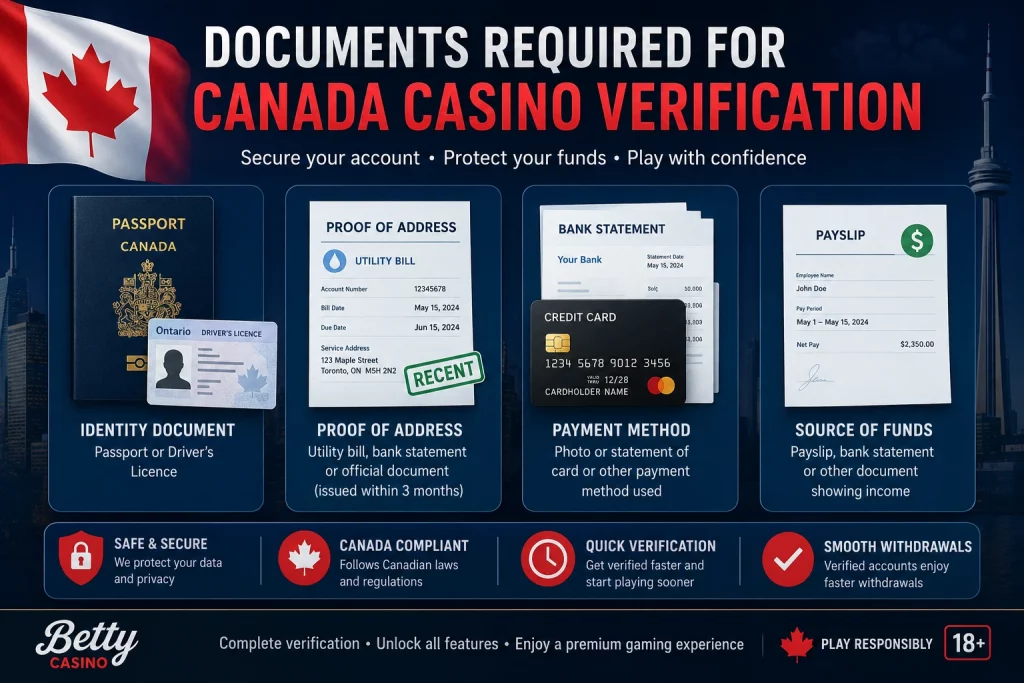
Why Casino Verification Matters in Canada
Casino verification in Canada is closely connected to account security and responsible account control. When a player submits identity documents, the platform can confirm that the person using the account is old enough, that the name matches the payment method, and that withdrawals are being sent to the correct owner. Without this step, online accounts would be more exposed to payment fraud, identity misuse, and unauthorized access.
Another reason verification matters is withdrawal protection. A deposit can often be processed quickly, but a withdrawal usually requires stronger checks because money leaves the platform. Before sending funds, the operator may need to confirm that the withdrawal request is made by the verified account holder. This is why some players only notice the verification stage when they request their first payout.
A well-organized verification process also reduces confusion later. If the identity profile, payment details, and address records are aligned early, future account activity becomes easier to manage. The player avoids repeated requests, while the platform has a cleaner account history to review. This creates a more predictable experience when changing payment methods, updating personal details, or reviewing account limits.
| Verification Area | Common Document | Main Purpose | Possible Issue If Missing |
|---|---|---|---|
| Identity Check | Passport, driver’s licence, provincial ID card | Confirms name, date of birth, and photo identity | Account review may remain incomplete |
| Address Check | Utility bill, bank statement, tax document, official letter | Confirms current residential address | Withdrawals or account changes may be delayed |
| Payment Ownership | Card image with hidden digits, e-wallet screenshot, bank proof | Confirms that the payment method belongs to the account holder | Payment method may be rejected or reviewed again |
| Source-of-Funds Review | Payslip, bank statement, financial declaration, income proof | Supports checks on larger or unusual financial activity | Additional questions may be requested before approval |
Main ID Documents Usually Accepted
The strongest document for identity verification is a government-issued photo ID. In Canada, this may include a passport, provincial driver’s licence, provincial identification card, or permanent resident card, depending on the platform’s accepted document list. The document should show the player’s full legal name, date of birth, photo, document number, and expiry date. All four corners should be visible, and the image should not be covered by glare, filters, stickers, or heavy compression.
A passport is often one of the easiest documents to review because the layout is standardized and the information is clearly structured. A driver’s licence or provincial ID card can also work well, provided that the address and identity data are readable. If a player uploads a card-style document, both sides may be required. The front side normally confirms identity, while the back side may contain barcodes, issue details, or additional validation data.
The key requirement is consistency. The name on the ID should match the account name. The date of birth should match the registration details. The document should be valid at the time of upload. If the player recently changed name or address, the account may require supporting documents to explain the difference. This is especially important when payment records still show older details.
Players should never upload altered ID documents. Even small edits, such as covering too much information, changing image contrast aggressively, or cutting off edges, may cause rejection. Sensitive numbers may be partially hidden only when the platform clearly allows it. Otherwise, the safest approach is to follow the upload instructions exactly and use a clean, readable scan or photo.
Proof of Address for Canadian Players
Proof of address is usually requested to confirm where the player lives. This document must show the full name, current residential address, issuing company or institution, and a recent date. Many platforms prefer documents issued within the last three months. Common examples include a utility bill, bank statement, credit card statement, internet bill, insurance letter, government correspondence, or official tax-related document.
The address document should match the address listed in the account profile. Minor formatting differences are usually not a problem, such as “Street” versus “St.”, but the core information must be the same. If the account shows an old address and the uploaded bill shows a new one, the player may need to update the profile first or provide clarification.
Mobile phone bills are sometimes accepted and sometimes rejected, depending on the operator’s document policy. Rental agreements may also be accepted in some cases, but they are not always preferred because they can be older, handwritten, or missing institutional verification. The safest documents are recent statements from banks, utilities, or government bodies because they usually contain structured data and clear issuer details.
Players should avoid uploading screenshots that do not show enough information. A cropped online banking screen, for example, may show a name but not an address, or an address but not a statement date. A downloadable PDF statement is usually stronger than a partial screenshot because it includes a complete header, issuer name, date, and account owner details.
Payment Method Verification
Payment verification confirms that the person who owns the casino account also owns the payment method used for deposits and withdrawals. This is important because payment details can be misused if account checks are weak. A platform may ask for proof of a bank account, card, or e-wallet when a player makes a withdrawal or changes payment options.
For bank cards, the platform may request a photo of the card showing the cardholder name and only part of the number. Players should never expose the full card number or CVV unless official instructions require a specific secure method. Usually, the middle digits can be hidden while the first six and last four digits remain visible. The CVV on the back should normally be covered. If the card has no visible name, additional bank proof may be requested.
For bank transfers, a bank statement or official account confirmation may be required. The document should show the account holder’s name, bank name, and enough account information to connect the payment method to the player. For e-wallets, a profile screenshot or statement may be requested, showing the registered email address, name, and transaction reference.
The most common mistake is uploading a payment screenshot that does not show ownership. A transaction receipt alone may not be enough if it only displays the amount and date. The platform needs to confirm that the payment method belongs to the same person whose ID was verified. This is why payment proof should show both identity-related details and payment reference details where possible.
Internal Navigation References
For a verification-focused page, internal links should help users move to account access, support, and information pages without pushing them into unnecessary action. A clean structure may include one reference to Login for account access, Sign up for account creation details, App for mobile document uploads, FAQ for common verification questions, and Links for support or policy pages. Sections such as Bonus, Slots, and Games should be used carefully on a document verification page, because the main purpose here is identity protection, not promotion.
Preparing Files Before Upload
Before uploading any document, the player should check image quality. The file should be clear, uncropped, and easy to read. All important information must be visible, including name, date, address, document number where needed, and expiry date if applicable. Photos taken in poor lighting often create glare on plastic ID cards, especially driver’s licences and provincial ID cards. Taking the photo on a flat surface with natural light usually produces a cleaner result.
File format also matters. Many platforms accept JPG, PNG, or PDF files. A scanned PDF is often useful for bank statements and utility bills, while JPG or PNG works well for ID photos. The file size should not be too large, but heavy compression can make text unreadable. If the upload system rejects a file, the issue may be size, format, blurry text, or missing document edges.
Players should also make sure the document is current. Expired IDs, old address statements, and outdated payment screenshots are common reasons for rejection. When using proof of address, the document date should be visible. When using proof of payment, the payment owner should be clear. When using ID, the expiry date should not be cut off.
Good preparation reduces repeated requests. Instead of uploading documents one by one in a rushed way, it is better to gather all likely files first: photo ID, proof of address, and payment proof. This makes the review process smoother and reduces the chance of receiving multiple correction messages.
How the Verification Review Usually Starts
The document review process usually begins after a specific account action. For some players, it starts immediately after registration. For others, it appears only when a withdrawal is requested, when a payment method changes, when account information is edited, or when the system detects activity that requires closer review. This can include inconsistent login locations, repeated failed payment attempts, mismatched personal details, or unusually large transaction movement.
For Betty Casino players in Canada, the practical point is simple: the account details entered at registration should be accurate from the beginning. A small typo in a name, date of birth, province, postal code, or email address can create unnecessary delays later. Verification systems compare account data with document data, so every mismatch creates a reason for manual review.
Players often assume that verification is only about uploading a passport or driver’s licence. In reality, the process can involve several layers. The first layer confirms identity. The second confirms address. The third confirms payment ownership. A fourth layer may apply when financial activity requires extra explanation. Not every player will go through every layer, but each layer has a clear purpose.
A smooth review depends on document quality and consistency. If the uploaded files are complete, readable, recent, and aligned with the account profile, approval is usually easier. If the files are incomplete or unclear, the system may request a new upload. This does not always mean the document is invalid; it often means the file did not provide enough visible information for the review team.
Identity Details That Must Match
The most important matching points are full legal name, date of birth, and document validity. The name in the account should be the same as the name on the ID document. If the player registered with a shortened name, nickname, middle name omission, or spelling variation, the review may take longer. For example, “Michael” and “Mike” may refer to the same person, but automated checks may not treat them as identical.
Date of birth is equally important. Canadian verification checks must confirm that the account holder is legally old enough to use the platform according to applicable requirements. If the date of birth in the account does not match the ID, the account may be paused until the difference is resolved. This is why the registration form should be completed carefully from the start.
The document must also be valid. Expired IDs are one of the most common causes of failed verification. A driver’s licence, passport, or provincial ID card should show a visible expiry date. If the expiry date is hidden by glare, cropped out, or too blurry to read, the platform may reject the file even if the document itself is genuine.
Another frequent issue is image modification. Players may try to protect privacy by covering too many details. Some masking is acceptable only when the upload instructions clearly allow it, especially for payment cards. For ID verification, however, excessive hiding can make the document unusable. The file must show enough information to confirm identity properly.
| Data Point | Where It Appears | Why It Matters | Common Problem |
|---|---|---|---|
| Full Legal Name | Account profile, ID document, payment proof | Confirms that all account records belong to the same person | Nickname, typo, missing middle name, different surname |
| Date of Birth | Registration form and photo ID | Confirms age and account eligibility | Incorrect day/month order or registration mistake |
| Residential Address | Account profile and proof of address | Confirms current location details | Old address, incomplete postal code, document too old |
| Payment Ownership | Bank statement, card proof, e-wallet profile | Confirms that deposits and withdrawals belong to the verified user | Receipt shows payment only, but not the owner |
| Document Expiry | Passport, driver’s licence, provincial ID | Confirms that the document is still valid | Expired ID or unreadable expiry date |
Common Reasons Documents Are Rejected
Document rejection usually happens for practical reasons. The most common reason is poor image quality. If the photo is blurry, too dark, overexposed, tilted, or affected by glare, the review team may not be able to read the details. Plastic ID cards are especially sensitive to reflection, so the image should be taken without flash and with the card placed on a flat surface.
Another common reason is cropping. All four corners of an identity document should be visible. If part of the card or passport page is cut off, the system may treat the image as incomplete. The same applies to proof of address documents. A bill or statement should show the name, address, issuer, and date. A cropped section with only the address may not be enough.
Outdated documents also cause delays. Proof of address documents are usually expected to be recent. If a utility bill or bank statement is several months old, it may not prove the current address. A recent PDF statement is often stronger than a screenshot because it includes document metadata, issuer details, and a formal layout.
Mismatch between account details and document details is another major rejection cause. If a player registered under one address but submits a document showing another, the account may need to be updated. If a payment method belongs to another person, it may be rejected completely. Using someone else’s card, bank account, or wallet can create serious account restrictions.
Payment Proof and Withdrawal Checks
Withdrawal checks are often stricter than deposit checks because funds are leaving the account. A platform needs to confirm that the withdrawal destination belongs to the same verified person. This is why payment proof can become important even after identity and address have already been approved.
For card deposits, the player may be asked to upload a card image. The cardholder name and partial card number should be visible if requested. The CVV should not be shown. If the card is virtual and does not have a physical image, a bank app screenshot or statement may be required, depending on what information it displays.
For bank withdrawals, a statement or account confirmation may be requested. The document should show the name of the account holder and bank details sufficient for matching. It does not need to expose unnecessary transaction history if the platform only asks for ownership confirmation, but the visible details must be enough to connect the bank account to the verified user.
For e-wallets, the issue is usually profile matching. A payment screenshot should show the registered email address, account name, and wallet provider. A simple transaction notification may not be enough because it might not confirm who owns the wallet. The stronger file is usually a profile page or downloadable statement showing account ownership.
Why Source-of-Funds Requests Can Appear
A source-of-funds request is not always part of standard verification, but it can appear when financial activity requires additional review. This may happen after larger transaction volumes, unusual deposit patterns, repeated payment changes, or account activity that requires a clearer financial explanation. The goal is to understand where the money used in the account comes from.
Documents used for this type of review may include payslips, bank statements, tax documents, business income records, pension statements, investment records, or other official financial documents. The platform does not necessarily need every detail of a player’s finances, but it may require enough information to confirm that the account activity is consistent with declared financial capacity.
Players should read the request carefully before uploading anything. A source-of-funds request is usually specific. It may ask for a statement covering a defined period, proof of salary, proof of sale, or confirmation of business income. Uploading unrelated files can delay the review because the team still has to request the correct document.
It is also important to avoid editing financial documents too aggressively. Sensitive information may sometimes be hidden if it is not relevant, but the name, date, issuer, income source, and transaction context may need to remain visible. If too much information is covered, the document may not satisfy the request.
How Mobile Uploads Affect Verification
Many Canadian players upload verification files from a smartphone. This is convenient, especially when using the App section or a mobile browser, but it also creates common file-quality problems. Phone cameras can produce excellent images, yet automatic compression, low light, motion blur, and reflective surfaces can reduce readability.
The best approach is to photograph documents in a well-lit room, place them on a plain background, and keep the camera directly above the document. Angled photos can distort text. Flash can create glare. Very close photos can blur small print. A stable, straight image usually works better than multiple rushed attempts.
When uploading a PDF statement from a phone, the player should confirm that the full file has uploaded, not just a preview image. Some mobile systems export screenshots instead of original PDFs, which can remove important header information. A proper PDF statement is usually easier to verify because it preserves structure and text clarity.
Mobile uploads can also fail because of file size limits. If the document is too large, the upload system may reject it. If it is too compressed, the text may become unreadable. A balanced file with clear text and reasonable size is usually best. JPG and PNG can work for photos, while PDF is often better for statements and official letters.
Verification Timing and Player Expectations
Verification time can vary. Some files may be reviewed quickly, while others require manual checks. Delays do not always mean something is wrong. Manual review may be needed if the document is unusual, the account data has inconsistencies, the payment proof needs additional comparison, or the uploaded file is difficult to read.
The player should avoid submitting the same document repeatedly unless instructed. Multiple duplicate uploads can make the account history harder to review. A better approach is to wait for the response and then upload a corrected file if the platform asks for one. If the request is unclear, the player should contact support and ask which detail is missing.
It is also useful to complete verification before relying on a withdrawal. Waiting until the first payout request can create frustration because the withdrawal may remain pending while documents are reviewed. Preparing documents earlier gives the account a stronger operational profile and reduces pressure later.
Verification should be treated as part of account maintenance. Just as players update passwords, review payment methods, and check account settings, they should also keep personal details current. If the address changes, if a card expires, or if a payment method is replaced, the account may need updated documentation later.
Document Safety During Upload
Document verification requires players to share sensitive personal information, so file safety should be treated as seriously as the verification itself. A Canadian player preparing documents for Betty Casino should focus not only on approval speed, but also on how the files are created, stored, and uploaded. The safest process is simple: use the official account area only, avoid sending documents through informal channels, check that the upload page is secure, and keep local copies stored carefully.
The verification page should normally be accessed from the player account dashboard, not through random links in emails or messages. If a message asks for documents, the player should log in directly through the official site and check whether the same request appears inside the account. This reduces the risk of phishing attempts, fake support messages, and document theft.
Files should be prepared in a controlled way. A document photo should not include unrelated personal items, other cards, family documents, computer screens, or visible location details in the background. A bank statement should be downloaded from the official banking portal and reviewed before upload. A payment proof file should show only what is required for ownership confirmation, not unnecessary private information.
Players should also avoid public Wi-Fi when uploading documents. Verification files contain identity data, address details, and sometimes financial information. Uploading them over a private, secure connection is a better practice. Once the file has been submitted, it is also sensible to delete unnecessary duplicate photos from the phone gallery, especially if the device is shared with other people.
Privacy Checks Before Sending Documents
Before submitting any file, the player should review it line by line. The goal is to ensure that the document contains all required information while avoiding needless exposure. For example, proof of address must show name, address, issuer, and date. It usually does not need to show every transaction on a full bank statement unless the request specifically asks for financial activity over a period.
For identity documents, the platform usually needs enough data to confirm the person’s identity. This may include full name, photo, date of birth, document number, and expiry date. Hiding too much information can cause rejection. At the same time, players should not add extra files that were not requested. More information does not always make verification faster; it can make the review more complicated.
Payment card verification requires special care. If the platform asks for a card image, the player should follow the masking rules exactly. Usually, the CVV should be covered. Often, only partial card digits are needed. If the cardholder name is visible on the card, that helps connect the card to the account holder. If the card has no printed name, a bank statement or card confirmation may be needed instead.
A useful rule is to ask whether every visible detail helps answer the verification request. If it does, keep it visible. If it does not, and the platform allows masking, hide it carefully without damaging the document’s core value. Random edits, heavy blur, filters, stickers, or screenshots with missing headers should be avoided because they make the file look unreliable.
| Document Type | Details That Should Be Visible | Details That May Need Protection | Best Upload Format |
|---|---|---|---|
| Passport or ID Card | Name, photo, date of birth, expiry date, document edges | Only hide details if instructions clearly allow it | Clear JPG, PNG, or scanned PDF |
| Utility Bill | Name, address, issuer, bill date, document header | Account balance or unrelated service data if not required | Original PDF or full-page scan |
| Bank Statement | Name, address, bank name, statement date, ownership details | Unrelated transactions unless requested | Downloaded PDF statement |
| Payment Card Proof | Cardholder name, first six and last four digits if requested | Middle digits and CVV | Photo with sensitive areas covered |
| E-wallet Proof | Registered name, email, provider name, profile or statement page | Unrelated balances or private notifications | Profile screenshot or statement PDF |
Account Data Consistency
Verification is much easier when the account profile and documents tell the same story. The name should match across the profile, ID, bank account, and payment method. The date of birth should be identical. The address should be current. The email address or phone number used for payment services should not create confusion with another person’s account.
Inconsistent account data often creates delays that could have been avoided. A player may move to a new address but forget to update the account profile. Another may use a short version of their name during registration, then upload a passport with a longer legal name. Some players use a family member’s card or bank account, which can cause the payment method to be rejected because the owner does not match the verified profile.
If a player’s name has changed legally, supporting documentation may be needed. This could include a marriage certificate, legal name change document, or updated government ID. The same logic applies to address changes. If the account profile shows an old address, a recent proof of address may need to be submitted after the account details are corrected.
The account should also use a personal email address controlled by the player. Shared inboxes, workplace emails, or family-managed accounts may complicate support and security checks. Verification is strongest when every core detail belongs to one person and can be confirmed across documents, payment systems, and account records.
Verification Priority by Document Type
Not all documents carry the same verification weight. A government-issued ID is usually the foundation because it proves who the player is. Proof of address confirms where the player resides. Payment proof connects financial activity to the verified account holder. Source-of-funds documents support additional financial checks when account activity requires more context.
The order of requests can vary. Some platforms begin with ID and address checks. Others ask for payment proof only after a withdrawal request. Source-of-funds checks usually appear later and are often connected to account activity rather than basic registration. This does not mean the player has done anything wrong. It means the platform needs stronger documentation for a specific review.
From a preparation standpoint, players should keep at least three categories ready: ID, address, and payment ownership. These cover most standard verification scenarios. If the platform later requests source-of-funds information, the player should respond with exactly the requested document type and date range.
How to Reduce Repeated Verification Requests
Repeated verification requests usually happen when the first submission does not fully answer the platform’s question. This may be caused by low image quality, missing corners, old address documents, mismatched profile details, hidden information, or an upload that shows the wrong page. Reducing repeat requests starts with reading the instruction carefully before choosing the file.
If the request asks for proof of address, the player should not upload only an ID card unless the platform says that ID can also confirm address. If the request asks for payment ownership, a generic transaction screenshot may not be enough. If the request asks for a bank statement covering a certain period, a single cropped transaction may not satisfy the review.
It also helps to use official documents rather than informal screenshots. A downloaded bank statement is stronger than a cropped mobile banking screen. A utility bill PDF is stronger than a photo of an envelope. A government letter is stronger than a delivery receipt. The clearer the issuer, date, and personal details are, the easier the review becomes.
Players should also avoid changing multiple account details during verification unless necessary. Updating address, payment method, phone number, and email at the same time can create more checks. If a change is required, it should be made carefully and supported with the correct document. A stable account profile gives the verification team fewer inconsistencies to resolve.
What to Do If Verification Is Delayed
A delayed review should be handled methodically. First, the player should check whether the platform has sent a specific correction request. Many delays happen because the review team needs one missing detail, such as a clearer image, a newer address document, the back side of an ID card, or payment ownership proof.
Second, the player should avoid uploading random replacement files without understanding the issue. If the rejection message says the proof of address is too old, uploading the same document again will not help. If the card proof does not show ownership, uploading a payment receipt without the cardholder name may still fail. The correction should address the stated reason directly.
Third, the player should keep communication concise. A support message can state which document was uploaded, when it was submitted, and what clarification is needed. Long messages with unrelated explanations can slow down the support process. The most useful information is usually the document type, upload date, account email, and the exact point that needs clarification.
Finally, the player should keep copies of submitted documents until the review is finished. This makes it easier to compare what was sent with what was requested. After the review is complete, unnecessary local duplicates should be removed from shared devices or unsecured folders.
Responsible Handling of Personal Documents
Personal documents should not be treated as ordinary image files. A photo ID, bank statement, or payment card proof can be misused if stored carelessly. After taking document photos, players should check where the files were saved. Cloud backup, shared folders, messaging apps, and public computers can create unnecessary exposure.
It is safer to upload documents from a personal device, using a secure connection, and then remove unneeded copies. If a document was edited to cover sensitive details, the original unmasked photo should not remain in an easily accessible folder. If the document was downloaded from online banking, the file should be stored only where needed and deleted when no longer required.
Players should also be careful with support communication. Documents should not be sent to unofficial social media accounts, unknown email addresses, or people claiming to be agents outside the official support channel. If support asks for documents outside the account dashboard, the player should verify that the request is legitimate before sending anything.
Good document handling protects the player beyond the verification process itself. It reduces the risk of identity misuse, accidental file sharing, and confusion during future account checks. The strongest verification process is not only fast; it is also controlled, secure, and limited to the information that is actually required.
Verification and Long-Term Account Stability
Verification is often viewed as a one-time requirement, but in practice it supports long-term account stability. A properly verified account usually experiences fewer interruptions during withdrawals, payment updates, and security reviews. Once the core identity profile has been confirmed, future checks become more predictable because the platform already has a validated reference point for the player’s information.
For Canadian users of Betty Casino, account stability depends on keeping personal details current. If a player changes address, renews a driver’s licence, replaces a bank card, or changes a surname, the account records may eventually need updated documents. Waiting until a withdrawal request to correct outdated information can slow the review process because several account details may need confirmation at the same time.
A stable account profile also improves support communication. When the account name, email, payment method, and verification documents are consistent, support agents can review requests more efficiently. This becomes especially important when dealing with payment reversals, failed withdrawals, transaction reviews, or security checks related to unusual login activity.
Players sometimes assume that once verification is approved, documents will never be requested again. In reality, a platform may request updated proof later if a document expires, if the address changes, or if account activity requires a fresh review. This does not necessarily mean there is a problem. It is often part of maintaining accurate account records over time.
Withdrawal Reviews and Financial Consistency
Withdrawal verification is one of the most sensitive stages of account review because money is leaving the platform. The review team may compare the withdrawal destination with previously verified payment methods, identity documents, and account details. If everything matches clearly, the process is usually simpler. If inconsistencies appear, additional checks may be required.
Financial consistency matters here. Deposits and withdrawals should normally follow the same ownership structure. If deposits come from one payment source but withdrawals are requested to another person’s bank account or wallet, the review may stop until ownership is clarified. This is why personal payment methods are strongly preferred during account use.
Transaction patterns can also influence verification depth. Frequent payment method changes, multiple failed deposits, unusual transaction sizes, or repeated location changes may trigger additional review layers. The purpose is not only operational security, but also confirmation that the account activity aligns with the verified profile.
Players can reduce delays by maintaining a simple payment structure. Using the same verified payment methods consistently creates a clearer transaction history. Repeated switching between cards, e-wallets, and bank accounts can create unnecessary complexity, especially if ownership documents are incomplete or inconsistent.
| Account Situation | Possible Verification Impact | Recommended Action | Typical Supporting Document |
|---|---|---|---|
| New withdrawal request | Payment ownership review | Use a verified personal payment method | Bank statement or card proof |
| Address change | Proof of address update may be requested | Update account details before future withdrawals | Recent utility bill or bank statement |
| Expired ID document | Identity review may reopen | Upload renewed government-issued ID | Updated passport or driver’s licence |
| Payment method replacement | Additional payment verification | Verify the new payment source early | Card image or bank ownership proof |
| Large transaction activity | Financial review or source-of-funds check | Prepare official financial documentation | Payslip, bank records, tax documents |
Support Communication During Verification
Support communication becomes more effective when the player provides precise information. Instead of sending long descriptions, it is better to explain the exact issue clearly. A strong message usually includes the document type, upload date, and the specific clarification needed. For example, if the proof of address was rejected, the player should ask whether the issue relates to document age, image quality, or missing information.
When support requests a replacement document, the new upload should directly address the previous issue. If the original file was blurry, the new version should improve clarity. If the document was outdated, the replacement should show a more recent issue date. Uploading unrelated files often creates longer delays because the review team still needs the requested information.
It is also useful to keep communication inside the official support system whenever possible. Messages sent through unofficial channels can become difficult to track. A documented support history inside the account area provides a clearer record of uploads, requests, and corrections.
Players should remain careful with personal information during support communication. Sensitive files should not be sent through random messaging platforms or public social media comments. The safest method is the official document upload section or the verified support channel connected to the account.
Understanding Reverification Requests
Reverification means the platform needs updated or additional documentation after an earlier approval. This can happen for several reasons. The most common are expired documents, updated personal details, new payment methods, changes in account activity, or long periods of inactivity followed by renewed use.
An expired passport or driver’s licence is one of the simplest examples. Even if the identity was verified successfully in the past, the account may require a valid replacement document later. The same applies to proof of address. A statement that was acceptable a year ago may no longer confirm the current residence.
Payment-related reverification can happen after a new bank card is added, a withdrawal destination changes, or a different e-wallet begins to appear in transactions. The review team may need confirmation that the new payment method belongs to the same verified account holder.
Reverification should not automatically be interpreted as a negative signal. In many cases, it reflects account maintenance requirements rather than suspicion. The strongest response is usually a straightforward one: upload updated documents that clearly answer the new request without adding unnecessary complexity.
Practical Verification Preparation Strategy
Players who want fewer delays usually follow a structured preparation approach. Before using the account heavily, they prepare several categories of documents in advance. This includes one government-issued ID, one recent proof of address, and one payment ownership document linked to the primary payment method.
The documents should be reviewed before upload. The player should confirm that the name is readable, the date is visible, the document is current, and all corners are included. For PDFs, it is useful to open the file on another device to ensure the text remains clear after download. For photos, the player should zoom in and confirm that smaller details are still readable.
File organization also matters. Keeping documents in clearly labeled folders reduces confusion when a replacement upload is requested later. At the same time, sensitive files should not remain permanently stored on shared devices or unsecured cloud folders. Once the verification process is complete, unnecessary duplicates should be removed carefully.
A calm, organized approach generally works better than repeated rushed uploads. Most verification delays come from preventable issues: poor image quality, inconsistent data, outdated documents, or incomplete files. Addressing these factors early creates a smoother account experience over time.
Verification and Mobile Access
Mobile access has changed how players complete verification. Many users now register, upload documents, review support messages, and monitor withdrawals directly from a smartphone. This improves convenience, but it also increases the importance of mobile file quality and account security practices.
When using the App or mobile browser for verification, players should confirm that the device camera produces readable images without compression artifacts. Some phones automatically reduce image quality during upload, which can make smaller text difficult to read. If a document repeatedly fails review, uploading a scanned PDF from a desktop device may produce better results.
Mobile account access should also remain secure. Players should avoid storing sensitive verification photos in public galleries, shared folders, or unsecured messaging apps. Biometric device locks, strong passwords, and updated operating systems help reduce exposure if the phone is lost or accessed by someone else.
A stable mobile setup also improves communication speed. Support requests, document updates, and verification notices can be reviewed quickly if account notifications are enabled and the player regularly checks the verified email connected to the account profile.
Managing Verification Expectations
Players often expect verification to be completed instantly, especially after uploading several documents at once. In practice, review times can vary depending on account activity, document quality, payment structure, and support workload. A clear submission usually helps, but manual review may still be required in some situations.
The best expectation is not “instant approval,” but “complete and accurate submission.” A single high-quality document is often more valuable than several incomplete ones. A readable bank statement is stronger than multiple screenshots. A clear passport scan is stronger than several blurry photos. Quality usually matters more than quantity.
It is also important to understand that different verification layers serve different functions. Identity documents confirm who the player is. Address documents confirm residence. Payment proof confirms ownership of financial methods. Source-of-funds documents support financial reviews connected to account activity. Each document category answers a different operational question.
Patience and accuracy usually produce better results than repeated uploads or aggressive support escalation. Verification is fundamentally a consistency process. The clearer the connection between the player, the account, and the payment methods, the smoother the review tends to become.
Final Verification Considerations
A well-prepared verification process protects both the player and the account structure itself. Strong document quality, accurate registration data, personal payment ownership, and careful handling of sensitive files all contribute to a more stable experience over time. Most review delays originate from practical issues rather than complex technical problems.
For Canadian players using Betty Casino, the strongest approach is usually straightforward preparation: maintain accurate account details, keep documents current, use personal payment methods, and respond carefully to any request for clarification. Verification becomes easier when the account history remains consistent across identity records, address data, and financial ownership.






Comments