
Gambling Helpline Canada
Gambling helpline services in Canada exist to give people a confidential route to support when gambling starts to feel stressful, difficult to control, or harmful. A helpline is not only for crisis situations. It can also help someone who is unsure about their habits, worried about a family member, or looking for local counselling and treatment options.
Canada does not operate one single gambling helpline for every province in the same way. Support is usually organized provincially, which means the correct contact can depend on where the person lives. The Responsible Gambling Council lists provincial gambling help phone numbers across Canada, including Ontario, British Columbia, Quebec, Manitoba, Saskatchewan, and other regions. ConnexOntario also describes its gambling support as free, confidential, and available 24/7 for adults in Ontario.
For a Betty Casino informational page, the purpose of this topic should be clear: gambling must remain controlled entertainment. If gambling becomes secretive, stressful, or financially harmful, a helpline can provide the first practical step toward support.
What a Gambling Helpline Does
A gambling helpline connects people with trained support workers or service navigators who can explain what help is available. This may include counselling referrals, addiction services, family support, self-exclusion information, crisis guidance, or local treatment programs. In many cases, the person calling does not need to know exactly what kind of help they need. The helpline helps sort that out.
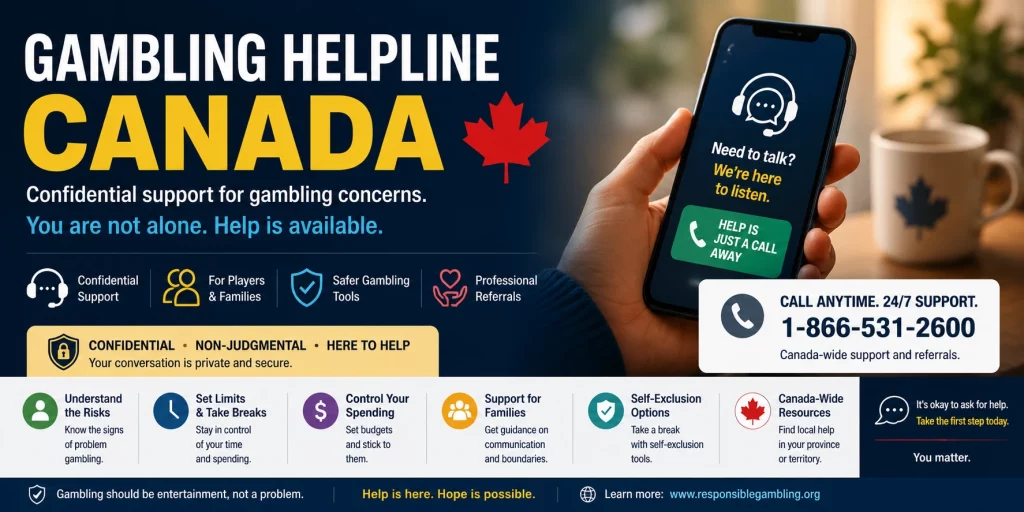
This is especially useful because gambling harm can feel confusing. Some people are not sure whether their behaviour is “serious enough” to ask for support. Others feel embarrassed and wait too long. A helpline removes that first barrier by giving a private place to ask direct questions.
On a casino website, support information should not be hidden behind promotional content. Internal sections such as Login, Bonus, Sign up, App, Slots, Games, FAQ, and Links may help users navigate the wider site, but a responsible gambling helpline page should keep the focus on protection, limits, and support access.
| Support Resource | Region / Role | How It Helps | Official Source |
| ConnexOntario | Ontario | Free confidential support, referrals, service navigation, gambling treatment guidance | ConnexOntario Gambling Treatment |
| Responsible Gambling Council | Canada-wide education and prevention | Problem gambling prevention, public education, Canadian help directory | Help for Canadians |
| GameSense | Player education and safer gambling support | Explains odds, safer play habits, warning signs, and support pathways | GameSense |
| PlaySmart | Ontario player education | Provides gambling facts, warning signs, and help guidance | PlaySmart Finding Help |
When Someone Should Contact a Gambling Helpline
A person should consider contacting a gambling helpline when gambling starts affecting money, sleep, mood, relationships, school, work, or daily responsibilities. The situation does not need to be extreme. Early contact can prevent the problem from becoming harder to manage.
Common signs include spending more than planned, chasing losses, hiding gambling activity, borrowing money, feeling anxious after gambling, or using gambling as a way to escape stress. Family members can also contact helplines if they are worried about someone else’s behaviour. PlaySmart explains gambling problems through warning signs and directs users toward free support resources.
Why Confidential Support Matters
Confidentiality is one of the main reasons gambling helplines are useful. Many people delay asking for help because they fear judgment or exposure. A confidential support route makes the first conversation easier. It allows the person to describe the situation honestly without needing to commit immediately to treatment or a formal program.
In Ontario, ConnexOntario states that its gambling support includes information, education, service navigation, referrals, and family support. That structure is important because gambling harm rarely affects only one area of life. It can involve finances, mental stress, family tension, and repeated attempts to stop without success.
A good helpline does not shame the caller. It helps clarify the next step. That may be counselling, a local support program, a self-exclusion option, or a conversation with a family member under safer conditions.
Gambling Helpline Canada and Responsible Play
A gambling helpline page should make one point very clear: help is available before a crisis. The earlier someone asks for support, the more options they usually have. For Canadian readers, the safest approach is to use official provincial resources, recognized support organizations, and confidential service directories rather than informal advice from forums or promotional gambling pages.
Betty Casino can use this page as a responsible gambling resource by keeping the message direct, calm, and practical. Gambling should never be presented as a solution to financial pressure, emotional stress, or personal problems. If gambling stops feeling controlled, a helpline is a serious and appropriate first step.
How Provincial Gambling Helplines Work
In Canada, gambling support is usually organized by province. This means a person in Ontario, British Columbia, Alberta, Quebec, Manitoba, or another province may be directed to a different phone line, referral service, or treatment pathway. The goal is the same across regions: to connect people with confidential support, local counselling, addiction services, and safer gambling resources.
This provincial structure matters because gambling rules, self-exclusion programs, public health services, and treatment networks are not identical everywhere. A gambling helpline can help the caller avoid confusion by directing them to the correct local support option instead of leaving them to search alone.
| Caller Situation | Helpline Response | Possible Next Step |
| Player feels unable to stop gambling | Support worker asks about urgency, risk, and current gambling behaviour | Referral to counselling, addiction services, or a local treatment provider |
| Player keeps chasing losses | Helpline explains risk patterns and harm-reduction options | Budget limits, cooling-off period, account restrictions, or self-exclusion |
| Family member is worried | Service provides guidance on communication and boundaries | Family support, counselling referral, and advice on protecting shared finances |
| Player wants a break from gambling | Helpline explains available exclusion or pause options | Self-exclusion through provincial or operator-based tools |
| Caller is unsure whether the issue is serious | Support worker helps identify warning signs without judgment | Education, monitoring, support planning, or professional assessment |
What to Expect During a Helpline Conversation
A gambling helpline conversation is usually practical rather than formal. The caller may be asked where they live, what type of gambling is involved, how often gambling happens, whether there are financial concerns, and whether immediate support is needed. The purpose is not to interrogate the caller. It is to understand which service can help.
The caller does not need perfect answers. Many people contact a helpline because they are confused, embarrassed, or unsure. A good support worker will help organize the situation into manageable steps. The conversation may include advice on reducing access to gambling, contacting a counsellor, speaking with family, or using self-exclusion.
For online casino players, one common recommendation is to reduce easy access. This may include removing saved payment methods, setting account limits, taking a cooling-off period, or closing an account. These steps are not replacements for support, but they can reduce immediate risk while the person considers longer-term help.
Helplines for Family Members and Friends
Gambling harm often affects more than the person who gambles. Partners, parents, friends, and relatives may experience financial anxiety, broken trust, arguments, or emotional exhaustion. A gambling helpline can help family members understand what they are seeing and what actions are safer.
Family support usually focuses on boundaries. For example, support workers may advise relatives not to repeatedly cover gambling debts without a structured plan, not to make threats that cannot be followed through, and not to ignore the situation because it feels uncomfortable. Instead, they may suggest calm conversations, financial safeguards, and professional guidance.
This is especially important when gambling is hidden. Online gambling can be private and difficult to notice until financial or emotional consequences appear. A family member who contacts a helpline early may receive guidance before the situation escalates further.
Why Local Referrals Are Important
A national article can explain gambling helplines in general, but a caller usually needs local help. Local referrals are important because counselling availability, treatment programs, crisis services, and self-exclusion procedures vary by province.
A local service can also explain whether help is available by phone, online chat, in person, or through community programs. This matters for people who live far from major cities or prefer confidential remote support.
For Betty Casino, the page should encourage Canadian readers to use official local gambling support services. It should avoid giving medical advice, avoid promising outcomes, and avoid presenting self-control as the only solution. Gambling harm can require structured support, and a helpline is often the fastest way to find it.
Digital Gambling Help and Online Support Options
Online gambling has changed how people access casino games, but it has also changed how support should be delivered. Many Canadian players now need help that is available remotely, privately, and quickly. Phone helplines remain important, but digital support options can also include online chat, referral forms, educational tools, self-assessment pages, and safer gambling dashboards.
Digital support is useful because not every person is ready to speak on the phone. Some players may prefer to read warning signs first, use a self-check tool, or look for local counselling privately. Others may be family members who want guidance before starting a difficult conversation. The best support systems give people several ways to begin.
| Digital Support Option | Main Purpose | How It Helps Canadian Players |
| Online Self-Assessment | Helps users review gambling habits privately | Shows whether gambling may already be causing financial, emotional, or social harm |
| Live Chat Support | Provides a lower-pressure alternative to phone calls | Useful for people who want confidential guidance without speaking aloud |
| Educational Pages | Explain odds, risk signs, and safer gambling tools | Helps players understand that gambling is entertainment, not income |
| Account Limits | Restrict deposits, losses, session length, or access | Creates practical boundaries before gambling becomes more difficult to control |
| Self-Exclusion Tools | Blocks or restricts gambling access for a defined period | Gives players structured distance from gambling when they need a stronger break |
How Helplines Connect With Self-Exclusion
Self-exclusion is one of the strongest tools connected with gambling support. It allows a person to block access to gambling services for a set period. In Canada, the exact process depends on the province and the gambling operator. A helpline can help explain where to start and what the person should expect.
Self-exclusion is most effective when combined with support. Blocking access can reduce immediate gambling opportunities, but it does not automatically solve financial stress, emotional triggers, or repeated urges to return. This is why helplines often recommend counselling, family support, and practical financial boundaries alongside exclusion tools.
A player may choose self-exclusion after repeated losses, repeated failed attempts to stop, or a feeling that gambling is becoming automatic. It is not a punishment. It is a protective tool. For online players, it can be especially important because gambling access may be available at any time through a phone, tablet, or desktop device.
Common Reasons People Delay Calling a Helpline
Many people delay contacting a gambling helpline because they feel ashamed, uncertain, or worried that the situation will be judged harshly. Others believe they should be able to solve the problem alone. This delay can make the situation more difficult because financial and emotional pressure often grows over time.
A responsible gambling page should challenge that delay directly. Calling a helpline is not an admission of failure. It is a practical step. People contact support services for many reasons, including confusion, family concern, loss of control, overspending, emotional stress, or the need for a structured break.
Safer Gambling Tools Before and After Calling
Safer gambling tools can help both before and after a person contacts a helpline. Before calling, tools such as deposit limits, session reminders, and cooling-off periods can reduce immediate pressure. After calling, those same tools can support a broader plan created with a counsellor or support service.
The most important rule is to set limits before gambling, not during an emotional moment. Limits created after losses may be less effective because the player may still feel pressure to recover money. A helpline can help the person think through limits more calmly and realistically.
For a Betty Casino support page, this section should not present tools as a complete solution. They are useful protective measures, but they work best with honest self-monitoring and access to professional help when gambling feels difficult to control.
Building a Personal Support Plan
A gambling helpline can be the first step toward a personal support plan. This plan does not need to be complicated. It may include calling a provincial support service, setting account limits, removing saved payment methods, speaking with a trusted person, and arranging counselling if needed.
The value of a plan is structure. When gambling feels urgent, emotional, or automatic, decisions become harder. A written plan gives the person a clear sequence of actions to follow before gambling harm becomes worse.
| Support Step | Purpose | Practical Action |
| Contact a helpline | Get confidential guidance | Use the official provincial gambling support number or referral service |
| Set financial limits | Reduce impulsive spending | Use deposit limits, block extra payments, and protect essential funds |
| Take a gambling break | Create distance from gambling triggers | Use cooling-off tools, account closure, or self-exclusion |
| Tell one trusted person | Reduce secrecy and isolation | Choose someone calm and supportive, then explain the situation honestly |
| Arrange ongoing support | Address deeper patterns | Ask the helpline about counselling, local programs, or family support |
Final Guidance for Canadian Players
A gambling helpline in Canada is not only a last resort. It is a practical support route for anyone who feels gambling is becoming stressful, secretive, expensive, or difficult to control. Players can use helplines to ask questions, find local services, understand self-exclusion, and begin a safer plan.
Family members can also contact gambling helplines. They do not need to solve the situation alone. Support services can explain warning signs, boundaries, financial safeguards, and referral options.
For Betty Casino, this page should communicate one message clearly: gambling must remain entertainment. When gambling starts to affect money, mood, trust, or daily life, contacting a Canadian gambling helpline is a responsible and appropriate next step.






Comments