

Understanding the Basics of Roulette: A Deep Dive into the Classic Casino Game
Roulette is one of the most iconic casino games that has stood the test of time. Whether you are a beginner or an experienced player, the elegance and simplicity of the game make it a favorite at both land-based and online Betty Casino. With a history dating back to the 18th century, Roulette has become a staple at almost every casino around the world, attracting players with its combination of chance, strategy, and excitement.
In this guide, we’ll explore everything you need to know about Roulette, from the basic rules to advanced strategies that can help improve your odds of winning. I’ll break the game down into its key components, walk you through various betting options, and offer practical advice based on my personal experiences in both real and online casinos.
What is Roulette?
At its core, Roulette is a simple game where players bet on the outcome of a spinning wheel, which contains 37 or 38 numbered slots, depending on whether you are playing European or American Roulette. Players can bet on various possibilities, including single numbers, groups of numbers, or even the color (red or black) of the pocket the ball lands in.
The game can seem intimidating to newcomers due to the variety of betting options, but once you break down the basics, it’s much easier to understand. The most important thing to remember is that Roulette is primarily a game of chance, though there are strategies you can use to manage your bets and potentially improve your outcomes.
The Components of a Roulette Game
Roulette consists of the following main components:
- Roulette Wheel: The wheel contains 37 or 38 pockets, each numbered either 0-36 (European) or 00-36 (American). The numbers alternate between red and black, with the 0 (or 00 in American Roulette) typically being green.
- Roulette Table: The table features a layout of numbers (1-36), along with sections for placing various types of bets, including odd/even, red/black, high/low, and individual numbers.
- Ball: A small ball is spun on the wheel. It eventually lands in one of the pockets, determining the winner.
European vs. American Roulette
The primary difference between the two versions of the game is the number of pockets on the wheel. European Roulette has 37 pockets, with one green zero, while American Roulette has 38 pockets, adding a second green double zero (00).
The presence of the double zero in American Roulette gives the house a slightly larger edge, making European Roulette the preferred version for most experienced players.
Key Differences Between European and American Roulette
| Feature | European Roulette | American Roulette |
|---|---|---|
| Number of Pockets | 37 (1-36, 0) | 38 (1-36, 0, 00) |
| House Edge | 2.70% | 5.26% |
| Popularity | Most popular globally | Common in North America |
| Betting Options | Same | Same |
| Jackpot Payouts | Same | Same |
The House Edge is a crucial factor to consider when deciding which version of the game to play. As you can see, European Roulette has a smaller house edge, which gives players a better chance of winning in the long run.
The Roulette Wheel and Bet Layout
The Roulette wheel consists of numbered pockets arranged in a specific order. In European Roulette, the pockets are arranged in a random order, but the placement of numbers on the wheel is carefully designed to make sure no patterns emerge during spins. In American Roulette, the numbers are arranged in a similar fashion but with the additional 00.
Betting Options in Roulette: A Breakdown of All the Possibilities
In Roulette, you can place several types of bets, each with its own odds and payouts. Understanding the different betting options is key to making smart choices at the table.
Inside Bets
Inside bets are wagers placed directly on specific numbers or small groups of numbers. These bets tend to have higher payouts but come with greater risk due to their lower probability of winning.
Inside Betting Options
| Bet Type | Description | Payout | Odds (European) | Odds (American) |
|---|---|---|---|---|
| Straight-up | A bet on a single number | 35 to 1 | 2.70% | 2.63% |
| Split | A bet on two adjacent numbers | 17 to 1 | 5.41% | 5.26% |
| Street | A bet on three numbers in a row (horizontal) | 11 to 1 | 8.11% | 7.89% |
| Corner | A bet on four numbers in a square formation | 8 to 1 | 10.81% | 10.53% |
| Five-Number Bet (American) | A bet on 0, 00, 1, 2, and 3 (exclusive to American) | 6 to 1 | N/A | 13.16% |
- Straight-up is the highest-risk, highest-reward bet, offering a payout of 35 to 1 if you correctly predict the exact number.
- Split, Street, and Corner bets provide lower payouts but also a higher chance of winning.
- The Five-Number Bet is unique to American Roulette, and although it offers a higher payout, it has a significantly worse house edge (7.89%).
Outside Bets
Outside bets are placed on larger groups of numbers, such as red/black or odd/even. These bets have a higher probability of winning but offer lower payouts.
Outside Betting Options
| Bet Type | Description | Payout | Odds (European) | Odds (American) |
|---|---|---|---|---|
| Red/Black | Bet on the color of the winning number | 1 to 1 | 48.65% | 47.37% |
| Odd/Even | Bet on whether the number is odd or even | 1 to 1 | 48.65% | 47.37% |
| High/Low | Bet on numbers 1–18 (low) or 19–36 (high) | 1 to 1 | 48.65% | 47.37% |
| Dozen (1st, 2nd, 3rd) | Bet on one of three dozen ranges (1-12, 13-24, 25-36) | 2 to 1 | 32.43% | 31.58% |
| Column | Bet on one of the three columns of numbers | 2 to 1 | 32.43% | 31.58% |
While Outside Bets have lower payouts, they come with a significantly higher probability of winning compared to inside bets. Players looking for more consistent, less volatile outcomes often favor these types of bets.
Probability vs. Payout for Inside and Outside Bets
Combining Strategies: How to Approach Roulette
While there’s no way to guarantee a win in Roulette, developing a strategy can help manage your bets and improve your overall experience. One common approach is to combine inside and outside bets, balancing high-risk, high-reward wagers with safer, more consistent bets.
we’ll cover some of the most popular Roulette strategies, explore their effectiveness, and provide examples of when and how to implement them in your game.
1. The Martingale Strategy: Double Down to Recover Losses
One of the most well-known betting strategies in Roulette is the Martingale system. The concept behind this strategy is relatively simple: after each loss, you double your bet until you win. The idea is that a single win will recover all previous losses and give you a profit equal to your original bet.
This strategy works best with Outside Bets like red/black, odd/even, or high/low because these bets have close to a 50% chance of winning. The Martingale system is designed to take advantage of the game’s low-risk bets, providing a consistent but small profit.
Table 1 – Example of the Martingale Strategy
| Round | Bet | Result | Total Bet | Total Win/Loss |
|---|---|---|---|---|
| 1 | $10 | Loss | $10 | -$10 |
| 2 | $20 | Loss | $30 | -$30 |
| 3 | $40 | Win | $70 | +$40 |
In this example, you start with a $10 bet. After each loss, you double your bet. After three losses, you bet $40. If you win, you cover your losses and make a profit equal to your initial bet.
Pros and Cons of the Martingale Strategy
Pros:
- Can be profitable if you have a large bankroll and are willing to risk successive bets.
- Simple to implement and understand.
Cons:
- Requires a large bankroll for prolonged losing streaks.
- Casinos typically have table limits, which may prevent you from doubling your bet indefinitely.
2. The Reverse Martingale Strategy: Ride the Wins
The Reverse Martingale system, also known as the Paroli system, is the opposite of the traditional Martingale. Instead of doubling your bet after a loss, you double your bet after a win. The idea is to capitalize on winning streaks and minimize losses during a losing streak.
The Reverse Martingale works best with Outside Bets. When you win, you increase your bet and ride the wave of your success. If you lose, you revert to your original bet.
Example of the Reverse Martingale Strategy
| Round | Bet | Result | Total Bet | Total Win/Loss |
|---|---|---|---|---|
| 1 | $10 | Win | $10 | +$10 |
| 2 | $20 | Win | $30 | +$30 |
| 3 | $40 | Loss | $70 | -$30 |
In this case, after each win, you increase your bet by doubling it. If you lose, you revert to your original bet.
Pros and Cons of the Reverse Martingale Strategy
Pros:
- Limits losses by reducing bets after losses.
- Potential for high rewards during winning streaks.
Cons:
- Can quickly lose gains if the winning streak ends unexpectedly.
- Requires discipline to stop betting after reaching a predetermined profit level.
3. The Fibonacci Strategy: A Sequence of Recovery
The Fibonacci strategy is based on the famous Fibonacci number sequence: 1, 1, 2, 3, 5, 8, 13, 21, etc. In this strategy, you increase your bet according to the Fibonacci sequence after each loss. When you win, you move back two numbers in the sequence. The idea is to recover losses gradually, with a slower progression compared to the Martingale system.
The Fibonacci strategy is typically used for Outside Bets, and it offers a more gradual approach to recovering from losses. The Fibonacci sequence helps players avoid the sharp increases in bet sizes that can occur with the Martingale strategy.
Example of the Fibonacci Strategy
| Round | Bet | Result | Total Bet | Total Win/Loss |
|---|---|---|---|---|
| 1 | $10 | Loss | $10 | -$10 |
| 2 | $10 | Loss | $20 | -$20 |
| 3 | $20 | Win | $40 | +$20 |
| 4 | $10 | Win | $30 | +$10 |
In this example, you start with a bet of $10. After two losses, you increase your bet to $20. If you win, you move two numbers back in the Fibonacci sequence, reducing your bet accordingly.
Pros and Cons of the Fibonacci Strategy
Pros:
- Less risky than the Martingale system since bets increase more gradually.
- Helps recover losses without risking the entire bankroll.
Cons:
- The sequence can lead to large bet increases during long losing streaks.
- Requires patience and a disciplined approach to stop after reaching a profit.
Probability of Winning Based on Bet Types
4. The Labouchère Strategy: The Cancellation System
The Labouchère system, also known as the Cancellation System, is a more complex strategy that involves creating a sequence of numbers that represent your target win amount. You add the first and last numbers in the sequence together to determine your bet. If you win, you remove those numbers from the sequence; if you lose, you add the amount of your bet to the end of the sequence.
The Labouchère strategy is often used for Outside Bets, especially when players are looking for more control over their betting progress.
Example of the Labouchère Strategy
| Round | Bet | Sequence | Result | Total Bet | Total Win/Loss |
|---|---|---|---|---|---|
| 1 | $5 | 1-1-2-2 | Loss | $5 | -$5 |
| 2 | $7 | 1-2-2-4 | Win | $7 | +$2 |
| 3 | $6 | 2-2-4 | Win | $6 | +$8 |
In this example, you start with a sequence of numbers (1, 1, 2, 2). After the first loss, you add the bet to the sequence. If you win, you cancel the first and last numbers.
Pros and Cons of the Labouchère Strategy
Pros:
- Gives more control over how much you bet and helps manage risk more gradually.
- Provides a sense of progression as you cancel numbers from the sequence.
Cons:
- Can be more complex to track compared to simpler strategies.
- Similar to the Martingale, it requires a larger bankroll to withstand losses.
The Importance of Bankroll Management in Long-Term Play
Before we dive into advanced strategies, one of the most crucial aspects of playing Roulette — or any casino game, for that matter — is bankroll management. Even with the best strategies, if you don’t know how to manage your money effectively, you risk losing it all.
One of the biggest mistakes I made early on in my Roulette sessions was failing to properly manage my bankroll. It’s easy to get carried away with the excitement of the game, especially during winning streaks, but without a solid plan, it’s easy to lose control and deplete your bankroll.
Key Bankroll Management Tips:
- Set a Budget: Decide in advance how much money you are willing to lose. This should be an amount that won’t affect your daily life or finances. The goal is to have fun, not to risk financial stability.
- Determine Bet Size: Based on your budget, decide how much you are willing to bet per round. This should be a small percentage of your bankroll, typically 1–5%. This ensures you can withstand losing streaks without depleting your entire balance in a few rounds.
- Stop-Loss and Stop-Win Limits: Set a limit for how much you are willing to lose and how much you want to win. Once you hit either of these limits, walk away from the table. This prevents you from chasing losses or getting greedy.
- Avoid Chasing Losses: One of the biggest pitfalls in Roulette (and gambling in general) is trying to win back losses. When you lose, take a break and don’t try to recover your losses in the next session.
- Take Breaks: Playing for long periods without a break can affect your decision-making. I find that taking short breaks helps me stay focused and make better decisions when I return to the game.
Example of a Bankroll Management Plan
| Bankroll Size | Bet Size (per round) | Stop-Loss Limit | Stop-Win Limit | Session Time |
|---|---|---|---|---|
| $100 | $1–$3 | $30 | $60 | 30 minutes |
| $500 | $5–$10 | $100 | $200 | 60 minutes |
| $1,000 | $10–$20 | $200 | $400 | 90 minutes |
This table shows how you can structure your bets and limits based on your bankroll. By determining your bet size, stop-loss, and stop-win limits in advance, you can maintain control over your session and avoid emotional decisions that could lead to significant losses.
Advanced Betting Patterns in Roulette
In Roulette, there are several betting patterns that players use to increase their chances of success. While no pattern guarantees a win, they can help structure your bets and manage risk.
1. The D’Alembert Betting System: A Safer Alternative to Martingale
The D’Alembert system is often seen as a more conservative alternative to the Martingale. Instead of doubling your bet after a loss, you increase your bet by one unit after a loss and decrease it by one unit after a win.
This strategy works best with Outside Bets like red/black, odd/even, and high/low. The idea is to find a balance between winning and losing, with the goal of returning to your original bet size after a series of wins and losses.
Example of the D’Alembert Betting System
| Round | Bet Size | Result | Total Bet | Total Win/Loss |
|---|---|---|---|---|
| 1 | $5 | Loss | $5 | -$5 |
| 2 | $6 | Win | $11 | +$1 |
| 3 | $5 | Win | $6 | +$6 |
| 4 | $4 | Loss | $10 | +$2 |
The D’Alembert strategy offers a slower, more sustainable approach compared to Martingale, as it doesn’t require the drastic bet increases seen in other strategies. It’s ideal for players who want to manage their risk but still experience some level of reward.
2. The James Bond Strategy: Betting Across the Entire Table
The James Bond Strategy is an aggressive betting system popularized by the James Bond movies. This strategy involves placing bets across a wide range of numbers on the Roulette table. Typically, you place a large bet on the high numbers (19–36), a smaller bet on the 13–18 range, and a small bet on 0 to cover the entire table.
Example of the James Bond Strategy
| Bet Type | Numbers Covered | Bet Size | Total Bet |
|---|---|---|---|
| Large Bet | 19–36 | $140 | $140 |
| Small Bet | 13–18 | $50 | $50 |
| Zero Bet | 0 | $10 | $10 |
| Total Bet | All numbers | $200 | $200 |
While this strategy covers most numbers, it comes with a relatively high risk since you’re placing large bets on the higher numbers. However, it can be effective if you’re playing a fast-paced session and are comfortable with larger stakes.
3. The Column/Dozen Strategy: A More Balanced Approach
The Column and Dozen betting strategies are another way to cover larger sections of the Roulette wheel. Both these betting systems involve betting on one of the three columns or dozens (1–12, 13–24, 25–36). This strategy is great for players who prefer a more balanced approach, as it covers a broader range of numbers while still offering a decent chance of hitting a winning combination.
Example of the Column/Dozen Strategy
| Bet Type | Numbers Covered | Bet Size | Total Bet |
|---|---|---|---|
| Column 1 | 1–12 | $50 | $50 |
| Column 2 | 13–24 | $50 | $50 |
| Column 3 | 25–36 | $50 | $50 |
| Total Bet | All columns | $150 | $150 |
This strategy spreads out the risk by covering multiple dozen or column bets, which increases your chances of winning but reduces the overall payout. It’s perfect for players who want a more consistent, low-risk approach to Roulette.
Payout vs. Probability for Different Bet Types
By now, you should have a solid understanding of the various betting strategies and how to manage your bankroll effectively. Whether you prefer aggressive strategies like the Martingale or more balanced approaches like the Column/Dozen system, the key to success in Roulette is adaptability.
Finding the Right Strategy for Your Playstyle
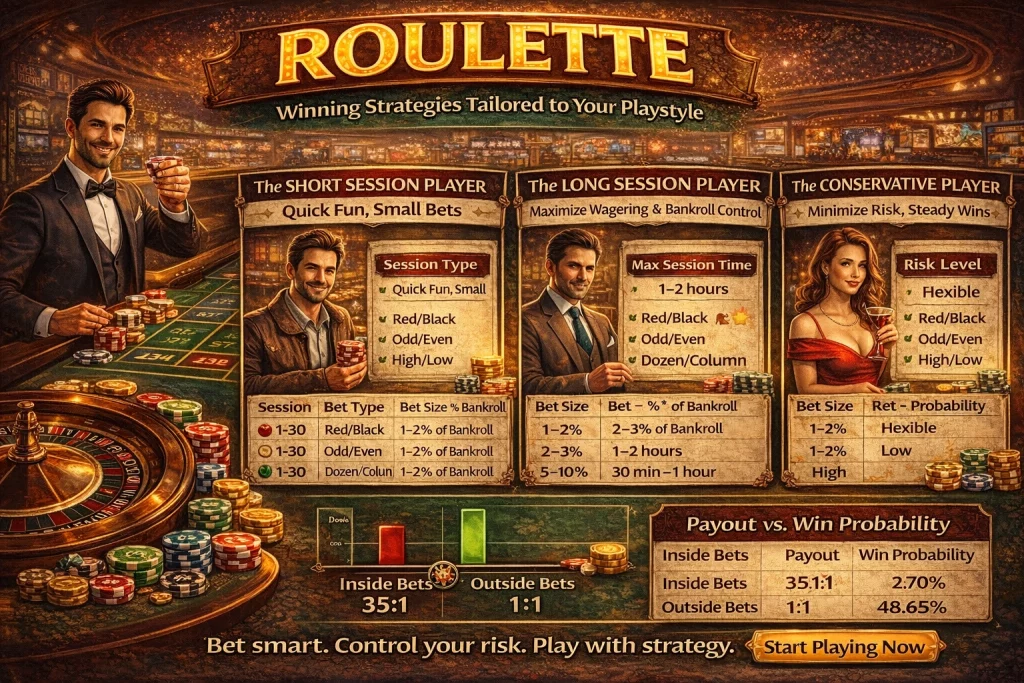
Every player approaches Roulette with different goals, whether it’s for short bursts of fun, long sessions, or a shot at big wins. The right strategy will depend on how much risk you’re willing to take, how long you plan to play, and how much of your bankroll you’re willing to wager.
Here, I’ll break down the most effective strategies for different types of players:
1. The Short Session Player: Quick Fun, Small Bets
For players who prefer quick, short bursts of play, focusing on Outside Bets is a good approach. These bets are less volatile, provide consistent outcomes, and allow you to play many rounds without risking too much of your bankroll.
Recommended Strategy:
- Bet Type: Focus on Red/Black, Odd/Even, or High/Low. These bets give you nearly a 50% chance of winning.
- Bet Size: Small bets — around 1% of your bankroll per round.
- Risk Level: Conservative (Low Risk).
- Session Time: 20–30 minutes max.
This strategy is great if you’re only looking to enjoy a few quick rounds. It minimizes volatility and keeps the game moving fast.
For players who enjoy longer sessions, it’s important to maintain a balanced approach that combines both Inside and Outside Bets. By alternating between higher-risk bets for potential big wins and safer bets for more consistent results, you can extend your playtime while keeping your bankroll protected. Monitoring your session carefully and adjusting bet sizes according to wins and losses helps maintain control and prevents emotional decisions from taking over.
Moreover, understanding your personal risk tolerance is key to long-term enjoyment. Some players prefer the thrill of high-stakes bets and are willing to accept more frequent losses, while others prioritize steady play with smaller payouts. Recognizing which category you fall into allows you to select strategies that align with your comfort level, ensuring that each Roulette session remains fun, engaging, and sustainable over time.
Short Session Strategy
| Session Type | Bet Type | Bet Size | Max Session Time | Risk Level |
|---|---|---|---|---|
| Quick Fun, Small Bets | Red/Black | 1–2% of Bankroll | 20–30 minutes | Low |
| Quick Fun, Conservative | Odd/Even | 1–2% of Bankroll | 20–30 minutes | Low |
| Casual Play | High/Low | 1–2% of Bankroll | 20–30 minutes | Low |
2. The Long Session Player: Maximizing Wagering and Bankroll Control
For players who enjoy longer sessions, Outside Bets (again) combined with Dozen/Column bets can offer a balanced approach. This provides a larger range of numbers, increasing the potential for frequent wins, and with Dozen/Column bets offering a 32% chance of winning, this is a good middle ground between risk and reward.
Recommended Strategy:
- Bet Type: Combination of Red/Black, Odd/Even, and Dozen/Column.
- Bet Size: Moderate bets — around 2–3% of your bankroll per round.
- Risk Level: Balanced (Medium Risk).
- Session Time: 1–2 hours max.
This strategy is ideal for longer sessions where you’re willing to risk a bit more in exchange for the potential of higher payouts.
Long Session Strategy
| Session Type | Bet Type | Bet Size | Max Session Time | Risk Level |
|---|---|---|---|---|
| Medium-Length Play | Red/Black | 2–3% of Bankroll | 1–2 hours | Medium |
| Longer Sessions | Odd/Even | 2–3% of Bankroll | 1–2 hours | Medium |
| Balanced Approach | Dozen/Column | 2–3% of Bankroll | 1–2 hours | Medium |
3. The High-Roller: Risking It All for Bigger Rewards
For those willing to embrace high volatility, Inside Bets offer a higher reward, though they come with greater risk. A more aggressive approach like the Martingale or James Bond strategies can also be used for high-risk players who are comfortable with larger bet sizes and potential losses.
Recommended Strategy:
- Bet Type: Focus on Straight-up, Split, or Street bets.
- Bet Size: Large bets — around 5–10% of your bankroll per round.
- Risk Level: High Risk.
- Session Time: 30 minutes to 1 hour max.
This strategy is perfect for high-rollers who are looking for the thrill of chasing bigger multipliers and high rewards.
High-Roller Strategy
| Session Type | Bet Type | Bet Size | Max Session Time | Risk Level |
|---|---|---|---|---|
| Aggressive High-Roller | Straight-up | 5–10% of Bankroll | 30 minutes–1 hour | High |
| Risk-Taking Approach | Split/Street | 5–10% of Bankroll | 30 minutes–1 hour | High |
| High-Risk Play | James Bond Strategy | 5–10% of Bankroll | 30 minutes–1 hour | High |
4. The Conservative Player: Minimizing Risk with Slow, Steady Wins
If you prefer to play cautiously and avoid big swings, a Low Risk approach is the best. Here, you can rely on Outside Bets and use a betting system like D’Alembert or Fibonacci, which provides a more gradual progression. The goal is to make small, consistent profits without exposing yourself to heavy losses.
Recommended Strategy:
- Bet Type: Stick to Red/Black, Odd/Even, and High/Low.
- Bet Size: Small bets — 1–2% of your bankroll per round.
- Risk Level: Very Low (Conservative).
- Session Time: Flexible, based on comfort level.
This strategy is best for players who prefer to play it safe, avoiding large risks and playing for longer durations with minimal volatility.
Conservative Strategy
| Session Type | Bet Type | Bet Size | Max Session Time | Risk Level |
|---|---|---|---|---|
| Safe, Steady Play | Red/Black | 1–2% of Bankroll | Flexible | Low |
| Conservative Strategy | Odd/Even | 1–2% of Bankroll | Flexible | Low |
| Low-Risk Approach | High/Low | 1–2% of Bankroll | Flexible | Lo |
When to Play Roulette and Why
Now that we’ve broken down the various strategies, the next question is: when should you play Roulette? Here are a few key moments when Roulette may be the perfect game for you:
- When You Want Fast-Paced Play: If you’re looking for a game that resolves quickly and gives you immediate feedback, Roulette is ideal. Each round lasts around 30 seconds, so it’s easy to play multiple sessions in a short amount of time.
- For Managing Wagering Requirements: If you’re completing a Bonus or Sign up offer that includes Roulette, this game is perfect for meeting wagering requirements quickly. The quick round times allow you to accumulate turnover efficiently.
- When You Prefer Low-Risk, Consistent Play: For players who enjoy Outside Bets and low-risk strategies like the D’Alembert system, Roulette provides a consistent experience without the long-term risk associated with higher-volatility games.
Final Thoughts on Roulette
Roulette is a thrilling game that combines luck, strategy, and excitement. While it’s important to remember that there’s no guaranteed way to win, having a solid strategy, managing your bankroll, and understanding the different bet types can give you an edge and help you enjoy the game to its fullest.
In summary:
• Use Outside Bets for low-risk, high-probability wins.
• Use Inside Bets if you’re after big payouts with higher volatility.
• Implement betting systems like Martingale or Fibonacci for structured risk management.
• Always have a Stop-Loss and Stop-Win limit to protect your bankroll.
Whether you’re playing Roulette for fun, clearing Bonus requirements, or aiming for big wins, there’s always a strategy that suits your style. Play responsibly and enjoy the game!






Comments