
Casino Licensing Explained
Casino Licensing Explained: Canada Player Safety Guide
Casino licensing is one of the main systems used to control how gambling operators are allowed to function. For Canada players, licensing is important because it helps explain who oversees a casino, what standards the operator may need to follow, and what protections may exist if something goes wrong. A licence does not make gambling risk-free, but it can create a clearer framework for accountability, fairness, responsible gambling, payment handling, and complaint review.
A licensed casino is expected to operate under rules set by a regulator or government-authorized body. These rules can cover identity checks, age restrictions, anti-money-laundering controls, responsible gambling tools, game fairness, payout integrity, advertising standards, and data protection. Without licensing or oversight, players may have fewer protections and fewer clear routes for complaints.
For Canada players, the licensing picture can be more complex than in countries with one central gambling regulator. Canada has a province-based gambling system. This means gambling law and operational oversight can vary depending on the province or territory. Ontario has a developed regulated iGaming market, while other provinces often rely more on government-operated lottery or gaming platforms.
What Casino Licensing Actually Means
A casino licence is official permission to operate under a defined gambling framework. It does not simply mean that a website looks professional or displays legal wording. A real licence should connect the operator to a regulator, jurisdiction, licence number or registration record, and specific operating standards.
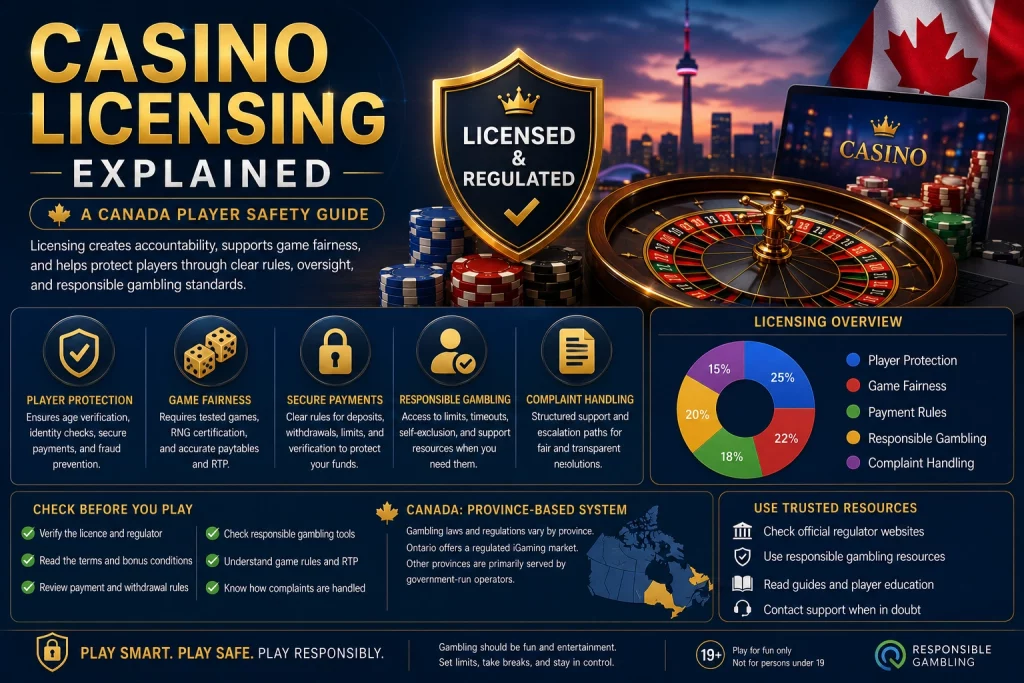
Licensing usually exists to protect the public interest. A regulator may require the operator to prove financial stability, protect player funds, apply identity checks, offer safer gambling tools, use tested games, and follow advertising rules. These requirements help reduce risk, but they do not remove the house edge, volatility, or the possibility of losing money.
In an educational context, Betty Casino can explain licensing as a player-safety topic rather than a promotional feature. The point is not to say that a licence makes a casino “perfect.” The point is that licensing gives readers a way to ask better questions: who regulates the platform, what standards apply, how complaints are handled, and whether responsible gambling tools are visible.
| Licensing Element | What It Means | Why It Matters for Canada Players |
| Regulator | The authority or approved body responsible for oversight. | Shows who sets rules and may review operator conduct. |
| Licence or registration | Formal permission to operate under specific standards. | Helps distinguish regulated activity from unclear or unsupported claims. |
| Player protection rules | Requirements around safer gambling, limits, age checks, and support. | Helps reduce harm and improves access to control tools. |
| Game fairness standards | Rules related to RNG, RTP, testing, and payout accuracy. | Supports technical integrity in casino games. |
| Complaint process | Steps for handling disputes, support issues, and escalation. | Gives players a clearer path when account or payment problems appear. |
Why Canada’s Licensing System Is Province-Based
Canada’s gambling framework is shaped by federal law and provincial authority. The federal Criminal Code sets the wider legal framework, but provinces and territories are responsible for conducting and managing gambling activity within their own systems. This creates a structure where gambling oversight is not identical across the country.
Ontario is the clearest example of an open regulated iGaming market in Canada. In Ontario, online gambling operators must meet registration and operating requirements under provincial oversight. In other provinces, online gambling is more often provided through government-run platforms or provincial lottery corporations.
This matters because a casino page should not imply that “licensed in Canada” means the same thing everywhere. A player in Ontario may face a different regulated environment than a player in British Columbia, Quebec, Alberta, or Manitoba. Educational content should explain that location matters and that readers should check the rules that apply to their own province or territory.
How Licensing Connects to Account Access
Licensing often affects how accounts are created and managed. A regulated platform may need to verify age, identity, location, and payment ownership. This can influence the account journey from Sign up to Login, because the platform must confirm that the user is eligible before allowing full access to gambling features.
These checks may feel administrative, but they serve important purposes. They help prevent underage gambling, reduce fraud, protect account ownership, and support responsible gambling controls. A platform that does not clearly explain account requirements may create confusion later, especially during withdrawals or verification reviews.
For Canada players, the practical lesson is that licensing is not only a legal label. It can affect real account procedures. If a site asks for verification, the user should be able to understand why the request exists, how documents are handled, and where privacy information is located.
Licensing and Casino Game Access
Licensing can also influence which Games are available, which providers are accepted, and what fairness standards apply. Regulated platforms may need to use approved suppliers, tested software, and documented game rules. This is especially relevant for digital Slots, live casino products, table games, and jackpot titles.
A licensed environment should make game information easier to evaluate. Players should be able to find rules, RTP data, provider information, bet limits, and responsible gambling controls. If a platform hides these details or presents them vaguely, the licensing claim becomes less useful from a practical perspective.
Game access should also be consistent across desktop and mobile App or browser use. Important rules should not disappear on smaller screens. Licensing standards are meaningful only when players can actually see and use the information that supports them.
Licensing, Bonuses, and Terms
Licensing can affect how promotions are written and presented. A Bonus should not be misleading, unclear, or presented as guaranteed value. Regulated environments often require clearer promotional terms, including wagering requirements, expiry dates, eligible games, maximum bet limits, and withdrawal restrictions.
This matters because bonus misunderstandings are common in online casino complaints. A player may see a headline offer but miss the rules that control how the promotion works. A responsible information page should explain that licensing does not make every bonus simple, but it can require better disclosure and fairer presentation.
For Canada players, the safest habit is to read terms before accepting any promotion. Promotional value should always be evaluated together with restrictions, wagering rules, and responsible gambling limits.
How Licensing Supports Player Protection
Casino licensing is not only about legal permission. It also supports player protection. A licensed operator may be required to follow standards for age verification, identity checks, anti-fraud monitoring, privacy, payment review, responsible gambling tools, and complaint handling. These systems do not make gambling risk-free, but they create a more structured environment.
For Canada players, this matters because an unregulated or unclear platform may not offer the same level of accountability. If terms are hidden, support is vague, or payments are delayed without explanation, it becomes harder for the player to understand what is happening. Licensing can make these processes more transparent by requiring policies and procedures.
| Protection Area | What Licensing Can Require | Why It Helps Players |
| Age verification | Checks that users meet the legal gambling age. | Helps prevent underage access. |
| Identity checks | Confirms that the account holder is real and eligible. | Reduces fraud and duplicate-account misuse. |
| Payment controls | Reviews deposits, withdrawals, and payment ownership. | Improves transaction security and account integrity. |
| Responsible gambling tools | Requires limits, timeouts, self-exclusion, or safer gambling resources. | Helps users manage risk and exposure. |
| Complaint handling | Sets expectations for support review and escalation. | Gives users clearer routes when disputes appear. |
Why Verification Is Part of Licensing
Verification is often one of the most visible effects of licensing. A player may be asked to provide identification, proof of address, payment ownership confirmation, or other documents. This can happen during registration, before a withdrawal, after account changes, or when risk systems identify unusual activity.
These checks are not designed to frustrate users. They are part of compliance, fraud prevention, and player protection. A licensed platform must usually know who is using the account, whether the user is old enough, and whether payment activity belongs to the same person.
The important factor is transparency. A responsible platform should explain why verification is required, what documents may be accepted, how data is handled, and how long review may take. If the platform gives no explanation, the process feels arbitrary.
Licensing and Payment Transparency
Payment transparency is another important part of licensing. A regulated or properly supervised platform should explain deposit rules, withdrawal rules, processing times, limits, fees, accepted methods, and verification requirements. These details help users understand the difference between a game payout and a withdrawal request.
A game payout is a result credited inside the casino balance. A withdrawal is a request to send available funds to an external payment method. Licensing can affect how withdrawals are reviewed because operators may need to check identity, payment ownership, responsible gambling risks, and bonus conditions before approving funds.
For Canada players, the practical lesson is to read cashier rules before using a platform. Clear payment policies are a stronger trust signal than fast promises.
Licensing and Responsible Gambling Tools
Responsible gambling tools are a core part of modern licensing expectations. These tools may include deposit limits, loss limits, session reminders, timeout options, self-exclusion, and access to support resources. Their purpose is to help users reduce harm and maintain control.
A licensed platform should not hide these tools. They should be easy to find in account settings, help pages, and responsible gambling sections. If a user has to search deeply to find limits or exclusion options, the platform’s practical transparency is weaker.
Educational content should present these tools as normal safeguards, not as emergency-only features. Limits are most useful before a problem appears.
Licensing Protection Flow
Why Licensing Does Not Guarantee a Perfect Experience
A licence can improve accountability, but it does not guarantee that every player experience will be smooth. Verification can still take time. Withdrawals can still be reviewed. Support teams can still request more information. Games can still produce losses. Bonuses can still include restrictions.
This is why licensing should be understood realistically. It provides a framework, not a guarantee of comfort. A licensed platform may still receive complaints, and an individual complaint does not automatically mean the licence is meaningless. The more useful question is how the operator responds: clearly, consistently, and within documented procedures.
For Canada players, this balanced view is important. Licensing helps create rules, but users still need to read terms, use limits, and understand gambling risk.
| Fairness Area | What Licensing May Require | Why It Matters |
| RNG testing | Review of random number generation in digital games. | Helps confirm that results are unpredictable and not manually controlled. |
| RTP validation | Review of theoretical long-term return models. | Supports clearer understanding of game mathematics. |
| Paytable accuracy | Checks that displayed payout values match settlement logic. | Reduces confusion around wins, losses, and feature payouts. |
| Provider approval | Use of recognized or approved game suppliers. | Supports stronger technical consistency and accountability. |
| Game rule transparency | Clear access to limits, mechanics, features, and payout rules. | Helps users understand a game before opening it. |
Why Testing Laboratories Matter
Testing laboratories review gaming systems from a technical point of view. Their work may include RNG analysis, mathematical model review, payout verification, jackpot logic testing, and software stability checks. This kind of review helps confirm that a game is not simply relying on a claim of fairness, but has been examined against defined standards.
For readers, the practical point is not to memorize every laboratory name. The useful habit is to check whether fairness claims are specific. A vague statement such as “all games are fair” is weaker than clear information about providers, testing, RTP, and rules. Licensing is stronger when it is connected to verifiable details.
Betty Casino can explain this carefully as an educational point: fairness testing supports integrity, but it should not be used as a promotional promise. Players still need realistic expectations.
Licensing and Advertising Standards
Licensing can also influence how casinos advertise. Regulated environments may require promotions to be clear, accurate, and not misleading. This is especially relevant for bonuses, jackpots, “risk-free” language, and claims about winnings. Gambling advertising should not suggest guaranteed profit or minimize financial risk.
For Canada players, advertising standards matter because promotional language can distort expectations. A large headline offer may look simple, but terms can include wagering requirements, expiry periods, maximum bet limits, eligible games, and withdrawal restrictions. Licensing can help require clearer disclosure, but players still need to read the details.
An educational licensing page should explain that marketing should be reviewed critically. A regulated message may still be promotional, and promotional language should always be balanced against terms and responsible gambling information.
Licensing and Complaint Escalation
A licensing framework can give players clearer options when problems occur. The first step is usually the casino’s internal support process. If the issue is not resolved, a licensed environment may provide additional complaint or escalation routes depending on the jurisdiction.
Common complaints involve delayed withdrawals, rejected documents, unclear bonus terms, account restrictions, technical errors, or disagreement over game settlement. A strong platform should explain how complaints are submitted, what information is needed, and what timeframe may apply.
For Canada players, documentation helps. Screenshots, transaction IDs, support transcripts, and account notices can make review easier. Licensing does not guarantee that every complaint will be resolved in the player’s favour, but it can create a more structured process.
Why Players Should Verify Licensing Claims
Players should not rely only on logos or footer text. A licensing claim should be checked through official or credible sources where possible. The platform should identify the operator, licensing body, registration number where applicable, responsible gambling information, and terms of service.
If a site does not explain who operates it, where it is licensed, or how complaints are handled, that is a weak transparency signal. Even if the website looks professional, unclear licensing information makes it harder to evaluate accountability.
A useful FAQ section and transparent information Links can help readers understand where to check licensing, terms, payment rules, and safer gambling resources before trusting the platform.
Licensing Resources and Final Safety Checklist
Casino licensing becomes easier to understand when readers know where to look for reliable information. Canada players should not rely only on casino footer text, badges, or marketing claims. A stronger approach is to compare licensing statements with official regulator pages, responsible gambling resources, testing references, and the platform’s own terms.
| Authoritative Resource | What It Helps Explain | Link |
| AGCO | Ontario gaming standards, operator registration, and player protection information. | Read source |
| iGaming Ontario | Ontario’s regulated online gaming market and operator framework. | Read source |
| Responsible Gambling Council | Education on safer gambling, prevention, and player-support resources. | Read source |
| Canadian Centre on Substance Use and Addiction | Research and public-health information related to gambling harms and addiction. | Read source |
| Gaming Laboratories International | Testing and certification information for gaming systems and technical standards. | Read source |
Casino Licensing Overview
How to Check a Casino Licence Carefully
A practical licence check starts with the operator information. Canada players should look for the legal company name, licensing body, registration or licence number where available, jurisdiction, responsible gambling information, and complaint process. If this information is vague or missing, the platform is harder to evaluate.
The second step is consistency. The licensing details in the footer should match the terms and conditions, privacy policy, payment pages, and responsible gambling section. If different pages give conflicting information, that is a weak trust signal.
The third step is official verification. Where possible, readers should check the regulator’s official website or public register. A logo alone is not enough. Licensing is strongest when the claim can be traced to a credible authority.
Why Licensing Should Be Read With Terms
A licence does not replace the need to read terms. Terms explain how the platform handles registration, verification, bonuses, payments, withdrawals, inactive accounts, complaints, and responsible gambling tools. Licensing creates a framework, while terms explain how that framework appears in the user experience.
This is especially important for payment rules and promotional conditions. A licensed platform may still apply verification reviews, withdrawal limits, bonus restrictions, and document requests. These processes can be legitimate when clearly explained, but they become frustrating when the user does not read the terms in advance.
For Canada players, licensing and terms should be reviewed together. One shows oversight; the other shows practical rules.
Final Practical Checklist for Canada Players
Before trusting a casino licensing claim, readers should check whether the operator is named, whether the licensing body is clear, whether official verification is possible, whether responsible gambling tools are visible, whether payment rules are specific, whether game fairness information is available, and whether complaint steps are explained.
Players should also avoid treating licensing as a guarantee of positive results. Licensed games can still have house edge, volatility, and random outcomes. The purpose of licensing is accountability and standards, not guaranteed financial return.
Casino licensing explains who oversees an operator, what standards may apply, and what protections may exist for players. In Canada, licensing must be understood carefully because gambling oversight varies by province and territory.
For Canada players, the best approach is to verify claims, read terms, check responsible gambling tools, review game fairness information, and understand complaint pathways. Betty Casino can present licensing responsibly by focusing on education, transparency, and player protection rather than promotional promises.






Comments