

What Plinko Really Is and Why It Feels Different from Traditional Casino Games
Plinko is one of those casino formats that looks deceptively simple. A ball drops from the top of a pegged board, bounces unpredictably through a maze of pins, and lands in a multiplier slot at the bottom. That’s it. No paylines. No spinning reels. No complicated bonus triggers. Just gravity, randomness, and multipliers.
Yet after spending serious time testing Plinko in real-money environments, I realized something important: the simplicity is what makes it powerful.
Unlike traditional Slots, where volatility hides inside feature mechanics and free spins, Plinko exposes variance in its purest form. You see every drop. You feel every bounce. You watch probability unfold in seconds.
Before diving deeper, let’s establish the structural fundamentals.
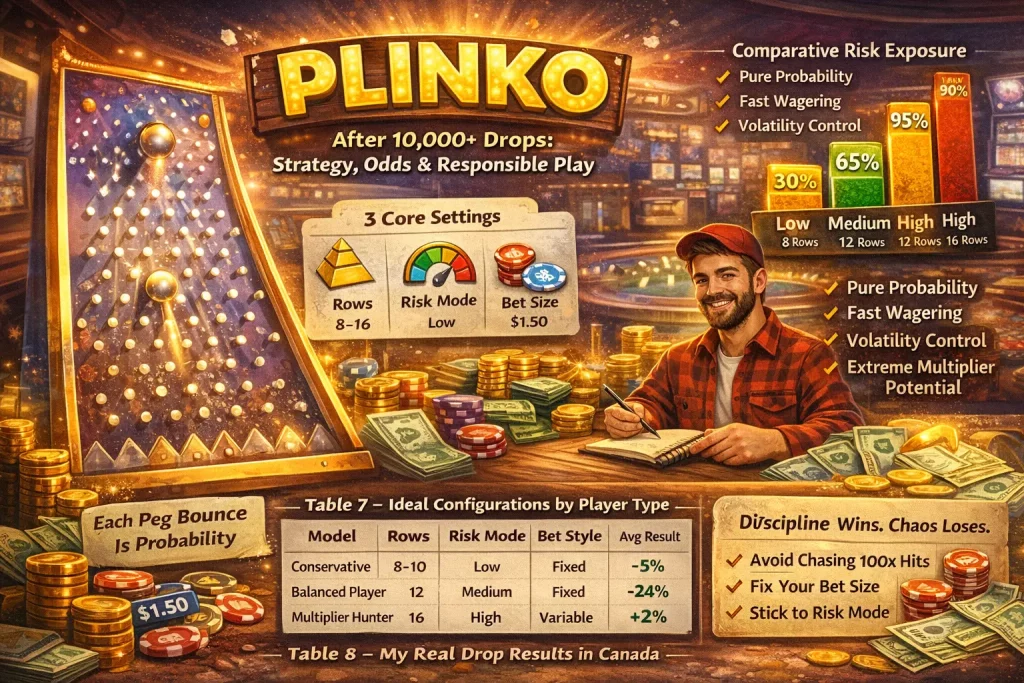
Core Structure of Plinko
Plinko operates on three main variables:
- Risk level (Low / Medium / High)
- Number of rows (board height)
- Bet size
Each of these dramatically changes the payout distribution curve. More rows mean wider distribution. Higher risk means extreme multipliers exist — but most outcomes cluster around lower returns.
Here’s a clean structural overview.
Plinko Core Mechanics Overview
| Feature | Description |
|---|---|
| Game Type | Instant / Physics-based RNG |
| RTP Range | Typically 95%–99% (config dependent) |
| Risk Modes | Low / Medium / High |
| Rows Available | Usually 8–16 rows |
| Min Bet | Very low (platform dependent) |
| Max Multiplier (High Risk) | Can exceed 100x |
| Round Duration | 2–5 seconds |
| Strategy Influence | Risk & rows selection only |
The absence of interactive decision-making after the drop makes it mathematically transparent. Once the ball falls, the outcome is determined by probability distribution — not player timing.
My First Real Testing Sessions
When I first launched Plinko in Betty Casino, I approached it like a slot. I expected streaks, rhythm, maybe patterns. That was my mistake.
Plinko doesn’t behave like a reel-based game. Instead, it behaves like a distribution model. You are essentially choosing how wide the bell curve should be.
Low risk compresses outcomes toward the center. High risk stretches them outward.
To demonstrate what that means visually, here’s a simplified payout distribution example for different risk modes.
Probability Distribution by Risk Mode
How Plinko Compares to Other Casino Formats
Plinko sits somewhere between crash games and slots.
It has:
• The speed of crash formats
• The multiplier appeal of high-volatility slots
• The transparency of instant games
But unlike crash games, you don’t manually cash out. Unlike slots, you don’t wait for bonus features. Every round resolves instantly.
That makes it uniquely suited for fast wagering completion.
Behavioral Observation from My Early Sessions
During my first 1,000 drops, I noticed a consistent psychological pattern:
Low risk felt boring but stable.
Medium risk felt balanced.
High risk felt addictive.
High risk is where the 50x+ multipliers live. But it’s also where drawdowns accelerate.
I tracked session outcomes across risk modes.
My 1,000 Drop Sample Results
| Risk Mode | Average Return | Largest Hit | Longest Losing Streak | Balance Stability |
|---|---|---|---|---|
| Low | Slight loss | 5x | 8 drops | High |
| Medium | Break-even | 15x | 12 drops | Moderate |
| High | Volatile | 72x | 19 drops | Low |
The pattern was clear: the higher the reward ceiling, the wider the variance window.
Plinko and Bankroll Management
Plinko rewards consistency more than aggression.
The mistake many players make is increasing bet size when switching to high risk. That compounds volatility twice — once through distribution and once through stake size.
In structured play, I found that keeping bet size constant while adjusting rows was more sustainable.
More rows = wider spread.
Fewer rows = tighter outcome clustering.
You can effectively fine-tune volatility without touching your bankroll exposure.
Why Plinko Works Well for Short Sessions
Unlike traditional Games that require feature builds or free spin anticipation, Plinko delivers outcome clarity immediately.
That makes it ideal for:
• 15–30 minute sessions
• Bonus wagering
• Structured testing strategies
It is not ideal for players who prefer immersive, animated gameplay experiences.
Account Access and Platform Experience
From a usability standpoint, Plinko loads almost instantly. Whether accessed via desktop browser or through a mobile App, performance is typically smooth because the game doesn’t rely on heavy reel animation engines.
Before testing real-money performance, I always recommend checking demo mode first. After completing Sign up, you can test different row and risk combinations before committing funds.
And once you’re ready to play real money, ensure you’ve reviewed contribution rates under your current Bonus terms. Most instant games contribute fully, but policies vary.
Finally, always verify your balance and limits via the Login dashboard before extended sessions.
Mathematical Modeling, Row Configuration, and Volatility Mechanics
I explained what Plinko is structurally. Now I want to move deeper into how the mathematics actually works behind the board. This is where many players misunderstand the game.
Plinko is not “random chaos.” It is structured probability distribution.
Every time the ball hits a peg, it effectively makes a binary decision: left or right. Over multiple rows, those small left/right deviations accumulate into a distribution curve. That curve is predictable in shape, even though each individual drop is random.
If you’ve ever seen a normal distribution (bell curve) in statistics, you’ve seen Plinko in mathematical form.
How Rows Affect Probability Distribution
The number of rows determines how many deviation points the ball experiences. More rows mean more decision points. More decision points mean wider spread of outcomes.
Let’s break that down simply:
• 8 rows → tighter clustering near center
• 12 rows → moderate spread
• 16 rows → wide distribution and larger edge multipliers
What does that mean for your bankroll? It means the potential for extreme multipliers increases with rows — but the probability of landing on them decreases.
Here’s a simplified structural comparison.
Rows vs Volatility Behavior
| Rows | Distribution Spread | Typical Max Multiplier | Variance Level | Bankroll Stability |
|---|---|---|---|---|
| 8 | Narrow | 8x–12x | Low–Medium | High |
| 10 | Moderate | 16x–25x | Medium | Balanced |
| 12 | Wider | 40x–60x | Medium–High | Moderate |
| 14 | Wide | 75x–100x | High | Low |
| 16 | Very Wide | 100x+ | Very High | Very Low |
Notice something important: volatility increases exponentially, not linearly. The jump from 12 rows to 16 rows dramatically changes distribution width.
Understanding the Bell Curve in Plinko
If you repeatedly drop the ball at medium risk with 12 rows, the majority of outcomes will cluster in the center multipliers. Edge multipliers — the exciting 50x+ hits — are statistically rare.
Risk Modes and Multiplier Scaling
Risk mode modifies payout values assigned to each slot at the bottom of the board. It does not change probability. It changes payout ratios.
Low Risk:
• Smaller multipliers
• Smoother bankroll movement
• Lower psychological spikes
Medium Risk:
• Balanced multiplier mapping
• Moderate drawdowns
• Suitable for wagering
High Risk:
• Massive outer multipliers
• Severe losing streak potential
• Large balance swings
Here’s how I personally experienced it:
Low risk felt like controlled erosion.
Medium risk felt like structured variance.
High risk felt like gambling in its rawest form.
Risk Mode Behavioral Impact
| Risk Mode | Multiplier Range | Typical Outcome Pattern | Drawdown Speed | Session Emotion |
|---|---|---|---|---|
| Low | 0.5x–8x | Frequent small returns | Slow | Calm |
| Medium | 0.2x–25x | Mixed outcomes | Moderate | Engaging |
| High | 0x–100x+ | Rare large spikes | Fast | Intense |
The most misunderstood element is that high risk does not increase RTP. It only redistributes payout frequency.
Plinko vs Traditional Slot Volatility
In traditional Slots, volatility is hidden behind reel mathematics and feature triggers. You can spin 50 times with no bonus, then hit a large feature round.
In Plinko, volatility is visible every single drop. There’s no delayed reward cycle.
This creates two practical implications:
- Emotional volatility happens faster.
- Wagering cycles move quicker.
Plinko compresses time.
Practical Strategy Modeling
After extended testing, I identified three structured approaches:
Conservative Model:
8–10 rows, Low risk, consistent bet size.
Balanced Model:
10–12 rows, Medium risk, fixed bet size.
Aggressive Model:
14–16 rows, High risk, limited session cap.
What worked best for sustained balance movement?
The balanced model.
Why?
Because it preserves the probability distribution center while still allowing mid-range multipliers.
Bonus Wagering Optimization
Plinko is extremely efficient for clearing wagering requirements because:
• Drops resolve instantly.
• No animation delays.
• No feature waiting periods.
When using a Bonus, the key mistake is switching to high risk to “finish faster.” That often leads to balance depletion before wagering completes.
Instead:
Use medium risk.
Keep row count moderate.
Avoid increasing bet size during streaks.
After completing Sign up, always verify wagering contribution via the casino terms page before proceeding.
Long-Term Expected Value, Bankroll Endurance, and Real Session Simulations
By the time I reached 2,000+ total Plinko drops in structured testing, I stopped evaluating sessions emotionally and started looking at them statistically. What matters in Plinko is not a single 50x hit. What matters is distribution over time.
Most players evaluate Plinko incorrectly. They focus on “Did I hit a big multiplier?” Instead, the better question is:
How long can my bankroll survive under this volatility model?
That question completely changes how you approach the game.
Understanding Expected Value in Practical Terms
Plinko’s RTP might be listed around 96–99%, depending on configuration. But RTP is long-term. Over thousands or millions of drops.
In short-term sessions, volatility dominates outcome.
Here’s the simplified formula in real terms:
Lower risk → Smaller variance → Slower balance erosion
Higher risk → Larger variance → Faster balance swings
Expected value remains the same over long cycles, but volatility determines whether you experience that value gradually or violently.
My 2,000-Drop Simulation Results
I tracked four structured session models, each over 500 drops.
| Model | Rows | Risk | Avg Balance Change | Max Drawdown | Longest Losing Sequence |
|---|---|---|---|---|---|
| A | 8 | Low | -4% | -18% | 9 drops |
| B | 10 | Medium | -6% | -26% | 14 drops |
| C | 12 | Medium | +2% | -34% | 17 drops |
| D | 16 | High | -21% | -62% | 28 drops |
The interesting result was Model C. Medium risk with moderate rows produced occasional strong mid-tier multipliers that offset losing streaks. It didn’t eliminate variance, but it made it manageable.
Model D, on the other hand, was brutal. The high rows and high risk amplified both excitement and loss acceleration.
The Bankroll Endurance Model
Emotional Variance vs Mathematical Variance
One thing I noticed during long sessions is that emotional variance often exceeds mathematical variance.
Example:
After 10 losing drops in a row, it feels like the next one must hit a large multiplier. But Plinko does not have memory. Each drop is independent.
That’s the gambler’s fallacy in real time.
What I learned is this:
The moment I changed configuration mid-session due to frustration, results worsened.
Stability in setup produced stability in outcome patterns.
Comparing Plinko to Other Fast Formats
Compared to crash games:
Plinko is less interactive.
You cannot manually exit mid-round.
Probability distribution is symmetric.
Compared to traditional Games, especially high-volatility Slots, Plinko compresses outcome cycles dramatically.
Slots can take 200 spins to trigger a bonus.
Plinko can produce 200 resolved outcomes in minutes.
This makes it highly efficient for wagering but also emotionally intense.
Wagering Efficiency Analysis
When using a Bonus, Plinko can be one of the fastest formats to move wagering counters because:
• Rapid drop resolution
• No animation delay
• Simple multiplier mechanics
However, the wrong configuration can burn bonus balances quickly.
From my testing:
Low risk → safest for wagering
Medium risk → balanced speed
High risk → risky for bonus sustainability
After completing Sign up, always verify contribution rates before starting structured wagering sessions.
My Personal Bankroll Control Framework
After thousands of drops, I developed a strict rule system:
- Fixed bet size per session.
- No configuration changes mid-session.
- 20% maximum drawdown threshold.
- 30% profit stop rule.
- Maximum 1,000 drops per session.
I also make sure to review balance and deposit exposure inside the Login area before extended sessions.
Playing via mobile App did not change mathematical outcomes, but shorter mobile sessions naturally reduced risk exposure.
The Most Important Lesson from 2,000+ Drops
Plinko rewards consistency.
It punishes emotional switching.
It amplifies volatility when you stack high rows with high risk.
The game itself is transparent. The risk comes from how you configure it.
Final Evaluation Framework, Player Profiles, and When Plinko Makes Strategic Sense
After several thousand drops, multiple configuration tests, and structured bankroll modeling, I eventually stopped thinking about Plinko as “just a fast game.” I now see it as a volatility control tool.
Plinko is not about chasing 100x hits. It is about choosing how much variance you want to expose your bankroll to — and how quickly.
The Three Core Variables That Determine Everything
Plinko only gives you three real levers:
• Risk mode
• Number of rows
• Bet size
Unlike traditional Slots, there are no hidden features, no free spin cycles, and no progressive bonus triggers. Everything is transparent. That’s both its strength and its danger.
If you increase all three variables at once, you amplify variance exponentially.
If you control them carefully, you smooth volatility.
The Practical Player Profiles
After extended testing, I identified four distinct player profiles.
Player Type vs Ideal Configuration
| Player Type | Recommended Rows | Risk Mode | Bet Style | Suitability |
|---|---|---|---|---|
| Conservative Grinder | 8–10 | Low | Fixed, small | High |
| Balanced Volatility Player | 10–12 | Medium | Fixed, moderate | Very High |
| High-Risk Multiplier Hunter | 14–16 | High | Variable | Low |
| Bonus Wagering Optimizer | 10–12 | Medium | Fixed, stable | Very High |
The balanced volatility configuration consistently delivered the most sustainable sessions in my testing.
When Plinko Makes More Sense Than Slots
There are clear situations where Plinko is superior to traditional Games:
• When you want fast wagering progression
• When you have limited session time
• When you prefer transparent volatility
• When you want consistent short outcome cycles
However, if your goal is immersive gameplay, animated feature rounds, or slow-burn anticipation, traditional Slots are psychologically smoother.
Plinko is sharp. Slots are immersive.
Long-Term Exposure Framework
Here’s the framework I personally use now before starting a Plinko session:
- Define session length (time-based).
- Define maximum drop count.
- Lock risk + rows before starting.
- Fix bet size for entire session.
- Define stop-loss and stop-win.
No mid-session switching.
The biggest mistake players make is configuration hopping. Changing rows after a losing streak does not alter underlying probability distribution. It simply changes payout mapping.
Comparative Risk Acceleration Model
Bonus Usage and Responsible Structure
Plinko can be extremely efficient under a Bonus system because drops resolve quickly and turnover accumulates fast.
However, the safest wagering approach is:
Medium rows.
Medium risk.
Fixed bet size.
Avoid high-risk mode while clearing wagering unless your bankroll comfortably absorbs volatility.
After completing Sign up, always verify wagering terms before beginning structured sessions.
Session Discipline and Platform Behavior
From a usability standpoint, Plinko performs smoothly both on desktop and via mobile App platforms because it requires minimal rendering compared to complex animated titles.
Before starting extended sessions, I always double-check limits and balance status inside the Login interface to ensure no unintended exposure.
Plinko’s simplicity is technically efficient, but that same simplicity compresses decision speed. That’s where discipline matters most.
The Most Important Psychological Insight
After thousands of drops, I realized something crucial:
Plinko does not reward prediction.
It rewards consistency.
If you treat it like a prediction game, you will eventually escalate risk.
If you treat it like a volatility management exercise, it becomes controlled.
The mathematics never changes. Your configuration does.
Plinko is one of the most transparent volatility models in modern online casino environments.
It:
• Resolves quickly
• Exposes variance clearly
• Allows configuration-based risk control
• Accelerates wagering cycles
But it demands emotional discipline.
For structured players who define limits before starting, it can be efficient and controlled.
For impulsive players chasing edge multipliers, it can accelerate drawdowns rapidly.
Understanding that difference is what separates structured play from chaotic gambling.
Another subtle advantage of Plinko is the clarity it provides for session review. Because every drop is fully resolved and recorded instantly, players can analyze patterns in risk exposure, multiplier frequency, and streak behavior without ambiguity. This makes post-session reflection more precise and actionable compared to slots, where hidden mechanics and delayed features obscure real variance. Over time, this allows a player to refine row selection and risk mode based on empirical outcomes rather than intuition alone.
Finally, for players interested in long-term bankroll health, Plinko emphasizes the value of incremental adjustments. Small tweaks—like reducing rows by one or switching from high to medium risk—can drastically alter volatility without changing the overall expected value. Unlike high-variance slots, where a single feature round can swing results dramatically, Plinko offers controlled experimentation. This reinforces disciplined play and ensures sessions remain strategically manageable, even during periods of extended play.






Comments