
Self Exclusion Canada Options
Self-exclusion is one of the strongest responsible gambling tools available to people who need a clear break from gambling access. For Canada players, self-exclusion can be useful when ordinary limits are not enough, when gambling feels difficult to control, or when repeated attempts to stop have not worked. It is not a punishment. It is a protective measure designed to create distance between the person and gambling activity.
In online gambling, access can be fast, private, and continuous. A user may return to a platform from a laptop, phone, or tablet without many physical barriers. This is why self-exclusion matters. It creates a structured block that helps reduce impulsive access during vulnerable moments. For someone dealing with gambling harm, that barrier can be more effective than relying only on willpower.
This guide is written for Betty Casino as an educational player-safety resource. Its purpose is to explain how self-exclusion works in Canada, what options may exist, when it may be appropriate, and how it fits with broader support such as counselling, financial safeguards, and responsible gambling tools. Self-exclusion does not solve every underlying issue by itself, but it can be an important first step toward stability.
What Self-Exclusion Means
Self-exclusion is a formal request to restrict access to gambling services for a selected period. Depending on the platform, province, or system, the exclusion may apply to one site, multiple connected platforms, a provincial gambling network, or land-based venues. The exact scope depends on where the person registers and which operator or regulator manages the exclusion system.
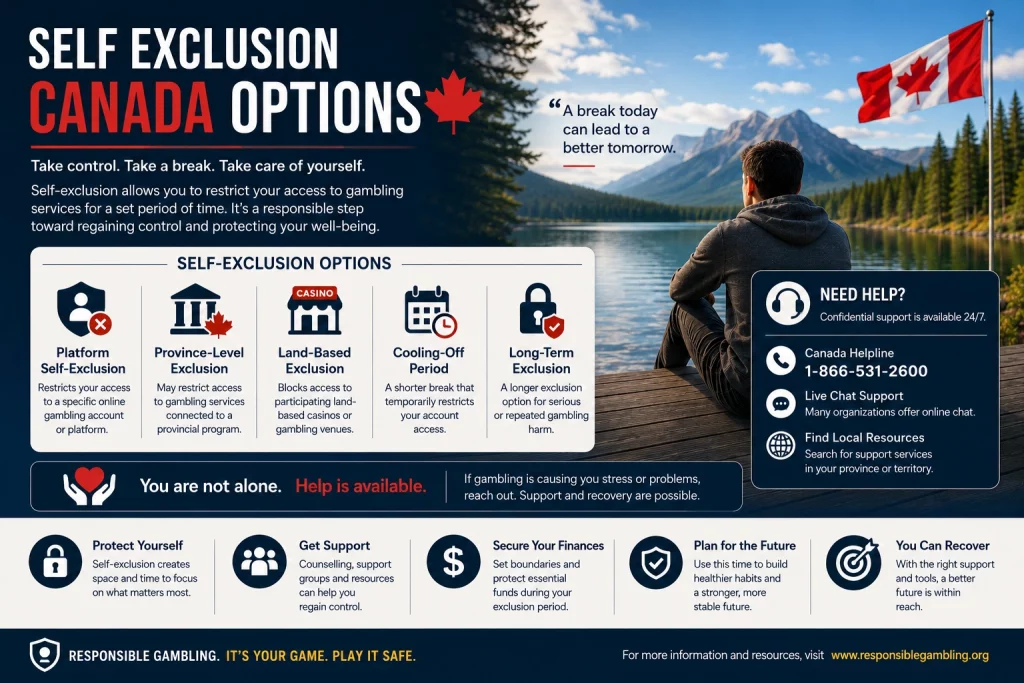
A self-exclusion period may be temporary or longer-term. Some options may last months, years, or indefinitely. During that time, the person should not be able to access gambling services covered by the exclusion. In many cases, accounts may be closed or suspended, promotional messages may stop, and withdrawals may be processed according to the platform’s rules.
For Canada players, the most important point is to understand the scope before activating the tool. A self-exclusion from one platform may not automatically cover every gambling website or venue. A province-level program may offer broader protection, but rules vary. Readers should check the exact terms and available options in their own province or on the specific platform.
| Self-Exclusion Option | What It Usually Means | When It May Help |
| Platform self-exclusion | Blocks access to one specific online gambling account or platform. | Useful when gambling harm is connected to a particular site. |
| Province-level self-exclusion | May restrict access to gambling services connected to a provincial program. | Useful when broader protection is needed within a regulated local framework. |
| Land-based venue exclusion | Blocks access to participating physical casinos or gambling venues. | Useful when harm includes in-person gambling activity. |
| Cooling-off period | A shorter break that temporarily restricts account access. | Useful after emotional play, repeated losses, or temporary stress. |
| Permanent or long-term exclusion | A stronger access block intended for serious or repeated gambling harm. | Useful when shorter breaks have not been enough to restore control. |
When Self-Exclusion May Be Appropriate
Self-exclusion may be appropriate when gambling feels difficult to stop, when losses are being chased, when essential money is being used, or when gambling affects sleep, work, study, relationships, or mental health. It may also be appropriate when a person repeatedly sets personal limits but breaks them during emotional sessions.
A common sign is returning to gambling after deciding not to. Another sign is making repeated deposits after losses because recovery feels urgent. If gambling begins to feel necessary rather than optional, stronger access restriction may be needed. Self-exclusion can create distance at the moment when personal control feels unreliable.
Betty Casino can explain self-exclusion as part of a responsible safety framework. A user should not feel that exclusion is only for extreme cases. It can be used early, especially when gambling behaviour starts becoming stressful or difficult to manage.
How Self-Exclusion Connects to Account Access
Self-exclusion is closely connected to account access. A user may usually find responsible gambling tools after Login, inside account settings or a dedicated safety section. Some platforms may also mention access restrictions during Sign up, especially where age checks, eligibility rules, or player-protection terms are explained.
Once self-exclusion is activated, the account may become unavailable for gambling activity. Depending on the rules, the user may not be able to reverse the exclusion early. This is intentional. If the tool could be cancelled easily during an urge to gamble, it would lose much of its protective value.
Users should read the self-exclusion terms carefully before confirming. They should check how long the block lasts, whether promotional messages stop, how remaining account balances are handled, and whether the exclusion applies only to one platform or a wider network.
Difference Between Cooling-Off and Self-Exclusion
A cooling-off period is usually a shorter pause. It may last hours, days, or weeks depending on the platform. It can be useful after a stressful session, repeated losses, or emotional play. It creates temporary distance but may not be strong enough for someone experiencing repeated loss of control.
Self-exclusion is usually stronger. It is designed for longer-term protection and may be harder or impossible to cancel before the selected period ends. This makes it more suitable for users who have already tried ordinary limits or short breaks without success.
The safest way to explain the difference is simple: cooling-off is a pause; self-exclusion is a protective barrier. Both can help, but they serve different levels of risk.
Why Self-Exclusion Should Be Combined With Support
Self-exclusion reduces access, but it does not automatically resolve the emotional, financial, or behavioural reasons behind gambling harm. For that reason, it works best when combined with support. A person may also need counselling, peer-support meetings, financial planning, debt guidance, or help from a trusted friend or family member.
If someone self-excludes but still feels strong urges to gamble, outside support is especially important. The exclusion creates space, but recovery requires new coping strategies. Without support, a person may look for other gambling opportunities not covered by the exclusion.
A responsible guide should encourage self-exclusion as part of a wider plan, not as a complete solution by itself.
How Self-Exclusion Works in Practice
Self-exclusion usually begins with a formal request from the user. On an online platform, this may happen through account settings, responsible gambling tools, live support, or a dedicated safety page. In some province-level systems, the user may need to register through an official gambling authority or approved program. The exact process can vary, so Canada players should always read the rules attached to the specific exclusion option.
Once activated, self-exclusion normally prevents the user from gambling through the covered account or system. The account may be locked, restricted, or closed for gambling activity. Promotional communication may also be stopped where the platform’s rules allow or require it. If there is a remaining balance, the casino may process it according to account terms, verification requirements, and applicable payment rules.
Self-exclusion is meant to be difficult to reverse during the selected period. This is important because gambling urges can be temporary but intense. If the tool could be cancelled instantly, it would not provide strong protection during vulnerable moments.
| Process Step | What Usually Happens | Why It Matters |
| Request | The user selects or asks for self-exclusion through account tools or support. | Creates a formal record of the decision to restrict gambling access. |
| Confirmation | The platform may ask the user to confirm duration and acknowledge terms. | Helps ensure the user understands the effect and scope of the restriction. |
| Access restriction | The account is blocked or limited for gambling activity. | Reduces impulsive return during high-risk moments. |
| Promotion control | Marketing communication may be stopped or reduced where applicable. | Limits triggers that could encourage return behaviour. |
| End-of-period review | Some systems may require a waiting period or review before access returns. | Prevents automatic return without reflection or safety checks. |
What to Check Before Activating Self-Exclusion
Before activating self-exclusion, users should check the duration, scope, account effects, balance handling, and reactivation conditions. The duration tells how long the restriction lasts. The scope explains whether it applies only to one account, one brand, several connected platforms, or a broader provincial system. Balance handling explains what happens to available funds. Reactivation rules explain whether the account can be reopened after the period ends.
This step is important because not all exclusions work the same way. A platform-level exclusion may not prevent access to unrelated gambling sites. A province-level program may offer broader coverage, but it may also require separate registration and specific identification. A land-based casino exclusion may not automatically apply to online activity unless the program says so.
A clear help page should explain these differences without making the process sound complicated. The goal is to help users choose the right level of protection.
Why Marketing Triggers Matter
Self-exclusion is more effective when marketing triggers are reduced. Promotional emails, push notifications, bonus reminders, and account messages can encourage return behaviour. If someone is trying to create distance from gambling, these messages may become a problem.
A responsible platform should take reasonable steps to stop gambling-related promotional communication after self-exclusion. Users can also protect themselves by turning off notifications, unsubscribing where possible, blocking gambling emails, and removing gambling-related shortcuts from devices.
A Bonus offer can be especially risky for someone trying to stop gambling because it may create urgency or the feeling of missed value. The safer approach is to treat promotional triggers as part of the exclusion plan, not as a separate issue.
Self-Exclusion and Mobile Access
Mobile access can weaken self-control because gambling is available quickly and privately. A user may not need to sit at a desktop or visit a venue. This makes self-exclusion especially relevant for users who gamble through an App or mobile browser.
When self-exclusion is activated, users should also review device-level risks. Removing gambling apps, deleting saved passwords, disabling payment autofill, and blocking gambling-related notifications can create extra barriers. These steps do not replace official self-exclusion, but they can strengthen it.
For Canada players, mobile safety should be part of the plan. If the harmful pattern usually happens late at night or during stress, reducing mobile access can be one of the most useful practical steps.
Self-Exclusion Support
How Self-Exclusion Affects Games and Account Activity
During self-exclusion, access to gambling activity should be restricted. This means the user should not be able to open Slots, table products, live casino rooms, or other Games covered by the exclusion. The exact effect depends on the platform and the exclusion scope, but the purpose is consistent: prevent gambling access during the selected period.
Account activity may still need to be handled for non-gambling reasons. For example, a user may need to withdraw an available balance, receive account communication about the exclusion, or complete verification required for payment. These actions should be managed through support and account rules, not through continued gambling access.
This distinction matters. Self-exclusion is not meant to block legitimate account resolution. It is meant to stop gambling activity.
Self-Exclusion and Support Resources in Canada
Self-exclusion is stronger when it is connected to support outside the gambling account. Blocking access can reduce immediate risk, but many people also need help with urges, stress, debt pressure, secrecy, or repeated return behaviour. For Canada players, the safest approach is to treat self-exclusion as one part of a wider recovery plan.
A person who self-excludes may still experience gambling thoughts or emotional triggers. This does not mean the tool has failed. It means the exclusion is doing one part of the work: limiting access. The next part is building support around the person so they are not relying only on account restrictions.
Support may include counselling, peer groups, helplines, financial planning, trusted family members, or addiction services. The right option depends on the person’s situation, but early help is usually easier than waiting until financial or emotional harm becomes severe.
| Support Resource | Type of Help | Link |
| Responsible Gambling Council | Education, prevention resources, and safer gambling guidance. | Visit resource |
| ConnexOntario | Confidential support for gambling, mental health, and addiction concerns in Ontario. | Visit resource |
| Gamblers Anonymous Canada | Peer-support meetings and recovery-focused community support. | Visit resource |
| CAMH Gambling Support | Clinical information and treatment-related guidance for gambling harm. | Visit resource |
| Canadian Centre on Substance Use and Addiction | Research and public-health information connected to addiction and harm reduction. | Visit resource |
Why Professional Support Can Help
Professional support can help users understand why gambling became difficult to control. A counsellor or addiction specialist may help identify emotional triggers, financial pressure, impulsive patterns, or beliefs that keep the behaviour active. This kind of support is especially important when gambling has become connected to stress, anxiety, loneliness, debt, or secrecy.
Self-exclusion reduces access, but professional help can address the reasons a person wants to return. For example, if gambling is used to escape stress, the person may need healthier coping strategies. If gambling is connected to financial panic, they may need practical budgeting help. If gambling is hidden from others, they may need support with disclosure and accountability.
A responsible page should present professional support as normal and practical. It is not only for extreme situations. It can help at the first stage when gambling starts to feel harder to manage.
Peer Support and Accountability
Peer support can also be useful because gambling harm often creates isolation. People may feel ashamed or reluctant to speak openly. A peer-support group can reduce that isolation by connecting the person with others who understand similar patterns.
Accountability is another benefit. When someone has regular support contact, it becomes easier to maintain the exclusion period and avoid replacing one platform with another. Peer support can help the person stay focused on recovery goals, especially during high-risk times.
For Canada players, peer support should be viewed as one possible layer, not the only solution. Some people respond better to counselling, while others benefit from group support. Many use both.
Financial Boundaries During Self-Exclusion
Financial boundaries are an important part of self-exclusion. If gambling has affected money, the person may need to protect essential funds, reduce access to credit, review bank statements, or speak with a financial advisor. The goal is to prevent further harm while the exclusion period creates distance from gambling.
Some people may benefit from removing saved payment details, lowering transaction limits, or asking a trusted person to help monitor financial priorities. These steps should be handled carefully and respectfully, but they can reduce the chance of impulsive decisions.
Self-exclusion works better when the person’s financial environment supports the decision. If money is still easily available for gambling elsewhere, the exclusion may not be enough by itself.
Using FAQ Pages and Help Content
A strong self-exclusion page should answer practical questions clearly. A user may want to know how long exclusion lasts, whether it can be reversed, what happens to account balance, how marketing messages are handled, and where to get outside help. A clear FAQ section can reduce confusion during a stressful moment.
Helpful Links should direct readers to responsible gambling resources, support organizations, platform terms, privacy information, and account help pages. The language should be simple and non-judgemental. Someone considering self-exclusion may already feel pressure, so the page should not make the process harder.
Betty Casino can improve player safety by making these explanations easy to find and easy to act on.
Self-Exclusion and Relapse Prevention
Relapse prevention means preparing for moments when the urge to gamble returns. Self-exclusion reduces access, but urges can still appear after stress, payday, boredom, conflict, or exposure to gambling-related content. A person should plan for those moments before they happen.
A useful relapse-prevention plan may include contacting a support person, taking a walk, blocking gambling content, reviewing financial goals, attending a support meeting, or using a crisis support service. The specific action matters less than having a prepared response.
The goal is to avoid making decisions during a strong urge. Self-exclusion gives time and distance, while a support plan gives the person something safer to do with that moment.
Long-Term Control After Self-Exclusion
Self-exclusion is often the first strong step toward safer control, but long-term stability usually requires a wider plan. Once gambling access is blocked, the person needs to think about what happens next: how to manage urges, how to protect money, how to handle emotional triggers, and how to avoid moving from one gambling platform to another. For Canada players, this is where self-exclusion becomes part of recovery rather than only an account restriction.
A good long-term plan should include practical boundaries. This may mean removing gambling apps, disabling promotional notifications, blocking gambling-related emails, reviewing payment settings, and avoiding situations where gambling becomes easy to restart. These actions do not replace official exclusion, but they support it by reducing everyday triggers.
Betty Casino can explain this clearly: self-exclusion is not a sign of failure. It is a responsible step for users who need distance from gambling activity. The strongest result comes when exclusion is combined with support, planning, and ongoing self-monitoring.
| Long-Term Step | Purpose | Practical Benefit |
| Remove gambling access | Delete gambling apps, saved bookmarks, and shortcuts. | Reduces impulsive return during vulnerable moments. |
| Limit payment triggers | Review saved cards, payment autofill, and deposit routes. | Makes spontaneous gambling harder to restart. |
| Block promotional messages | Unsubscribe from gambling emails and disable push notifications. | Reduces reminders that may trigger urges. |
| Use outside support | Contact counselling, peer support, or trusted people. | Creates accountability and reduces isolation. |
| Review progress | Track mood, spending, urges, and relapse risks. | Helps maintain awareness after the exclusion begins. |
What Happens When the Exclusion Period Ends
When a self-exclusion period ends, access may not always return automatically. Some systems may require a waiting period, support contact, or confirmation that the user wants access restored. In other cases, the account may remain restricted until the user takes specific action. The exact process depends on the platform or exclusion program.
Canada players should treat the end of exclusion carefully. The question should not only be whether access can return. The better question is whether returning is safe. If gambling previously caused stress, debt, secrecy, or loss of control, reactivation may recreate the same risk pattern.
Before making any decision, the person should review what has changed. Have financial boundaries improved? Are urges lower? Is support in place? Are there new coping strategies? If the answer is unclear, continuing the break may be safer.
Self-Exclusion Recovery Plan
How to Avoid Replacing One Platform With Another
One risk after self-exclusion is substitution. A person may block one account but then search for another gambling site, app, or venue. This can reduce the protective effect of the exclusion. If the urge moves from one platform to another, the issue is not solved; it has only changed location.
This is why broader barriers matter. Device-level blocks, financial restrictions, support conversations, and province-level exclusion options may provide stronger protection than a single account block. The person should also remove gambling-related content from search history, email, phone notifications, and saved payment settings where possible.
Betty Casino’s educational content should explain this without judgement. Substitution is common in addictive patterns. The right response is not shame; it is stronger planning and wider support.
Final Practical Checklist for Canada Players
Before using self-exclusion, users should check the duration, scope, account effects, balance handling, and whether the restriction applies only to one platform or a wider program. After activating it, they should reduce gambling triggers, remove easy access, protect essential funds, and contact support if urges continue.
Self-exclusion is strongest when it is not used alone. A person should combine it with financial boundaries, emotional support, practical barriers, and relapse-prevention planning. This creates more protection than relying only on the account block.






Comments