
Safe Gambling Tips Canada
Safe gambling tips in Canada should begin with one simple principle: gambling must stay entertainment, not a financial plan, emotional escape, or daily habit. Canadian responsible gambling resources often focus on limits, awareness, warning signs, and access to help before gambling becomes harmful. The Lower-Risk Gambling Guidelines recommend keeping gambling within strict boundaries, including no more than 1% of household income before tax per month, no more than 4 gambling days per month, and avoiding regular gambling across more than 2 types of games.
For a Betty Casino information page, the tone should be practical and safety-first. A responsible page should not push users toward play. It should help readers understand when gambling is becoming risky, how to set limits, and where to find support. Site sections such as Login should never be more visible than responsible gambling guidance, account controls, and help resources.
Set a Fixed Gambling Budget Before Playing
The first safe gambling tip is to set a fixed budget before any session begins. This budget should come only from disposable entertainment money, never from rent, bills, food, debt payments, school costs, family expenses, or savings. Once the budget is gone, the session should stop.
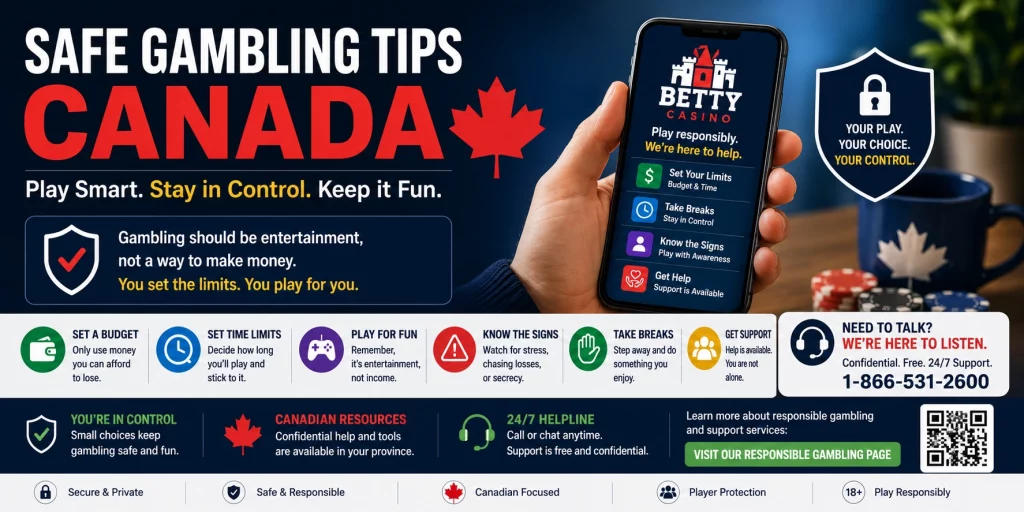
A safe budget must be decided before emotions are involved. If a person sets a limit after losing money, the decision may already be affected by frustration or the urge to recover losses. This is why responsible gambling tools are most effective when they are set early and treated as firm boundaries.
| Safe Gambling Tip | Why It Matters | Practical Action | Official Resource |
| Use a monthly gambling budget | Prevents gambling from affecting essential expenses | Keep gambling spending within a small entertainment-only amount | Lower-Risk Gambling Guidelines |
| Limit gambling days | Reduces the risk of gambling becoming routine | Avoid frequent sessions and take regular non-gambling breaks | Responsible Gambling Council |
| Understand warning signs | Helps identify risky behaviour early | Watch for secrecy, chasing losses, stress, or overspending | PlaySmart Finding Help |
| Use education tools | Improves understanding of odds, randomness, and game risk | Read safer gambling guidance before using casino features | GameSense |
Keep Bonuses Separate from Safe Play Decisions
Promotional offers can make gambling feel less expensive than it really is. A Bonus may look attractive, but wagering requirements, expiry rules, eligible games, and withdrawal conditions can increase pressure to continue playing. Safe gambling means checking whether a promotion supports controlled entertainment or creates urgency.
A player should never use a bonus to justify spending more than planned. If the offer requires extra deposits or long wagering sessions, it may not be suitable for someone trying to keep strict limits. The safest approach is to treat all promotions as optional, not as a reason to gamble.
Understand That Gambling Is Not Income
A major safe gambling rule is to reject the idea that gambling can reliably produce income. Casino games are designed around chance and mathematical advantage for the operator. A person may win sometimes, but results are unpredictable, and losses are part of the structure.
This is especially important for online play, where speed and convenience can make losses happen quickly. A safe gambling mindset means accepting the cost of gambling as entertainment spending. If losing the money would cause stress, the amount is too high.
Use Account Limits Before Risk Appears
Safe gambling tools are most useful before a person feels out of control. Deposit limits, session reminders, cooling-off options, and self-exclusion tools should not be treated as last-resort features. They are basic protection tools.
During Sign up, users should be encouraged to review responsible gambling settings before making any gambling decisions. This makes safer play part of the account setup process rather than something hidden in the background.
Control Session Time Before It Controls You
Time control is one of the most important safe gambling habits. Money limits matter, but time limits matter as well because long sessions can weaken decision-making. The more tired, emotional, or focused on losses a player becomes, the harder it is to stop at the planned point.
A safe session should have a clear start and end time. This is especially important on mobile, where gambling can happen privately and without obvious interruption. The App should be treated as a convenience tool, not as a reason to gamble more often or outside planned entertainment time.
| Time-Control Tip | Risk It Reduces | Safe Action |
| Set a session timer | Long play without awareness | Decide the end time before opening the account |
| Take breaks between sessions | Emotional or automatic gambling | Pause fully, leave the screen, and do something unrelated |
| Avoid late-night play | Tired decisions and weaker limits | Do not gamble when exhausted, stressed, or distracted |
| Track weekly activity | Gambling becoming routine | Review how many days gambling happened during the week |
| Stop after strong emotions | Chasing losses or overconfidence after wins | End the session when gambling feels urgent rather than calm |
Avoid Chasing Losses
Chasing losses is one of the clearest warning signs of unsafe gambling. It happens when a person continues gambling mainly to recover money already lost. The decision is no longer entertainment-based. It becomes emotional and reactive.
Safe gambling requires accepting losses as final. A lost amount should never become a reason to deposit again, raise the stake, or extend the session. The correct response is to stop, take a break, and return only if gambling can remain within a fixed entertainment budget.
This applies to all casino formats. Whether a person is playing table games, live casino products, or Slots, the result of one session does not create a reliable path to recovery in the next session. Each outcome remains uncertain.
Watch Emotional Triggers
Many gambling problems develop when gambling becomes connected with emotion. Stress, boredom, loneliness, anger, frustration, or excitement can all increase risk. A person may begin gambling not because they planned entertainment, but because they want to change how they feel.
A safe gambling tip is to check emotional state before starting. If the answer is “I need this to feel better,” gambling is not the right activity at that moment. Better alternatives may include walking, calling someone, resting, exercising, or using a support resource.
Emotional gambling is risky because it turns random outcomes into personal pressure. A loss feels like failure. A win feels like permission to continue. Both reactions can weaken control.
Keep Game Variety Under Control
Trying many casino products in a short period can make gambling harder to track. Different games move at different speeds, use different rules, and create different levels of intensity. Safer gambling means understanding what is being played and avoiding constant switching.
The same rule applies across Games in general: if the player does not understand the odds, pace, rules, or risk profile, they should not wager real money. Learning the game does not remove the house edge, but it reduces confusion and impulsive decisions.
Use Practical Tools, Not Willpower Alone
Safe gambling should not depend only on willpower. A player may start with good intentions, but strong emotions, fast gameplay, and easy payment access can weaken control. Practical tools create structure before risk increases.
Deposit limits, loss limits, time reminders, cooling-off periods, and self-exclusion options are not signs of failure. They are normal safety measures. A responsible player uses them early, especially when gambling online, where access is faster and more private.
| Safety Tool | Main Purpose | Best Time to Use It |
| Deposit Limit | Controls how much money can be added to the account | Before the first deposit or before a new month begins |
| Session Reminder | Shows how long the player has been active | Before starting any longer session |
| Cooling-Off Period | Creates a temporary break from gambling | When gambling feels emotional, rushed, or repetitive |
| Self-Exclusion | Blocks gambling access for a longer period | When stopping independently feels difficult |
| Transaction Review | Helps identify spending patterns | Weekly or monthly, before gambling again |
Review Payment Behaviour Regularly
Safe gambling includes payment awareness. Players should review deposits, withdrawals, cancelled withdrawals, and repeated top-ups. A pattern of frequent deposits can be a stronger warning sign than one large loss because it shows repeated attempts to continue gambling.
A good habit is to check account history before playing again. If spending looks higher than expected, the safest action is to stop and reassess. Continuing without review can make gambling feel normal even when it is no longer controlled.
Players should also avoid using credit, loans, borrowed money, or funds meant for essential needs. Gambling with money that is not truly disposable increases financial and emotional pressure.
Make Support Easy to Find
Safe gambling information should be visible and direct. A player should not need to search deeply through the website to find help. Support pages, responsible gambling tools, and official assistance resources should be easy to access from account areas, footer sections, and help pages.
A well-structured FAQ can also reduce confusion by explaining deposit limits, self-exclusion, cooling-off periods, warning signs, and support contacts in plain language. This matters because some users will look for quick answers before they are ready to contact a helpline.
Recognize When Gambling Should Stop
A player should stop gambling when the activity no longer feels calm, optional, and affordable. Warning signs include hiding activity, gambling longer than planned, increasing deposits, borrowing money, cancelling withdrawals, or feeling anxious when not gambling.
Another warning sign is treating gambling as a solution. If a player thinks gambling can fix debt, stress, boredom, or personal problems, the risk level is already high. At that point, the safer choice is to stop and use support resources.
For Canadian players, responsible gambling guidance should be practical rather than abstract. Safe gambling is not about perfect control every time. It is about noticing risk early and acting before harm becomes harder to manage.
Create a Personal Gambling Safety Plan
A personal gambling safety plan helps Canadian players turn general advice into clear action. The plan does not need to be complicated. It should answer four basic questions: how much money can be spent, how much time can be used, what signs mean gambling should stop, and where support can be found.
The safest plan is written before gambling begins. It should not be created during a losing session or after a large win, because emotional moments can distort judgment. A calm plan gives the player a fixed reference point when gambling starts to feel more intense than expected.
| Safety Plan Area | Question to Ask | Safe Gambling Action |
| Money Limit | Can I afford to lose this amount without stress? | Use only entertainment money and never increase the limit during play |
| Time Limit | How long will this session last? | Set a timer and stop when the planned time ends |
| Emotional Check | Am I gambling to escape stress or recover losses? | Do not gamble when tired, upset, angry, pressured, or desperate |
| Support Access | Where can I find help if gambling feels difficult to control? | Save official support **Links** and use local Canadian help resources early |
| Account Controls | What tools can reduce risk before the next session? | Use deposit limits, cooling-off periods, time reminders, or self-exclusion |
Final Safe Gambling Advice for Canadian Players
Safe gambling in Canada is based on prevention, not reaction. The safest approach is to set limits before play, keep gambling separate from essential finances, avoid chasing losses, and treat wins as chance-based outcomes rather than proof of skill or control.
Players should also review their habits honestly. If gambling becomes more frequent, more expensive, more secretive, or more emotional, the safest decision is to stop and use support resources. This does not mean the player has failed. It means the activity is no longer staying within safe boundaries.
For Betty Casino, this page should communicate one clear message: gambling is only safe when it remains optional, affordable, and controlled. When that changes, Canadian players should use account tools, take a break, and contact trusted support services.






Comments