
Betty Casino Legality
Legality and Player Protection in Canada
Online gambling legality in Canada is not defined by one simple national rule. The country uses a layered framework where the Criminal Code sets broad federal boundaries, while provinces and territories manage most gambling activity within their own jurisdictions. This means that a legality page should not tell players that online casino access is universally the same across Canada. A more accurate approach is to explain that legal status, operator oversight, age limits, advertising rules, and player protection standards depend heavily on location.
For informational pages connected with Betty Casino, the legality section should therefore be written as a compliance-oriented guide rather than a promotional entry point. The central question is not only whether online gambling exists in Canada, but whether a player understands who regulates gambling, where a platform is authorised, what protections apply, and what risks may remain when using offshore or privately operated sites.
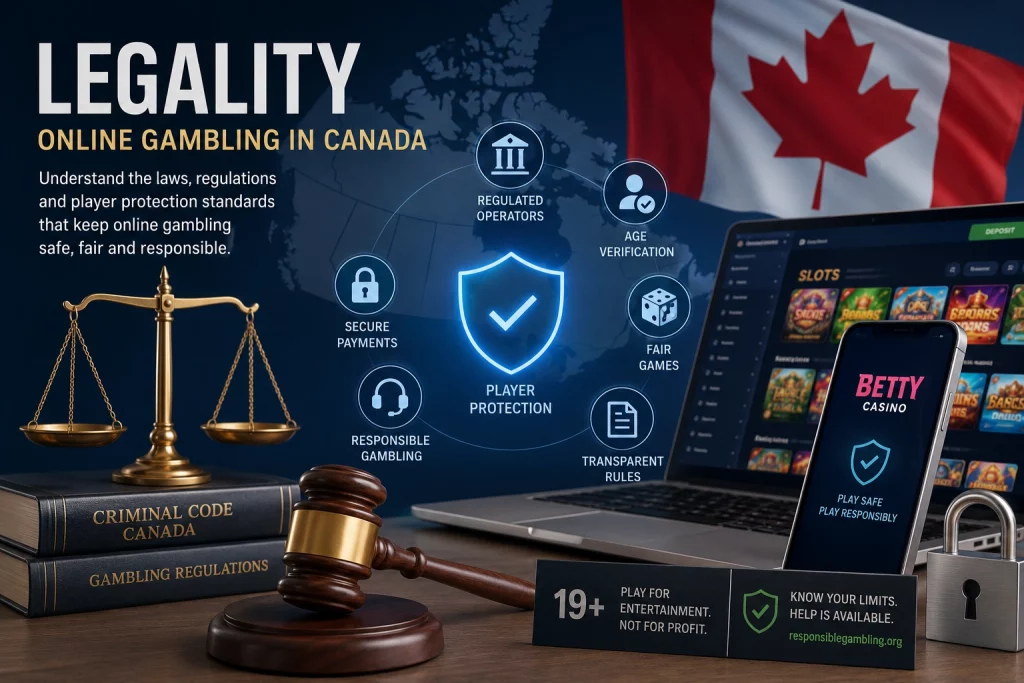
In Ontario, regulated online gambling is managed through iGaming Ontario and the Alcohol and Gaming Commission of Ontario. iGaming Ontario lists regulated operators and notes that online gambling in that market is restricted to people aged 19+ who are physically located in Ontario. This is one of the clearest regulated online casino frameworks in Canada. Outside Ontario, the model differs by province, with many regions relying on provincial lottery corporations or government-managed online gambling platforms.
| Legal Area | What It Means | Player Protection Relevance |
| Federal law | Sets the broad criminal-law framework for gambling activity in Canada. | Explains why gambling is not treated as one uniform commercial market. |
| Provincial control | Provinces and territories manage or authorise gambling within their own systems. | Players must check rules based on their actual province or territory. |
| Ontario model | Ontario has a regulated private iGaming market with listed operators. | Registered sites are easier to verify through official directories. |
| Age restrictions | Legal gambling age is usually 18 or 19 depending on province and activity. | Underage gambling is not permitted and should be clearly discouraged. |
| Responsible gambling | Legal access does not remove risk of financial or behavioural harm. | Limit tools, self-exclusion, and help resources should be visible. |
For internal navigation, the legality page can mention related informational sections once, without turning them into promotional instructions. A user may review account access information through Login, read offer conditions through Bonus, understand registration rules through Sign up, check mobile access details through App, compare game-category information through Slots and Games, review support answers through FAQ, or use Links for general site navigation.
A responsible legality page should also separate three different ideas: legal availability, platform authorisation, and personal suitability. A gambling product may be available in a market, but that does not automatically mean every platform is locally licensed, every bonus is suitable, or every player should participate. Legal information should therefore be presented with clear warnings about age limits, verification, financial risk, and local regulation.
The safest editorial position is to avoid broad promises. Instead of saying that an online casino is “legal in Canada” as a blanket statement, the page should explain that legality depends on provincial rules, operator status, player location, and compliance with age and identity requirements. This framing is more accurate and better aligned with responsible gambling standards.
Provincial Rules, Operator Status, and Safer Navigation
Canadian online gambling law is best understood as a provincial system operating under a federal legal framework. The federal Criminal Code creates the basic boundaries, but practical gambling access is mainly organised by provinces and territories. This is why players may see different rules, different age limits, different official platforms, and different verification procedures depending on where they live or where they are physically located.
For a legality page, this distinction is essential. A user who reads a general statement about online gambling in Canada may wrongly assume that one rule applies everywhere. In reality, Ontario, British Columbia, Québec, Alberta, Manitoba, and other provinces each have their own gambling bodies, public operators, or regulatory structures. Before using any account-related area such as Login, a player should understand whether the platform they are accessing is locally regulated, offshore, or operating under another licensing model.
| Province / Area | General Online Gambling Model | What Players Should Check |
| Ontario | Regulated iGaming market with registered private operators. | Whether the operator appears through official Ontario iGaming channels. |
| British Columbia | Government-linked online gambling through provincial systems. | Whether the platform is connected to the recognised provincial model. |
| Québec | Provincial gambling services are managed through local public structures. | Language, age rules, payment standards, and responsible gambling information. |
| Alberta | Provincial oversight applies, with gambling access shaped by local policy. | Whether online play is supported by an approved provincial channel. |
| Other provinces and territories | Rules and access models vary across Canada. | Official provincial gambling authority information should be reviewed first. |
A responsible legality page should also explain the difference between a licence and a marketing claim. A casino may display badges, seals, or references to international regulation, but the player still needs to understand what those references actually mean. A licence issued outside Canada may not provide the same dispute process, complaint route, or local consumer protection as a provincial Canadian framework. This does not automatically answer every legal question, but it does show why verification matters.
The same caution applies to bonus visibility. A Bonus page can describe available offer terms, but legality and safety depend on more than promotional wording. Wagering requirements, restricted games, withdrawal caps, maximum bet limits, and identity checks can all affect how an offer works. On a legality page, bonus information should be framed as a risk-disclosure topic rather than a reason to start playing.
Another important area is age verification. Canadian gambling access generally requires a legal adult age, which is often 18 or 19 depending on province and gambling type. A platform should not rely only on self-declared age. Stronger systems use identity checks, payment-name matching, and location confirmation. These controls may feel inconvenient, but they are central to preventing underage access and reducing account misuse.
Responsible pages should also clarify that verification is not only a withdrawal issue. Some users assume that identity checks matter only after a win. In regulated environments, verification can be part of account creation, ongoing monitoring, anti-fraud screening, and responsible gambling protection. This is why a Sign up process may request personal information before full account use. The key question is whether the process is proportionate, secure, and clearly explained.
Payment legality and transparency should be addressed separately. A site may support deposits and withdrawals, but players should still check whether payment methods are available in their region, whether card issuers allow gambling transactions, and whether withdrawal conditions are stated before play. Any legality page should avoid implying that payment availability equals legal approval. Payment processing is only one part of the wider compliance picture.
Mobile access creates another layer of risk. A player using an App or mobile browser may still be subject to the same provincial location rules, age restrictions, and verification requirements as desktop users. The convenience of mobile gambling does not change the legal framework. It simply makes responsible controls more important because gambling access becomes easier, faster, and more private.
Location checks are especially relevant in regulated markets. Ontario, for example, requires players to be physically located in Ontario when participating in its regulated iGaming market. This means that residency alone may not be enough. A player who has an account but travels outside the permitted area may lose access until they return to the authorised location. A legality page should explain this clearly because it affects both account access and user expectations.
Offshore platforms should be discussed carefully. Many Canadian players encounter offshore casino websites, but their legal and consumer-protection status can be harder to evaluate. The most responsible wording is to say that players should check local law, licensing information, dispute-resolution options, payment transparency, and responsible gambling tools before using any gambling service. The page should not present offshore access as a simple workaround.
Game categories should also be described in legal context. Slots may look like simple entertainment products, but they are still gambling products when real money is involved. Their fairness depends on certified random number generation, published rules, clear return-to-player information, and independent testing where applicable. Legal access does not remove the need to understand volatility, loss risk, and session control.
The same applies to broader Games sections. Table games, live dealer products, crash-style games, and instant-win formats may have different speeds, betting structures, and risk profiles. A legality page should not treat them as interchangeable. Faster games can increase decision frequency, while complex bonus-linked games may create confusion around eligible play. Clear rules and accessible game information are therefore part of the legality and safety discussion.
Another key point is complaint handling. A regulated platform should explain how disputes are submitted, how long reviews may take, and whether an external body can be contacted. If a site offers only vague support channels, no clear escalation route, and no meaningful complaint process, that is a warning sign. Users should be able to find help information in a clear FAQ section rather than searching through unclear policy pages.
A strong legality page should also contain external information routes. These can include regulator pages, consumer guidance, responsible gambling organisations, and official provincial gambling resources. Site-level Links should help users move toward policy, terms, privacy, responsible gambling, and verification information, not only toward commercial pages.
The purpose of this structure is not to overcomplicate the page. It is to reduce misleading simplicity. Online gambling law is location-sensitive, and player protection depends on several practical checks: age, location, licence status, identity verification, payment clarity, dispute options, and responsible gambling tools. When these topics are explained together, the page becomes more useful and more defensible.
In editorial terms, the best legality content avoids absolute claims unless they are supported by official sources. Phrases such as “fully legal everywhere” or “available to all Canadian players” are too broad. Better wording is more conditional: access depends on provincial rules, platform status, player age, physical location, and compliance requirements. This style gives users clearer expectations and reduces legal ambiguity.
Verification, Fairness, Payments, and Legal Risk Signals
Verification is one of the most important parts of online gambling legality because it connects several compliance duties at once. A casino account is not only a username and password. It is a regulated gambling profile that may require age confirmation, identity checks, payment validation, fraud screening, and location controls. When these checks are clearly explained, they support safer access. When they appear suddenly or are applied inconsistently, they can create disputes.
For Canadian players, the safest approach is to treat verification as a normal part of gambling compliance rather than as an obstacle. A platform may ask for documents such as government-issued ID, proof of address, or payment ownership confirmation. These requests should be proportionate, secure, and connected to stated policy. If a platform asks for excessive information without explaining why, that is a risk signal.
| Legal Check | Why It Matters | Warning Signal |
| Identity verification | Helps confirm legal age and account ownership. | Unclear document requests or repeated rejected uploads. |
| Location control | Ensures access follows provincial rules where required. | Claims of unrestricted access without location checks. |
| Payment review | Reduces fraud and confirms withdrawal ownership. | Different names on account and payment methods. |
| Game fairness | Supports confidence in random outcomes and published rules. | No RTP information, testing reference, or game rules. |
| Complaint process | Gives users a route when account or payment issues occur. | No escalation path beyond basic support chat. |
Fairness is another core part of legality. Legal gambling products must not rely only on visual trust. Players need access to game rules, payout tables, return-to-player information where available, and clear explanations of how outcomes are generated. In online casino environments, random number generation and independent testing are often used to support fairness, but the user still needs readable information, not only technical seals.
This is especially relevant when a platform presents a large casino lobby. A broad game catalogue may look attractive, but quantity does not prove legal reliability. A smaller, better-documented library can be more transparent than a large catalogue with unclear provider details. The legality page should therefore connect game access with fairness, supplier transparency, and responsible play information.
Payments also require careful treatment. Deposit acceptance does not automatically prove that a site is locally authorised. A payment method may work technically even where the legal or regulatory position is more complex. For that reason, players should review transaction limits, withdrawal rules, account-name matching, processing timeframes, and any verification steps before depositing.
Withdrawal policy is often where weak legality pages fail. A responsible page should explain that withdrawals may involve review, especially when identity checks are incomplete or payment ownership is unclear. At the same time, the platform should not use verification as an excuse for indefinite delay. Clear policy, predictable document review, and transparent communication are all part of legal confidence.
Bonus terms can also create legal and reputational risk. The safest wording is to explain that offers must be read with attention to wagering rules, maximum conversion limits, excluded games, expiry dates, and withdrawal restrictions. A bonus is not only a marketing feature; it is a contract-like condition attached to play. If those terms are unclear or hidden, the page should not present the offer as straightforward.
Advertising standards should be mentioned as well. Gambling content should not suggest guaranteed winnings, financial improvement, or risk-free entertainment. It should not target minors or vulnerable users. A legality page should maintain a factual tone and avoid pressure language. This is especially important for casino brands because promotional wording can conflict with responsible gambling expectations.
Privacy is another major legal topic. Online gambling accounts involve sensitive data: identity documents, payment records, address details, contact information, and behavioural activity. A legality page should explain that privacy protection, encryption, document handling, and account security are part of the player-protection framework. Users should be encouraged to read privacy and security policies before sharing personal information.
Responsible gambling controls should not be treated as a secondary footer item. Deposit limits, time reminders, self-exclusion options, reality checks, and access to support organisations are central to lawful and ethical gambling environments. A page about legality should explain that legal access does not remove the possibility of harm. Gambling can create financial stress, emotional pressure, and loss of control, so safer-use tools should be visible before problems develop.
The page should also address player responsibility. Users should not use false information, borrowed payment methods, VPN tools to bypass location checks, or accounts opened on behalf of someone else. These actions can breach platform rules and may result in account closure, payment delays, or loss of access. Legal confidence depends on both operator compliance and user honesty.
In Canada, the strongest practical guidance is to check official provincial information first. A user should understand whether they are in a regulated local market, whether the operator is recognised there, and what dispute or self-exclusion systems apply. If the answer is unclear, the safer interpretation is not to proceed until the user has confirmed the regulatory position.
A good legality page is therefore not a simple permission statement. It is a structured explanation of how gambling access works, what protections matter, and what risks should be checked before any account activity. The purpose is to help users make informed decisions, not to push them toward immediate play.
Official Sources, Safer Interpretation, and Final Legal Guidance
A legality page should end with clear caution rather than commercial pressure. Online gambling rules in Canada are shaped by federal law, provincial control, operator status, player location, and responsible gambling standards. Because those elements can change, users should not rely only on brand wording or general internet summaries. The safer approach is to check official sources, read policy pages, and treat uncertainty as a reason to stop and verify first.
Canadian law is not built around a single national online casino licence for all private operators. The federal Criminal Code creates the broader gambling framework, while provinces and territories control many practical gambling arrangements. Ontario is the most visible example of a regulated private iGaming market, where operators must be registered with the AGCO and have an operating agreement with iGaming Ontario, except for OLG.ca.
| Official Resource | Why It Matters | Link |
| Justice Laws Website — Criminal Code | Shows the federal legal basis for gambling-related offences and exceptions. | Criminal Code of Canada |
| iGaming Ontario | Explains Ontario’s regulated iGaming market and the meaning of authorised operators. | Regulated iGaming Market |
| AGCO | Provides Ontario standards for internet gaming and player protection expectations. | Registrar’s Standards for Internet Gaming |
| Responsible Gambling Council | Offers Canadian-focused safer gambling information and harm-prevention resources. | Responsible Gambling Council |
Legal confidence should be based on evidence, not surface design. A polished interface, a large lobby, or smooth payments do not prove local authorisation. More reliable indicators include official registration, transparent company information, clear terms, privacy protection, fair-game documentation, age checks, location controls, and visible responsible gambling tools. The AGCO states that it registers and regulates online gambling sites in Ontario and sets standards intended to protect players and support game integrity.
Players should also understand the limits of Betty Casino legality page. It can explain the framework, but it should not replace legal advice or official provincial guidance. Gambling rules may depend on a user’s province, physical location, age, account status, and the specific operator involved. If any of these points are unclear, the safest decision is to pause and consult official information before creating or using an account.
Responsible gambling belongs inside the legal discussion, not outside it. A lawful market still involves risk. People can lose money, chase losses, misunderstand bonus terms, or gamble longer than intended. The Responsible Gambling Council describes its work as reducing gambling risks through awareness and improved safeguards, which is why a legality page should include harm-prevention information alongside licensing and regulatory explanations.






Comments