
When players see the word Kahnawake attached to an online casino, reactions usually split in two.
Some assume it means “unregulated.” Others treat it as a badge of trust. Both interpretations are incomplete — and that gap is where most confusion starts.
At Betty Casino, references to betty kahnawake are not decorative. They point to a specific regulatory context that exists outside provincial frameworks but inside a long-established gaming structure. Understanding that context requires stepping away from slogans and looking at how regulation actually functions.
This text explains what Kahnawake is, how it operates in online gaming, why it matters for Canadian players, and where its limits clearly are. Educational and informational only.
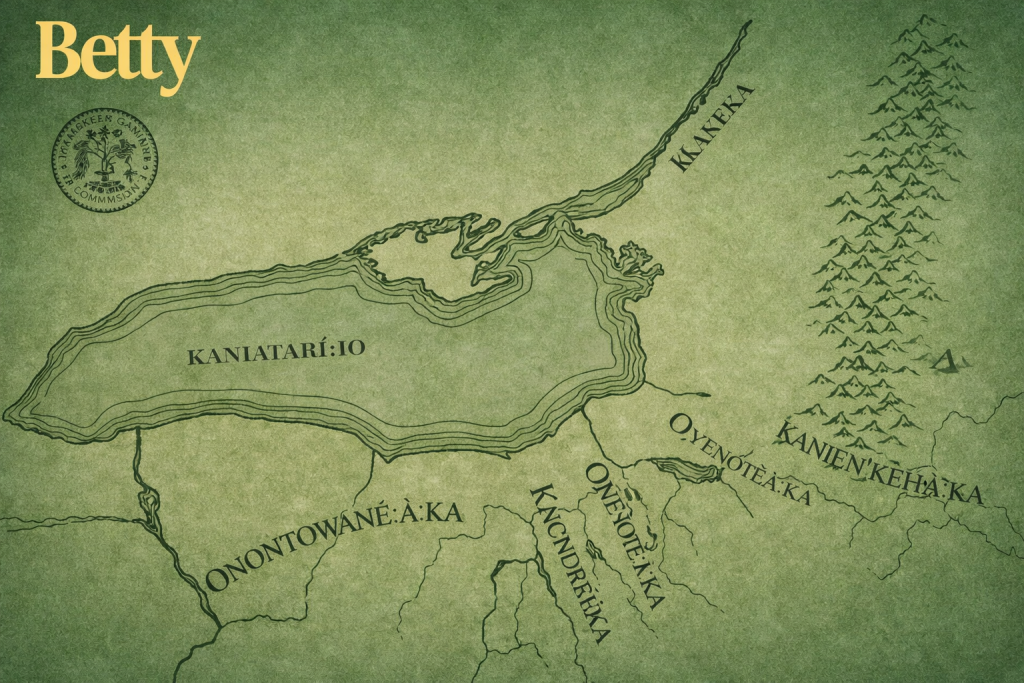
What Kahnawake Actually Is
Kahnawake is a Mohawk territory located near Montreal, Quebec. In online gambling, it is known primarily for the Kahnawake Gaming Commission (KGC), which has licensed and overseen online gaming operations since the late 1990s.
Kahnawake is not:
- a Canadian province
- a federal regulator
- an offshore island jurisdiction
It exists in a parallel legal space, operating under Indigenous governance. That position gives it authority over certain forms of online activity hosted under its jurisdiction, while still interacting with broader Canadian law.
This dual position creates both clarity and limitation — something players often miss.
Why Kahnawake Entered Online Gaming Early
Kahnawake’s early involvement explains much of its current relevance.
In the late 1990s:
- online gambling expanded faster than national law
- Canada had no unified federal online gambling framework
- provinces focused almost exclusively on land-based casinos
- internet-based operations existed in a regulatory vacuum
Instead of waiting for federal coordination, Kahnawake established its own regulatory body. It created licensing standards, technical hosting rules, compliance requirements, and dispute procedures.
This is why betty kahnawake appears most often in casinos that target Canadian players broadly: the framework was built around Canadian legal realities, even if it is not provincial.

What a Kahnawake License Actually Covers
Precision matters here.
A Kahnawake license generally covers:
- legitimacy of the casino entity
- hosting and technical infrastructure compliance
- internal audits and reporting
- dispute resolution mechanisms
- anti-fraud and anti-money-laundering controls
What it does not do:
- override provincial consumer law
- guarantee player winnings
- replace responsible gaming obligations
- protect players from poor decisions
In short, Kahnawake licensing defines how a casino may operate, not how a player should behave.
Why Betty Casino Mentions Kahnawake
Casinos do not reference jurisdiction unless it matters.
At Betty Casino Canada, mentions of betty kahnawake usually appear in contexts related to:
- legal positioning for Canadian players
- explaining cross-provincial access
- jurisdictional transparency
- distinguishing the platform from unlicensed offshore operators
Canada is not a single regulatory environment. Ontario, Quebec, and other provinces treat online gaming differently. Kahnawake exists outside that fragmentation, which is both its advantage and its complexity.
Kahnawake vs Provincial Regulation
Players often ask a simplified question:
“Is Kahnawake legal in Canada?”
That question misses the point.
A more accurate one is:
“How does Kahnawake licensing interact with provincial consumer law?”
Here’s the practical distinction:
| Aspect | Provincial Platforms | Kahnawake-Licensed Casinos |
|---|---|---|
| Operator location | Provincial entity | Indigenous jurisdiction |
| Market access | Province-specific | Cross-provincial |
| Consumer oversight | Provincial regulator | KGC + general law |
| Player responsibility | Local | Still local |
Kahnawake licensing defines where the operator sits, not where the player lives. Player responsibility remains local regardless of jurisdiction.
Why Kahnawake Is Called a “Grey Area”
The term appears constantly — and it’s misleading.
Kahnawake is not legally invisible. It operates under:
- recognized Indigenous governance
- contractual enforcement mechanisms
- international hosting and payment standards
What creates uncertainty is Canada’s lack of a single federal online gambling law. In that vacuum, Kahnawake becomes visible — not because it is weak, but because it fills a structural gap.
At Betty Casino, referencing betty kahnawake is a way of acknowledging that gap instead of hiding it.
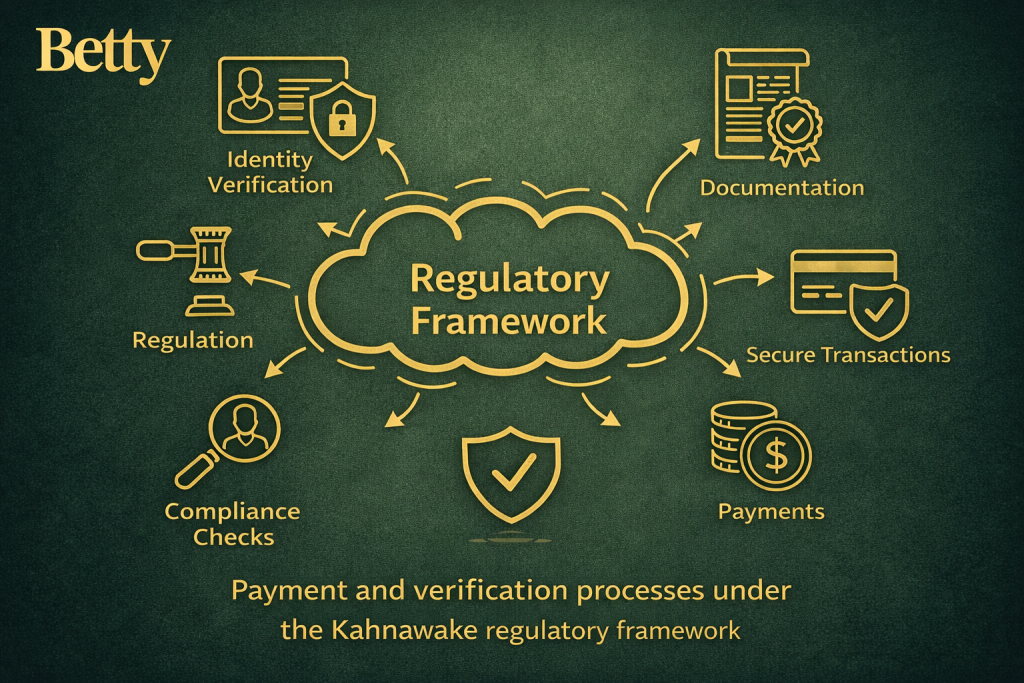
Payments and Verification Under Kahnawake
One practical area where Kahnawake matters is payments.
Casinos under this framework typically:
- work with international payment processors
- avoid province-specific bottlenecks
- maintain cross-border transaction capability
- apply stricter verification standards
For players, this often results in:
- clearer verification requirements
- predictable withdrawal timelines
- stronger AML checks
These are not disadvantages. They are consequences of operating outside a single provincial system.
What Kahnawake Does Not Protect You From
A Kahnawake license does not protect players from:
- poor bankroll management
- misunderstanding bonus funds
- ignoring bonus conditions
- chasing losses
- skipping terms
Regulation sets boundaries. It does not make decisions.
At Betty Casino, betty kahnawake should be understood as structural legitimacy, not personal insurance.
Why This Matters to Me as a Reviewer
I do not treat Kahnawake as a selling point or a red flag by default. I treat it as context.
What matters more is:
- transparency about jurisdiction
- readable terms
- documented dispute paths
- visible player controls
When a casino openly explains its regulatory position, that’s a baseline trust signal. Betty Casino’s use of betty kahnawake fits that standard.
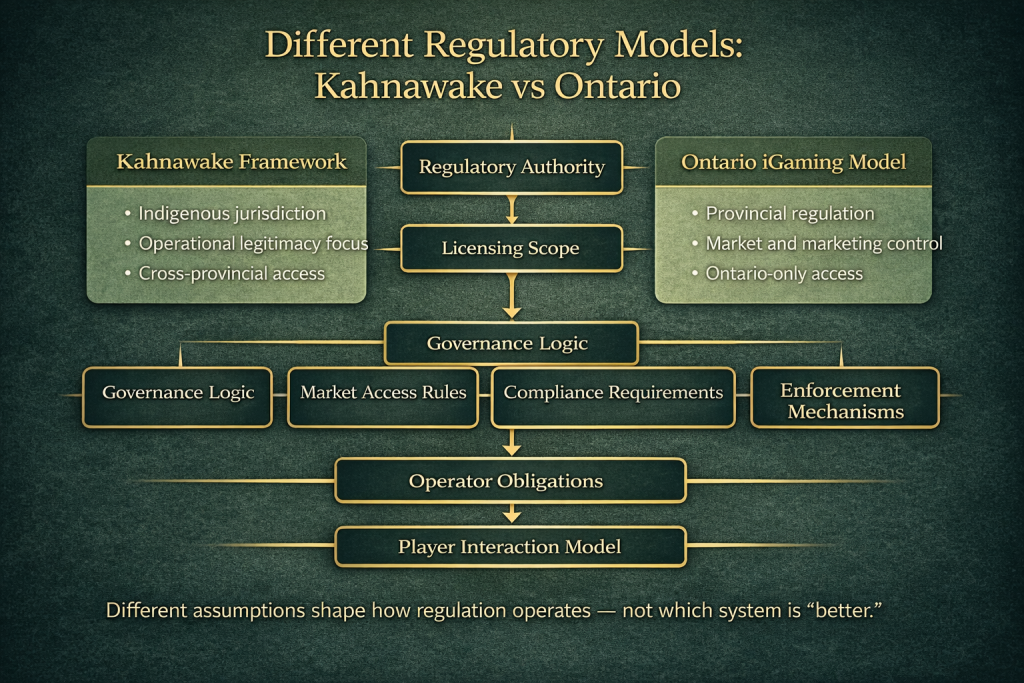
Kahnawake vs Ontario: Different Models, Different Assumptions
Ontario dominates the Canadian gambling conversation today because it is loudly provincial. Many players assume this makes it automatically safer than everything else. That assumption doesn’t hold up under scrutiny.
Ontario and Kahnawake are not competing versions of the same system. They are built on different regulatory assumptions.
| Dimension | Ontario (iGaming) | Kahnawake Framework |
|---|---|---|
| Regulatory logic | Market control | Operational legitimacy |
| Access | Ontario residents only | Cross-provincial |
| Licensing focus | Operator + marketing | Operator + hosting |
| Enforcement style | Centralized | Rule-based |
| Adaptation speed | Slow, rigid | Faster, flexible |
Ontario is designed to control who may operate and how they market.
Kahnawake is designed to define how operations must function once allowed.
Neither model is universally better. They serve different regulatory goals.
Why Some Casinos Choose Kahnawake Over Ontario
This choice is not accidental.
Ontario licensing imposes:
- strict advertising limits
- ring-fenced liquidity
- province-only player pools
- heavy compliance overhead
Kahnawake allows:
- national Canadian access
- unified liquidity
- consistent infrastructure
- fewer marketing restrictions
For platforms like Betty Casino Canada, referencing betty kahnawake explains why the casino is available across provinces without claiming provincial endorsement. This is alignment, not avoidance.
The Role of the Kahnawake Gaming Commission (KGC)
The Kahnawake Gaming Commission is often misunderstood as passive. It isn’t.
In practice, the KGC:
- approves and audits operators
- enforces technical and hosting standards
- requires dispute-resolution procedures
- monitors compliance
- can suspend or revoke licenses
What it deliberately does not do is micromanage player behavior. The system assumes adult accountability.
The commission regulates operators, not outcomes.
How Disputes Are Actually Handled
Disputes are where regulation proves its value.
The real escalation path looks like this:
- Player contacts casino support
- Internal review by the operator
- Formal complaint submission
- Review under KGC procedures
- Decision based on logs, rules, and compliance
Two facts matter more than anything else:
- terms outweigh emotions
- documentation outweighs assumptions
If a player violated bonus rules, failed verification, or breached account policies, regulation will not override that. Ontario works the same way — it just communicates it less directly.
Why Some Complaints Fail
In my review experience, unresolved disputes usually fall into predictable categories:
- bonus conditions misunderstood
- multiple accounts created
- verification incomplete
- payment rules breached
- self-excluded behavior ignored
Regulation is not a sympathy system. It is a rule-enforcement system.
At Betty Casino, referencing betty kahnawake means disputes are processed under a defined framework — not that outcomes are guaranteed.
What became clear to me while reviewing this structure is that most frustration does not come from the framework itself, but from expectations that were never aligned with it in the first place. Players often assume that any regulatory reference implies protection in outcomes, when in reality it only guarantees that procedures exist and are followed. Once I shifted my perspective from “protection” to “process,” the entire dispute system made more sense and felt significantly more predictable.
This is also where documentation becomes critical. Every interaction — from bonus activation to verification steps — leaves a trace, and those traces are what ultimately define the result of a dispute. In a Kahnawake-based environment, clarity is not optional; it is the foundation of resolution. The more precisely a player understands the rules before engaging, the less likely they are to encounter conflict later.
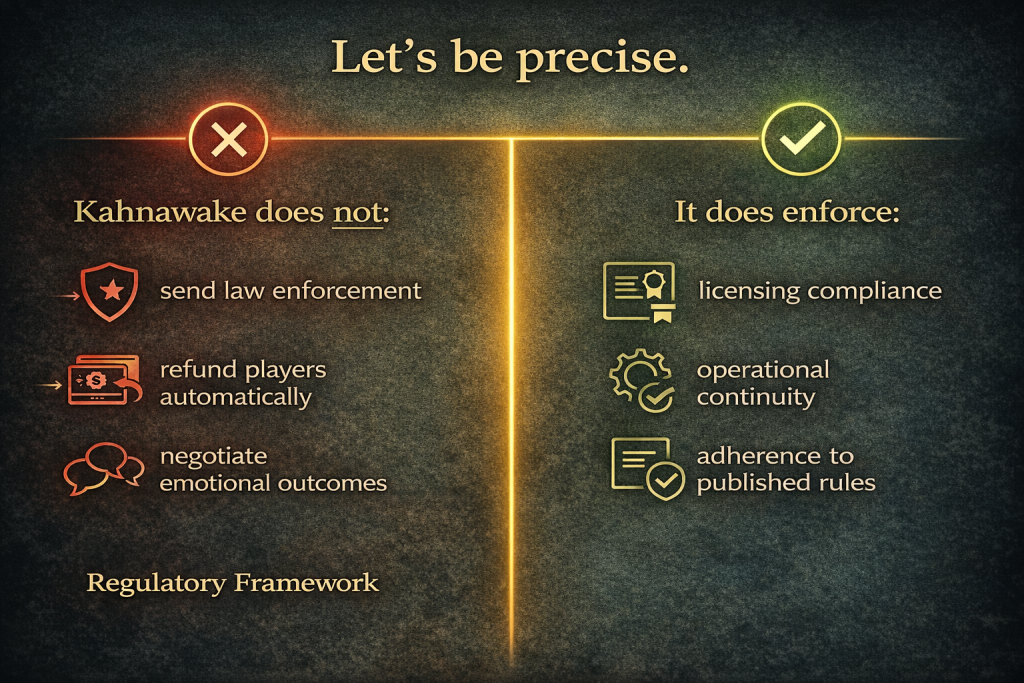
Enforcement Reality: What Kahnawake Can and Cannot Do
Let’s be precise.
Kahnawake does not:
- send law enforcement
- refund players automatically
- negotiate emotional outcomes
It does enforce:
- licensing compliance
- operational continuity
- adherence to published rules
This is why I repeat one rule constantly:
If you would not accept the rule in advance, don’t accept the bonus.
Kahnawake assumes players are capable of that decision.
Why Experienced Players Often Prefer Kahnawake
This surprises newer players, but many experienced ones prefer Kahnawake-licensed casinos because:
- terms are explicit
- bonuses are less aggressive
- verification is consistent
- withdrawals are predictable
Less protection theater. More structure.
That doesn’t suit everyone — but it suits players who value clarity over comfort.
My Reviewer’s Baseline Test
I don’t ask whether Kahnawake is “good” or “bad.”
I ask:
- is the jurisdiction disclosed clearly?
- are the terms readable?
- are dispute paths documented?
- are player tools visible?
At Betty Casino, betty kahnawake passes that baseline. That signals legibility — and legibility matters more than labels.
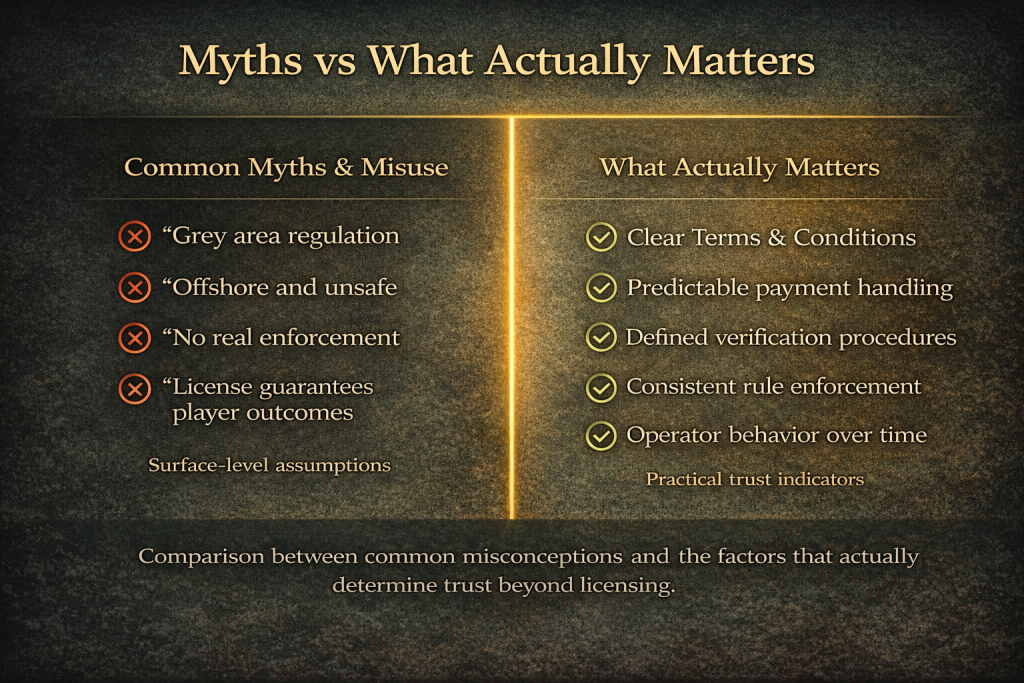
Myths, Misuse, and What Actually Matters More Than a License
At this point, one thing should be clear:
Kahnawake itself is not the problem. Misunderstanding it is.
Most criticism aimed at Kahnawake is not based on how the framework works, but on how players expect regulation to behave. That mismatch creates myths — and those myths shape bad decisions.
The Core Myths
Myth: “Kahnawake means no rules.”
Reality: Kahnawake licensing includes audits, compliance checks, hosting standards, and dispute procedures. “No rules” usually means rules were ignored.
Myth: “Kahnawake is offshore.”
Reality: Kahnawake is located in Quebec, Canada. It is not provincial, but it is not an offshore island jurisdiction either. Indigenous governance is not the same as foreign regulation.
Myth: “Kahnawake casinos are unprotected.”
Reality: Protection is contextual. Kahnawake regulates operators, not player decisions. No regulator protects players from bad bankroll management or misunderstood bonuses.
How the Name “Kahnawake” Gets Misused
This is where criticism becomes justified — but it’s aimed at operators, not the framework.
Low-quality casinos sometimes misuse “Kahnawake” in three ways:
- Implied licensing without proof or verification
- Historical references to past hosting arrangements
- Token mentions buried in footers without explanation
This is why disclosure quality matters more than the jurisdiction name itself.
At Betty Casino , references to betty kahnawake are contextual and consistent, not decorative. That difference matters.
Why Jurisdiction Alone Is a Weak Trust Signal
Players often reduce evaluation to a shortcut:
License = safe
No license = unsafe
That shortcut fails in practice.
Stronger signals include:
- clear and readable Terms & Conditions
- transparent bonus fund separation
- predictable withdrawal procedures
- documented verification steps
- visible responsible-gaming tools
A casino with these elements but a less familiar license is often safer than a licensed platform with opaque behavior.
Kahnawake vs Offshore Island Licenses (Reality Check)
| Aspect | Kahnawake | Typical Offshore License |
|---|---|---|
| Location | Canada | Outside Canada |
| Governance | Indigenous | State-based |
| Market focus | Canadian players | Global |
| Dispute handling | Rule-based | Often limited |
| Transparency tendency | Medium–High | Highly variable |
This comparison doesn’t declare a winner. It explains why Canadian-facing platforms often choose Kahnawake: jurisdictional relevance.
“Legal” vs “Available”: The Distinction That Matters
Players often ask whether a casino is “legal.”
What they usually mean is: can I use it without surprises?
A better framework is:
- legal for the operator to offer services
- available for the player to access
- acceptable under local responsibility laws
Kahnawake addresses the first point.
Availability addresses the second.
Responsibility always stays with the player.
This is why Betty Casino can be accessible nationwide without claiming provincial endorsement.
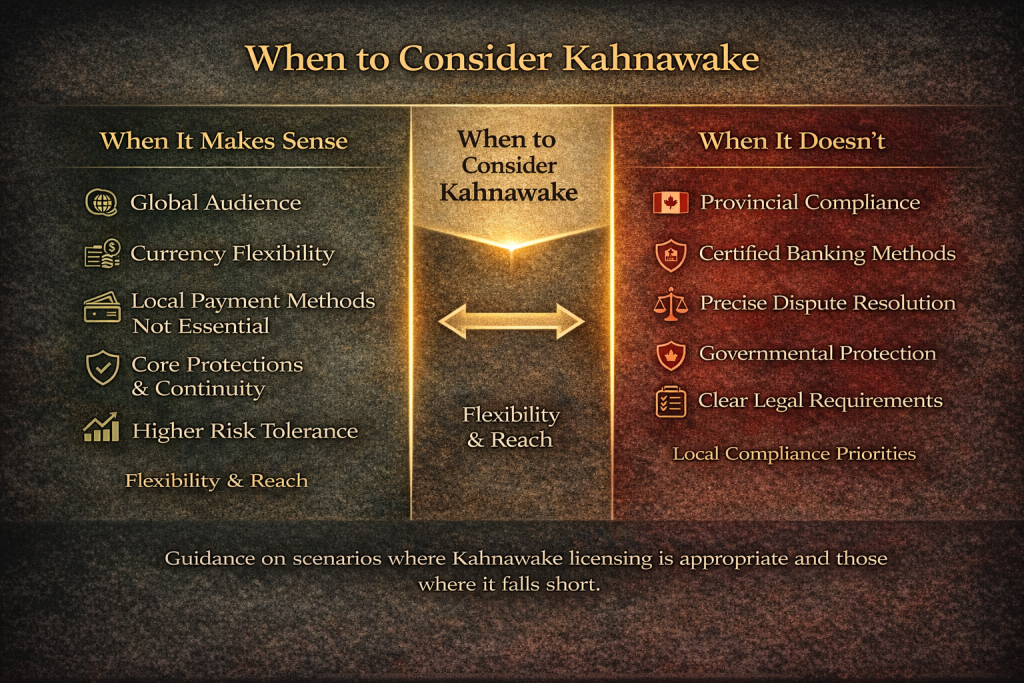
When Kahnawake Makes Sense — and When It Doesn’t
Kahnawake works well for players who value:
- cross-provincial access
- consistent verification standards
- explicit rules
- structured dispute handling
- low marketing pressure
It may not suit players who expect:
- automatic refunds
- emotional arbitration
- heavy consumer intervention
That difference is philosophical, not moral.
My Final Position as a Reviewer
I don’t rank casinos by jurisdiction alone.
I rank them by clarity, consistency, and respect for player agency.
Kahnawake contributes structure.
Execution determines trust.
At Betty Casino, betty kahnawake signals where the platform stands — not what outcomes it promises. For informed players, that honesty is more valuable than reassurance.
Understanding regulation doesn’t guarantee results.
Misunderstanding it guarantees frustration.






Comments