
KYC Verification Canada Casino Guide
KYC verification in a Betty Casino context is a structured identity-check process used to confirm who holds an account, whether account details are consistent, and whether financial activity should be reviewed before certain actions continue. In Canada, casinos are covered by federal anti-money-laundering obligations, and FINTRAC publishes casino-specific guidance on when identity verification may be required under the Proceeds of Crime (Money Laundering) and Terrorist Financing Act framework.
A KYC page for a Canada-focused casino guide should explain verification as part of account security and payment integrity. It should not be written as a vague warning or as a hidden condition. The reader should understand what KYC means, why it exists, which account areas it can affect, and why consistent personal information matters from the first account step.
In Ontario, the online gaming market has its own regulated structure involving the Alcohol and Gaming Commission of Ontario and iGaming Ontario. iGaming Ontario states that its regulated market was established with the Government of Ontario and AGCO to help protect consumers using private gaming operators, and its public directory lists regulated operators and sites for Ontario. This makes KYC especially relevant because identity, age, account ownership, and payment traceability are part of a wider player-protection and compliance environment.
What KYC Verification Means in Canada
KYC means “Know Your Customer.” In a casino-related setting, it usually refers to checks that confirm the identity of the account holder and help detect account misuse, payment inconsistency, fraud risk, duplicate accounts, or suspicious financial behaviour. FINTRAC’s identity-verification guidance describes methods such as government-issued photo identification, credit file methods, and dual-process methods for verifying a person’s identity under Canadian AML rules.
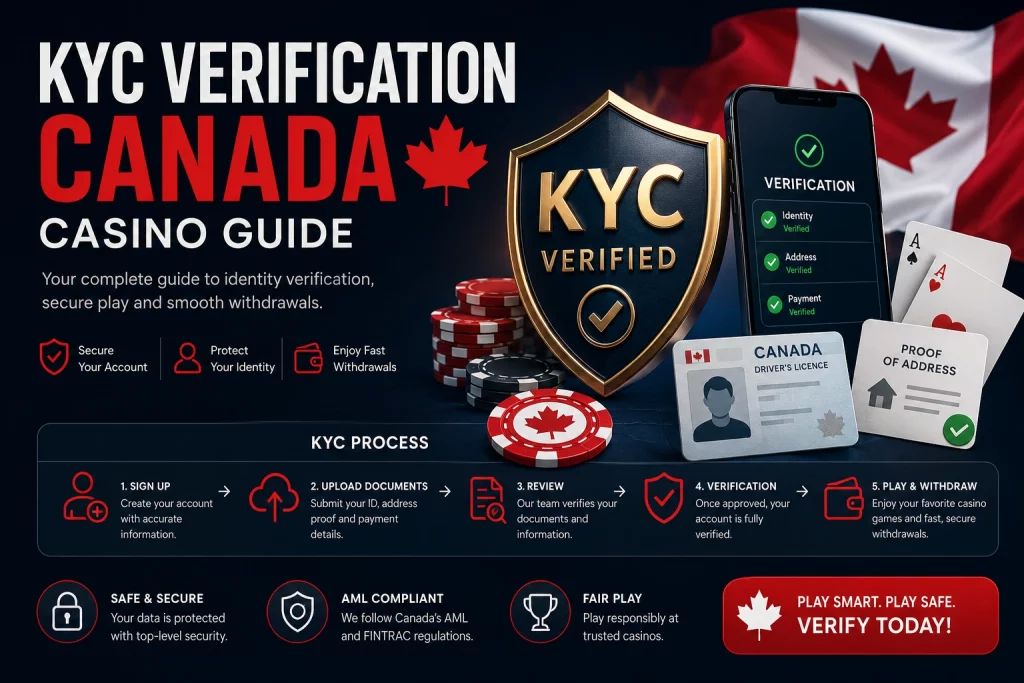
For a casino guide, the important point is that KYC is not only a document upload step. It is a wider account-control process. It can involve identity details, proof of address, payment method ownership, account activity, and transaction history. It may also connect with withdrawal checks, especially when funds are being moved out of an account.
A useful KYC page should also make clear that Canadian regulation is not identical in every province. Ontario has a distinct regulated iGaming market, while other provinces and territories may have different frameworks or government-run models. The page should therefore avoid presenting all of Canada as one identical online casino system.
Account Navigation and KYC Touchpoints
KYC can touch different areas of a casino website. The first touchpoint is usually Sign up, where the user enters core profile data. The second is Login, because secure account access is needed before any verification area can be reviewed. Later, KYC can connect with payment sections, withdrawal requests, document upload tools, and support messages.
The Bonus area can also be relevant because promotional use may depend on account eligibility, one-account rules, location rules, or completed checks. This does not mean KYC is a bonus feature. It means account status can affect how promotional conditions are reviewed.
Mobile access also matters. If a site offers an App experience, the verification flow should still be clear on smaller screens. Document uploads, account status messages, payment notices, and support instructions should remain readable and secure.
Other navigation areas such as Slots, Games, FAQ, and Links should not distract from verification requirements. If these sections are included in the internal structure, they should support clear navigation to rules, help pages, and account-safety information rather than hiding important KYC details.
KYC Verification Overview
| KYC Area | What It Usually Checks | Why It Matters in a Canada Casino Guide |
|---|---|---|
| Identity Details | Name, date of birth, and consistency with official documents. | Identity checks help confirm that the account belongs to the correct person. |
| Age and Eligibility | Whether the account holder meets the applicable legal and platform requirements. | Canadian casino rules depend on jurisdiction and regulated access controls. |
| Address Information | Residential address and consistency with profile data. | Address checks can support jurisdiction, account accuracy, and document review. |
| Payment Ownership | Whether payment methods appear to belong to the account holder. | Payment consistency helps reduce third-party transaction and withdrawal issues. |
| Account Activity | Unusual patterns, duplicate-account indicators, or transaction inconsistencies. | KYC is part of broader risk monitoring, not only a one-time upload step. |
Why KYC Is Connected to AML Rules
KYC is closely connected to AML, or anti-money-laundering, rules. The purpose is to reduce the risk that financial systems are used for money laundering, terrorist financing, fraud, or identity misuse. FINTRAC’s broader guidance states that reporting entities must verify client identity for certain activities and transactions under Canadian AML obligations.
In casino environments, this matters because accounts can involve deposits, withdrawals, payment method changes, and promotional balances. Even when the user experience looks simple, the compliance layer behind it may require identity and transaction checks.
A Canada casino KYC guide should therefore explain verification as part of financial governance. It should not frame KYC as an inconvenience only. It should explain that identity review, transaction records, and payment ownership checks help support a safer operating environment.
Ontario-Specific Relevance
Ontario is especially important in Canadian iGaming discussions because it has a regulated online market structure. AGCO publishes Registrar’s Standards for Internet Gaming applicable to regulated internet gaming sites in Ontario. iGaming Ontario also maintains a public regulated-market directory for approved operators and sites in Ontario, with the listing marked as accurate as of May 7, 2026.
For a KYC guide, this means Ontario examples should be handled carefully. The page can explain that regulated operators must follow standards and account-control expectations, but it should not imply that every Canadian online casino operates under the same Ontario framework.
A well-written page can say that Ontario provides one of the clearest public examples of regulated online casino oversight in Canada. It can then explain that readers should always check the rules that apply to their province or territory.
What a KYC Page Should Explain First
The first part of the page should explain the basic purpose of verification. A reader should immediately understand that KYC is used to confirm identity, support account integrity, and review payment-related activity when required.
The second point should be timing. KYC may happen during account setup, before deposits, before withdrawals, after unusual activity, or when payment details need confirmation. A good page should not say that verification always happens at only one fixed moment.
The third point should be document quality. If documents are requested, they usually need to be readable, current, and consistent with account information. A blurred, cropped, expired, or mismatched document can slow review.
KYC Documents, Upload Quality, and Review Status
The second part of a KYC Verification Canada Casino Guide should explain documents in a practical way. The reader needs to understand what types of information may be checked, why document quality matters, and how review status can affect account activity. KYC is not only about asking for files. It is about confirming that the account profile, identity documents, address information, and payment details are consistent.
In Canada, identity verification may rely on different methods depending on the situation. FINTRAC describes identity-verification methods such as using government-issued photo identification, credit file information, or a dual-process method based on reliable sources. This means a KYC guide should not claim that one single document is always the only possible route. The exact method can depend on the operator, the jurisdiction, the account activity, and the applicable compliance process.
For casino-related content, the most useful approach is to explain the common document categories: proof of identity, proof of address, and proof of payment ownership. These categories help readers understand why the same account may be reviewed from several angles. An ID document confirms who the person is. An address document supports profile accuracy. A payment document helps confirm that financial activity belongs to the account holder.
Proof of Identity in a Canadian Casino KYC Process
Proof of identity is usually the core part of KYC. It may involve a passport, driver’s licence, provincial photo ID card, or another government-issued document accepted by the operator. The document should show the account holder’s full legal name, date of birth, photo where required, document number, and expiry date.
Document quality is critical. A clear upload reduces the chance of review delays. The document should not be blurred, cropped, covered by glare, heavily edited, or partially hidden. All corners should be visible if a full-document image is required. If the document has two sides, the system may request both.
The account profile should match the document. If the profile uses a nickname, shortened surname, wrong date of birth, or outdated address, the review may become slower. A KYC guide should advise readers to use accurate legal details from the beginning because profile errors often appear later during withdrawals or payment checks.
Proof of Address and Location Consistency
Proof of address is used to confirm residential information and account consistency. Depending on the operator’s rules, accepted documents may include a utility bill, bank statement, government letter, tax document, or other official correspondence. The document usually needs to show the full name, full address, issue date, and issuing organization.
Address verification can matter in a Betty Casino context because gaming access, operator availability, and account controls can be affected by jurisdiction. Ontario, for example, has a regulated iGaming market with approved operators and sites listed through iGaming Ontario. For this reason, address and location-related information should be handled carefully in any Canada-focused KYC guide.
The proof of address should be current. If a document is too old, missing the issue date, or does not match the account profile, it may be rejected. The page should explain this clearly so the reader understands that address verification is not only about uploading any document with an address. It is about uploading a document that is readable, recent, and consistent.
KYC Document Preparation
| Document Area | What Should Be Visible | Common Issue to Avoid |
|---|---|---|
| Government-Issued ID | Full legal name, date of birth, photo where required, document number, expiry date, and full document edges. | Blurred image, cropped corners, expired document, or mismatch with account profile. |
| Driver’s Licence or Provincial ID | Name, date of birth, photo, licence or ID number, expiry date, and both sides if requested. | Uploading only one side when the review requires front and back. |
| Proof of Address | Name, residential address, issue date, issuer name, and full document page. | Old document, missing address, missing date, or different address from the profile. |
| Bank Statement | Name, address if used for address proof, bank name, issue date, and ownership details where required. | Cropped page, hidden name, unreadable statement, or missing issue date. |
| Payment Ownership Proof | Account holder name and selected payment details according to the operator’s instructions. | Using a third-party payment method or hiding too much information. |
Payment Ownership Checks
Payment ownership checks are especially important when deposits and withdrawals are involved. A casino may need to confirm that the payment method belongs to the same person who owns the account. This can apply to cards, bank accounts, e-wallets, or other supported payment routes.
The purpose is to reduce third-party payment use and prevent disputes. If a player deposits with someone else’s card or wallet, the account may face additional review before withdrawals. A KYC guide should explain that payment consistency helps prevent avoidable delays.
For card checks, the operator may ask for selected visible digits while requiring other digits to be hidden. For bank or wallet checks, the operator may request a screenshot or statement showing ownership details. The exact instructions matter. Hiding too much can make the proof unusable, while showing unnecessary sensitive information is not recommended.
Upload Quality and File Format
Upload quality is one of the simplest factors to control. A readable file can move through review more smoothly than a poor-quality image. The document should be photographed or scanned in good lighting, placed on a flat surface, and captured without reflections or shadows covering key details.
The file should also meet format requirements. Many verification systems accept common formats such as JPG, PNG, or PDF, but each operator may apply its own limits. If a file is too large, too small, corrupted, or unsupported, the upload may fail before review even begins.
Mobile uploads are common, so the page should explain how to prepare a phone image. The reader should check the photo before submitting it. If the text cannot be read clearly on the phone screen, it may not be readable by the review system either.
Common Verification Status Outcomes
What Pending Review Means
Pending review means the document or account check has been submitted but has not yet reached a final decision. This status does not automatically mean there is a problem. It usually means the operator is checking file quality, profile consistency, document validity, or payment ownership.
A KYC guide should explain pending status calmly and precisely. The reader should know that uploading the same file repeatedly while review is pending may not help. It can create duplicate submissions and slow the process.
If the pending period exceeds the stated review window, the reader may need to contact support through official account channels. The support request should include the document type, upload date, current status, and any message shown in the account area.
Why KYC Documents May Be Rejected
Document rejection usually has practical causes. The file may be blurred, cropped, expired, incomplete, or inconsistent with account information. The wrong document type may have been uploaded. The address may not match. The payment proof may not show ownership. The identity document may be missing the back side.
A useful guide should help readers correct the issue. If identity proof is rejected, they should check expiry date, visibility, and profile match. If address proof is rejected, they should check document age, full address, and issuer details. If payment proof is rejected, they should check whether ownership information is visible according to instructions.
The review message should ideally explain the exact reason. A general rejection notice is not enough. The reader needs a specific correction path, such as “upload a newer address document” or “show all four corners of the ID.”
KYC and Data Security
KYC involves sensitive personal information, so upload security matters. Documents should be submitted only through official account areas or approved secure upload tools. Readers should not send identity files through unknown links, social media messages, or unofficial communication channels.
The page should also explain that payment documents should follow platform instructions. The reader should not expose unnecessary card numbers, full bank details, or unrelated private information. At the same time, the proof must show enough information to confirm ownership.
Security also includes device safety. Uploading documents from a shared public computer or unsecured network can create risk. A private device and secure connection are safer choices for document submission.
KYC Timing, Withdrawal Readiness, and Account Stability
KYC timing is one of the most important parts of a Canada casino guide because verification does not always happen at the same moment for every account. Some checks may happen during account setup, some before deposits, some before withdrawals, and some after unusual account or payment activity. A clear guide should explain that KYC is not only a one-time document upload. It can also be an ongoing account review process.
The timing depends on several factors. These can include document quality, account consistency, payment method ownership, transaction pattern, bonus activity, jurisdictional controls, and whether additional AML review is required. FINTRAC’s casino guidance explains that casinos are subject to client-identification obligations in specific situations, including certain financial transactions and account-related activities under Canadian AML rules.
For readers, the practical point is simple: verification is easier when the account is accurate from the beginning. If the profile details match the documents, payment methods belong to the account holder, and account activity is consistent, the review process usually has fewer obvious issues. If the profile contains errors, the documents are unclear, or payment routes are inconsistent, verification can take longer.
When KYC Verification May Be Requested
KYC may be requested at different points in the account lifecycle. During registration, basic identity and eligibility information may be collected. Before financial activity, the operator may need to confirm account details or payment ownership. Before withdrawals, the review may become stricter because funds are leaving the account. Additional checks may also appear if account behaviour changes suddenly.
A Canada casino KYC guide should not promise that verification will always be completed immediately after registration. It should explain that the exact timing depends on the operator’s rules and applicable obligations. The reader should understand that an account may appear active while certain functions remain subject to later checks.
Withdrawal readiness is the most common reason players care about KYC timing. If documents are not approved before a cashout request, the payout may remain pending until verification is complete. This does not automatically mean the withdrawal is refused. It usually means the account must pass review before funds can be released.
KYC Timing and Account Impact
| KYC Timing Point | What May Be Reviewed | How It Can Affect the Account |
|---|---|---|
| During Account Creation | Name, date of birth, country, contact details, and eligibility information. | Incorrect profile data can create verification conflicts later. |
| Before Payment Activity | Payment method ownership, account consistency, and transaction rules. | Some payment actions may require additional checks before completion. |
| Before Withdrawal | Identity, address, payment ownership, bonus status, and withdrawable balance. | Payouts may remain pending until verification is approved. |
| After Unusual Activity | Login pattern, device changes, payment changes, or abnormal transaction behaviour. | The account may enter additional review for security or AML reasons. |
| After Document Rejection | Replacement files, corrected data, and updated proof. | The review timeline resets or extends until acceptable files are received. |
Withdrawal Readiness and KYC
Withdrawal readiness means more than having a visible account balance. The balance must be eligible for cashout, payment details must be compatible with withdrawal rules, and the account may need to pass verification. A KYC guide should make this connection clear because many payout delays begin with incomplete account approval.
Before requesting a withdrawal, the reader should check whether identity verification is complete, address proof is approved if required, and payment ownership has been confirmed. If any of these areas remain pending, the withdrawal may wait for review. This is especially relevant when larger payouts, new payment methods, or bonus-linked winnings are involved.
A useful guide should also explain that deposit approval does not automatically mean withdrawal approval. A platform may allow funding first and request stronger checks later. This can feel surprising to readers, so the page should state it clearly before the payout stage.
Bonus Activity and Verification Review
Bonus activity can influence verification because promotional terms often affect withdrawal eligibility. A reader may complete identity verification but still be unable to withdraw if bonus wagering is incomplete. The reverse can also happen: wagering may be complete, but the account may still need document approval.
A Betty Casino KYC guide should explain that these checks are separate but connected. Identity verification confirms the account holder. Bonus review confirms whether promotional terms were followed. Payment review confirms whether the payout route belongs to the account holder. All three can affect the final withdrawal outcome.
This is especially important when the account has used deposit bonuses, free spins, cashback offers, or loyalty rewards. Promotional funds may carry wagering requirements, maximum bet rules, game restrictions, expiry periods, and maximum cashout limits. If these terms are not complete, verification alone will not make the full balance withdrawable.
Account Stability Factors in KYC Review
AML Review Triggers
AML review may be triggered by transaction size, transaction pattern, account behaviour, or inconsistencies between account data and payment activity. FINTRAC guidance describes casino-related client identification and compliance obligations under Canadian AML rules, so a Canada-focused guide should explain that verification can be part of broader financial monitoring.
This does not mean every review indicates wrongdoing. Many checks are routine. A request for updated documents, payment proof, or account clarification may simply be part of the platform’s control process. The important point is that the reader should respond through official account channels and provide accurate information.
A good guide should avoid making AML checks sound mysterious. It should explain that casinos may review identity, source of funds where required, payment route consistency, and transaction behaviour. The more consistent the account data is, the easier it is to understand the review path.
Duplicate Accounts and KYC Problems
Duplicate accounts can create major KYC issues. If one person creates more than one account, the operator may need to review identity overlap, bonus use, payment routes, and account ownership. This can delay withdrawals or lead to restrictions depending on the terms.
A reader should understand that account recovery is usually better than opening another profile. If login details are lost, the safer route is to use official recovery tools or support. Creating a second account can make KYC more complicated because the platform may detect matching names, documents, addresses, devices, or payment methods.
This is especially relevant for bonus-linked accounts. Promotional offers often rely on one-account rules. If duplicate accounts appear, the operator may review bonus eligibility and related winnings. A KYC guide should explain this before the problem appears.
Payment Method Changes and Review Delays
Payment method changes can also affect KYC timing. If a reader deposits with one method and later requests withdrawal through another, the operator may need to confirm why the route changed. Some platforms require funds to return to the original deposit method where possible. Others may allow alternatives only after review.
Using payment methods in the account holder’s name reduces friction. Third-party cards, wallets, or bank accounts can create verification problems because ownership is unclear. A Canada casino guide should advise readers to keep payment activity consistent and avoid using someone else’s payment method.
If a payment method becomes unavailable, the reader should follow the official support process. Changing payment routes without explanation may trigger additional checks. A clear record of ownership and account consistency is the best way to avoid unnecessary delays.
Location and Jurisdiction Controls
Canadian online gambling rules vary by province and territory, and Ontario’s regulated iGaming market is one of the clearest public examples of this structure. For KYC, location and address information can matter because operators may need to confirm whether an account is eligible for specific services.
A guide should explain that address verification and location checks are not always the same thing. Address proof confirms residential details. Location controls may confirm where the user is accessing the service from at a given time. These checks can support jurisdictional compliance and account eligibility.
The reader should not use inaccurate profile information to bypass restrictions. Incorrect address details can create KYC conflicts later, especially during withdrawals. Accurate information from the start is the cleaner approach.
How Readers Can Reduce KYC Delays
Readers can reduce KYC delays by preparing valid documents early, using accurate profile information, keeping payment methods in their own name, and checking verification status before requesting withdrawals. They should also read account messages carefully and correct the exact issue if a file is rejected.
It helps to avoid unnecessary account changes while review is pending. Editing profile details, changing payment routes, or submitting repeated duplicate documents can extend review time. If something is incorrect, the reader should use the official correction process and follow support instructions.
Another useful habit is to keep copies of accepted documents available in updated form. If an address document expires or a payment method changes, the account may need refreshed proof later. KYC is not always a one-time event.
Final KYC Checklist, Data Security, and Account Review
The final part of a KYC Verification Canada Casino Guide should bring the full process into one clear structure. By this stage, the reader should understand what KYC means, which documents may be requested, how upload quality affects review, why payment ownership matters, how verification connects with withdrawals, and why Canadian rules can differ by province or territory.
KYC should be explained as an account-control process that supports identity accuracy, payment traceability, and safer financial handling. It is not only about uploading an ID card. It can involve profile details, address checks, payment routes, transaction history, bonus-related review, location consistency, and account behaviour over time.
A strong final section should help the reader prepare before problems appear. The most useful approach is a simple checklist: keep account data accurate, use personal payment methods, upload clear documents, check review status, read account messages, and contact support only through official channels when clarification is needed.
Final KYC Verification Checklist
| KYC Checkpoint | What Should Be Confirmed | Why It Matters in Canada Casino Verification |
|---|---|---|
| Profile Accuracy | Full legal name, date of birth, address, country, and contact details match official records. | Incorrect profile data can create verification conflicts during account review. |
| Identity Proof | The ID document is valid, readable, complete, and matches the account holder. | Identity confirmation is usually the core part of KYC review. |
| Address Proof | The document is recent, official, and shows the same residential address as the profile. | Address consistency can support jurisdictional and account-integrity checks. |
| Payment Ownership | Cards, bank accounts, or wallets belong to the same person as the casino account. | Third-party payment methods can delay review or create withdrawal problems. |
| Review Status | The account clearly shows whether documents are approved, pending, rejected, or missing. | Visible status helps the reader know whether action is required. |
Data Security During KYC
KYC involves sensitive information, so document security is essential. Identity documents, address records, and payment proof should be submitted only through the official account area or another approved secure upload channel. Files should not be sent through unknown links, unofficial social media profiles, random emails, or third-party messages claiming to represent support.
A secure KYC process should keep the reader inside the verified account environment. The basic path should be simple: access the account, open the verification area, upload the requested document, check the status, and respond if a replacement is requested. This reduces the risk of sending personal data to the wrong place.
Payment documents require particular care. If a card image or bank proof is requested, only the details required by the platform should be shown. Too much hidden information may make the proof unusable, but unnecessary exposure of full payment details is also unsafe. The reader should follow the exact masking or visibility instructions provided by the operator.
How to Handle Rejected Documents
A rejected document does not always mean there is a major issue. Most rejections are practical: the image is blurred, the document is expired, the address is missing, the file is cropped, or the uploaded proof does not match the account profile. The important step is to correct the exact problem.
If proof of identity is rejected, the reader should check whether the document is still valid, whether all corners are visible, and whether the name and date of birth match the profile. If proof of address is rejected, the issue may be document age, missing issuer details, or an address mismatch. If payment proof is rejected, the account holder’s name or required payment details may not be visible.
The same file should not be uploaded repeatedly unless the rejection message was clearly incorrect. A better approach is to prepare a cleaner version, use a different accepted document if needed, and follow the correction instructions shown in the account area.
Support Guidance for KYC Issues
Support becomes useful when the account status is unclear, when review takes longer than the stated window, when a document is rejected without a specific reason, or when the upload tool does not work. The reader should contact support through official account channels and provide precise information.
A useful support message should include the document type, upload date, current review status, and any error message visible in the account. It should not include unnecessary sensitive details in open chat unless the platform specifically provides a secure upload path.
The best support response should give a clear next step. For example, it may ask for a newer proof of address, a clearer ID scan, the back side of a document, or payment ownership proof. Vague responses create uncertainty, so the guide should encourage readers to ask for a specific correction if the reason is not clear.
KYC and Long-Term Account Maintenance
KYC is not always finished forever after one approval. Account details can change. A reader may move to a new address, replace a payment method, update a legal name, or use a new withdrawal route. These changes can trigger additional checks.
For that reason, account information should remain current. If the address changes, the profile should be updated according to the operator’s rules. If a new payment method is added, ownership may need to be confirmed. If an old document expires, the account may require a new version later.
Long-term account stability depends on consistency. The same legal identity, accurate contact information, personal payment methods, and clear transaction history all reduce unnecessary review friction.
Final View of KYC Verification in Canada Casino Guides
A complete KYC Verification Canada Casino Guide should explain identity checks, document requirements, address proof, payment ownership, review timing, withdrawal readiness, AML relevance, duplicate account risks, jurisdictional variation, and data security. These topics should be connected, not treated as isolated points.
The most important message is that KYC is part of the account’s trust structure. It supports identity accuracy, protects payment routes, and helps explain why some account actions may require review before completion.
For Canada-focused content, the page should also avoid oversimplifying the regulatory environment. Federal AML expectations, provincial gambling frameworks, and operator-specific account rules can all affect how verification is handled.
Practical Final Summary
KYC verification works best when account information is accurate from the beginning. The reader should use legal details, submit clear documents, keep payment methods in their own name, avoid duplicate accounts, and check status messages carefully.
If verification is requested, the process should be handled through official account channels only. Documents should be readable, current, complete, and consistent with the account profile. If a file is rejected, the correction should address the exact reason rather than repeating the same upload.
A strong Betty Casino KYC guide should make verification understandable before the reader reaches a payout problem. It should show how identity, documents, payments, bonuses, withdrawals, and account security connect inside one review process.






Comments